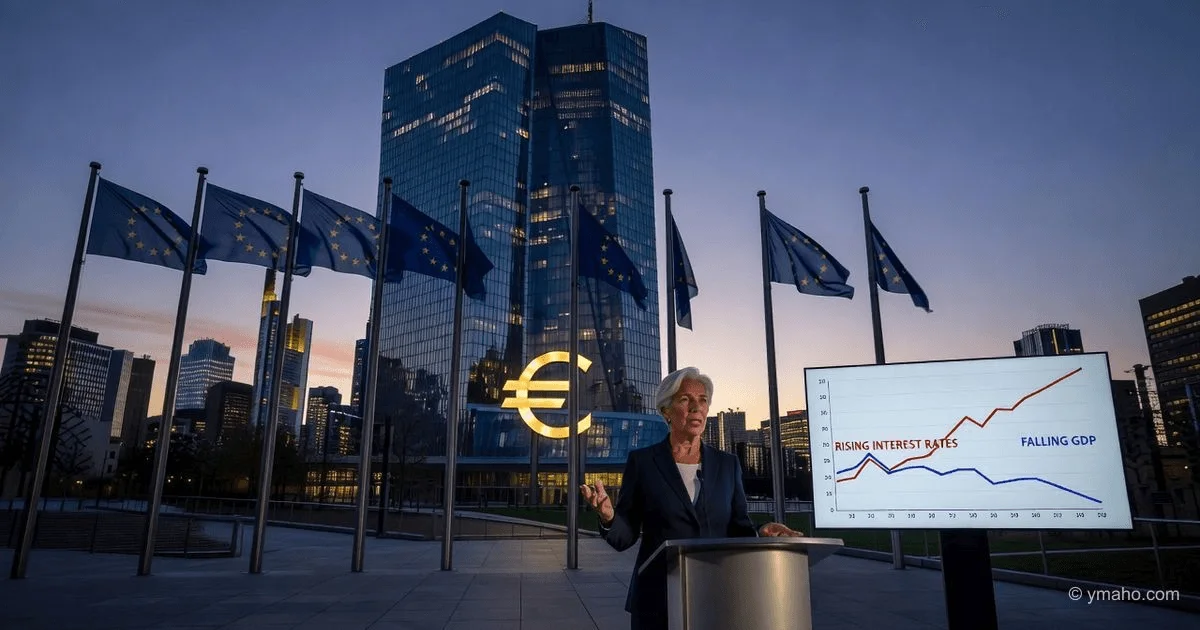
ECB Likely to Raise Rates Despite Eurozone Recession
The European Central Bank is expected to raise its key interest rate by 0.25% despite an unexpected contraction in the eurozone economy in the first quarter, as a record surge in inflation driven by rising energy prices forces its hand.
Headline: Raising Rates in a Recession — Not an ECB Mistake, but an Act of Euro Self-Preservation.
Author: Analytical Commentary (Insider View)
When investors see the headline "ECB raises rates despite recession," their first reaction is "madness" or "policy error." That's what newspapers usually write. But I, tracking real capital flows, credit default swaps (CDS), and sentiment in ECB corridors, argue the opposite: Christine Lagarde simply had no choice. This rate hike is not about fighting inflation for its own sake. It's about fighting for the survival of the euro as a reserve currency.
Conventional analysis focuses on the dilemma: inflation vs. economic growth. In reality, the dilemma is different: allow the eurozone to break apart due to yield spreads, or kill growth but save the currency. The ECB has chosen the latter, and the decision is already made. We are just waiting for the formal announcement.
[The Core]: What Is Really Happening
The public narrative says: eurozone inflation accelerated to 3.2% in May — a 2.5-year high — and the ECB must curb price pressures. The recession, according to revised data, is a mere -0.2% — technical. So, a rate hike is possible.
But the real reason runs deeper. In fact, the ECB fears a euro collapse more than a recession. Look at EUR/USD. It trades around 1.07, but if the ECB does nothing (pauses), consensus forecasts a fall to parity at 1.00-1.02 by autumn. A 5-7% drop in the euro imports inflation via more expensive imports (especially energy, which is dollar-denominated). This creates a vicious circle: a falling euro — rising inflation — market demands for even higher rates.
The insider key known only to secondary government bond traders: the spread between Italian (BTP) and German (Bund) bond yields has already widened to 180 basis points (bps). With a 0% rate hike, this spread risks jumping to 250-300 bps, triggering an "Italian crisis" (like in 2011-2012). The ECB is forced to raise rates and simultaneously launch a covert program to buy Italian debt ("transprotectionism") to prevent the spread from blowing out. But to secretly buy debt, it must first raise rates to flush out speculators.
The second hidden layer: the ECB is preparing for a war with the dollar. While the Fed also keeps rates high (3.50-3.75% and a hawkish signal), any easing of the ECB's monetary stance would trigger capital flight to the US. Trillions of euros would flow across the Atlantic, collapsing an already weak economy. Raising rates is a defense against devaluation.
Timeline and Context
The decision has been in the works for the last three weeks. On May 15, 2026, inflation data from Germany (3.5%) and Spain (3.8%) exceeded forecasts. By May 20, ECB Governing Council member, German hawk Joachim Nagel, publicly called for tightening even if the economy contracts. By then, the market had already priced in a 60% probability of a hike.
May 28 — a turning point. Eurozone inflation data (3.2%) and a GDP revision (-0.2%) were released simultaneously. Two shots at the same target. That same day, ECB President Lagarde spoke at a conference in Sintra, saying the ECB had "abandoned the notion of a pause." The market instantly shifted to a 90% probability of a hike.
June 3-4 — final pressure from the Bundesbank (Nagel) and the Austrian central bank (Holzmann). They threatened a public split if rates were not raised. Lagarde, who represents consensus on the council, had to agree.
The decision will be announced on Thursday, June 11 (European time). Not only the hike itself but also the "tone" of the statement will be key. If Lagarde says "this is neither the first nor the last hike," the euro could strengthen to 1.09. If she says "a pause in August," the euro will fall to 1.04. The market currently leans toward a "hawkish pause" — one hike, then a wait-and-see stance until September.
Who Wins and Who Loses
Winners:
- Italian banks (UniCredit, Intesa). Paradoxically, higher rates increase their net interest margin. At the same time, the ECB, through covert mechanisms (TLTRO and hidden QE), will feed them liquidity to prevent a crisis. They get the best of both worlds: a high spread and a safety net.
- Holders of short-term European debt (1-2 years). Yields on these will jump by 30-40 bps. This benefits pension funds and insurance companies, which finally get real yields above 2%.
- Volatility traders (EUR Vol). Uncertainty around the decision and subsequent Lagarde communication has pushed implied euro volatility to year highs. Calls on volatility are the best hedge.
Losers:
- French corporations with high debt (Airbus, TotalEnergies, Carrefour). Interest expenses will rise by €3-5 billion in aggregate. Their profits are already falling due to trade wars. The rate hike will be the "last straw" for several capital expenditure programs.
- Greece and Portugal. Their government debt exceeds 100% of GDP. A 25 bps rate hike increases debt servicing costs by €1.5-2 billion per year — money they did not budget for.
- Housing markets in the Netherlands and Germany. Mortgage rates in the eurozone will rise from 3.5% to 4.0-4.2% (including bank margins). This kills housing demand, especially in Amsterdam and Munich, where prices are already overvalued by 20%.
Unexpected loser — Switzerland. The Swiss National Bank (SNB) will come under pressure. To prevent the franc from strengthening too much (which would kill exports), the SNB will have to either cut its rate (scary given inflation) or conduct currency interventions by selling francs. Interventions cost reserves.
What the Media Isn't Saying
First non-obvious insight: the ECB is preparing a scenario where it raises rates and buys bonds simultaneously. Formally, this violates the "one instrument, one goal" rule. But through the Transmission Protection Instrument (TPI), the ECB can buy bonds of troubled countries (Italy, Spain) to contain spreads while raising the key rate. In effect, this is "hidden QE" disguised as structural policy. The market will figure this out in 2-3 weeks, then peripheral yields will fall while the rate stays high.
Second silence: Lagarde has already struck a deal with the German government on gas subsidies to compensate industry for the high-rate shock. This is an unofficial bargain: the ECB fights inflation (Berlin's demand), and Berlin allocates €50 billion from off-budget funds to lower gas prices for chemical and metallurgical plants. Details will emerge in July, but traders already know and don't believe in "pure" monetary policy.
Third and most alarming: the likelihood of a political crisis in the EU. Italian Prime Minister Meloni publicly criticizes the ECB, claiming the recession is Frankfurt's fault. If the ECB keeps raising rates, Matteo Salvini's League will start collecting signatures for a referendum on leaving the euro (Italexit). The probability of a referendum in 2027 is estimated at 20%. A mere mention of this would send the euro down 5% in a single day. By raising rates, the ECB is trying to prove that the euro is a strong currency worth staying in.
Forecast: Next 30 Days and 90 Days
30 days (until July 6, 2026):
A 25 bps rate hike on June 11 is almost certain. The market has priced it in at 90%. After the announcement, the euro will strengthen to 1.075-1.08 (short-term), then begin to decline as economic data for May-June (PMI, industrial production) show a deepening recession. By end of June, EUR/USD will return to 1.05-1.06. The yield on 10-year German Bunds will rise to 3.1%.
90 days (until September 5, 2026):
If inflation does not fall (and it won't, as energy gets more expensive), the ECB may go for a second hike in September (total +50 bps). This would shock the market. The euro would fall to parity (1.00-1.02) as the recession worsens. European stock indices (STOXX 600) would drop 8-10%. A rise in the Italian spread to 250 bps would force the ECB to activate the TPI and start buying bonds. This would be a "2012 scenario" repeated in 2026.
Editorial Forecast
Asset: EUR/USD (futures for July 2026).
Direction: Short-term rise before the meeting (24-48 hours), then fall.
Key levels: Resistance at 1.0800 (break unlikely). Support at 1.0500, target after the meeting — 1.0450 within 72 hours.
Confidence level: Medium (60%). Too much depends on Lagarde's rhetoric. A dovish accompaniment to the hike could send the euro down 150 pips immediately.
Main risk: An unexpected pause (10% probability). If the ECB does not hike, the euro would crash 2-3% in one day, as the market would punish the central bank for indecision.
The editorial opinion is not investment advice. All decisions to buy or sell assets are your own.
— Editorial Team