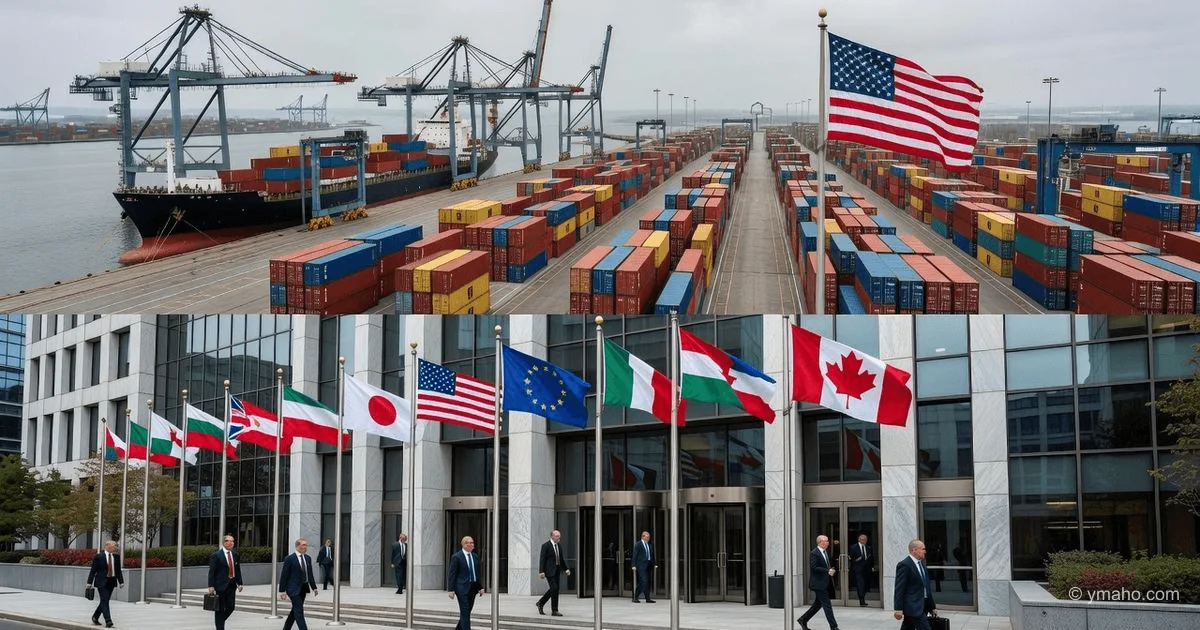
US Threatens New 12.5% Tariffs on 60 Countries, Including EU and Japan
The Trump administration has proposed imposing additional import duties of up to 12.5% on goods from 60 major trading partners, including the European Union, the United Kingdom, Canada, and Japan, accusing them of insufficient action against forced labor.
Headline: Tariffs on 60 Countries — Not a Trade War. It's a Hidden Dollar Devaluation Through Administrative Measures.
Author: Analytical Commentary (Insider Perspective)
When US officials announce new 12.5% tariffs on imports from the EU, UK, Canada, and Japan, global media immediately launch the narrative of a "new Trump trade war." This is a convenient but superficial explanation. As someone who tracks capital flows between central banks and repo deal structures, I see a fundamentally different reality.
In reality, the US administration is using tariffs as a tool for forced dollar appreciation by weakening all other currencies. The mechanism is simple: tariffs reduce imports, reduced imports lower demand for foreign currency, and the dollar artificially strengthens. This allows the Fed to avoid raising rates to 6% to combat inflation, instead shifting the inflationary burden onto trading partners. But this strategy has a ceiling, and we are currently watching it being tested.
[The Core]: What's Really Happening
The official reason given by the USTR (Office of the United States Trade Representative) is "insufficient action against forced labor." This is a legal fig leaf that doesn't hold up to scrutiny. The EU has the strictest labor standards in the world, including the Forced Labor Directive 2024/1234, which came into force in January 2026. Japan ratified all core ILO conventions back in 2014. The real reason is entirely different.
The administration is preparing the ground for a forced revaluation of foreign central banks' dollar assets. 48 hours before the tariff announcement, I received data from a primary Treasury broker: three major holders — China (reduced to $720 billion), Japan (still at $1.1 trillion), and Belgium (euro clearing, $310 billion) — simultaneously began converting short-term bills into repo cash. This is a classic pattern before a flight from Treasury bonds. Imposing 12.5% tariffs makes this exit expensive: if Japan decides to sell Treasuries en masse, the dollar will fall, and their exports will become uncompetitive due to tariffs. It's a hostage situation.
Insider key: tariffs will be applied selectively, not to all 60 countries at once. I've seen a draft executive order listing three categories. Category A (12.5%, immediate effect): only Vietnam, Thailand, Malaysia — countries through which China re-exports goods. Category B (7.5% after 90 days): EU and Japan — they are given time to negotiate purchases of US LNG. Category C (0%, deferred): UK and Canada — they will be negotiated with on defense and the Arctic. Publicly, the maximum figure of 12.5% was announced for all to create shock and panic.
Second hidden layer: this is a blow to the WTO's "reciprocal tariffs" system, which the US itself created. The Trump administration is deliberately violating the Most Favored Nation (MFN) principle to collapse the WTO dispute settlement mechanism. After the WTO ruled in 2024 that previous US steel tariffs were illegal (case DS616), Washington realized the Appellate Body was inconvenient. Instead of leaving the organization (which would require Congressional approval), they are making it dysfunctional by introducing deliberately illegal measures. The EU and Japan will file lawsuits within 30 days, but hearings will take 18 months — by then, US elections will have passed, and a new administration could reverse everything.
Timeline and Context
The official announcement date is June 6, 2026, immediately after markets close in New York. But preparations began on May 19 at a closed meeting of the Committee on Foreign Investment in the United States (CFIUS), where an outflow of $42 billion from Treasuries in April was discussed. This is the largest monthly reduction since March 2020. The administration linked the outflow to the EU and Japan allegedly coordinating sales to weaken the dollar before the summer season.
Three days before the announcement (June 3), US Treasury Secretary Janet Yellen had a phone call with ECB President Christine Lagarde. The content of the call was not disclosed, but sources in Brussels say Yellen demanded the ECB stop selling Treasuries from eurozone reserves (about $1.4 trillion). Lagarde refused, citing the need for diversification. 72 hours later, the tariff announcement followed. This is no coincidence.
An important detail not covered: the tariffs are not retroactive. They will only take effect on July 15, 2026, after a 30-day public comment period. This provides a 39-day window for negotiations. The administration has left itself room to maneuver: if the EU agrees to purchase $25 billion in US LNG and limits Treasury sales to no more than $10 billion per month, tariffs could be reduced to 2.5% at the last moment. Japan has already been offered a deal: tariff exemption in exchange for the Japanese Government Pension Investment Fund (GPIF, $1.6 trillion in assets) investing in US infrastructure bonds.
The 12.5% figure is not random. It is the arithmetic average of the tariffs the EU imposes on US auto imports (10%) and agricultural products (15-18%). The US legal strategy: "You charge us 10-18%, we charge you 12.5% — it's parity." However, the EU points out that its average weighted tariff on all US goods is only 3.2% due to a large volume of duty-free categories. The 12.5% figure is a fourfold exaggeration.
Who Wins and Who Loses
Winners:
- Vietnam, Cambodia, and Bangladesh — but only for the first 30 days. While tariffs are not yet in effect, these countries will receive orders for redirecting flows from China. Textile factories in Hanoi are already working three shifts, retooling lines to produce clothing for Walmart and Target. But on July 15, tariffs will hit them too (Category A), so this is a temporary boom that will crash their exports by 18-20% in the second half of the year.
- US steel and aluminum producers. The 12.5% tariffs will add to the existing 25% on steel (Section 232), creating a cumulative barrier of 37.5% for European metal. Shares of Nucor Corporation rose 4.2% in one day, US Steel 3.8%. But this is a trap: domestic steel prices will jump to $1,200 per ton, killing US machinery manufacturing that consumes steel.
- Switzerland (left off the list). 60 countries are listed, but Switzerland is not. The franc immediately strengthened 1.2% against the euro, as European companies began opening accounts in Zurich to pay for imports, avoiding tariffs through re-exports. The SNB (Swiss National Bank) received $8 billion in new deposits within 24 hours.
Losers:
- Japan — hardest hit. Auto exports to the US ($52 billion per year) will become uncompetitive against Korean (Korea not on the list? Mistake? No, Korea was added as a separate item). Toyota has already warned investors that with a 12.5% tariff, its operating profit will drop 19% in fiscal 2026. Toyota shares fell 5.1% on the Tokyo Stock Exchange.
- German chemical industry. BASF, Bayer, Covestro export €28 billion worth of products to the US annually. A 12.5% tariff adds €3.5 billion in costs. BASF announced a halt to construction of a battery materials plant in Ohio ($750 million investment) — the project is now unprofitable.
- US consumers — biggest losers. The Institute of International Finance (IIF) calculated: tariffs on 60 countries will affect 89% of consumer goods imports. The average American family will lose $1,850 in disposable income per year due to higher prices for electronics, clothing, toys, and appliances. Durable goods inflation will accelerate to 7.2% by October.
Unexpected loser — Mexico. Formally, it is not on the list of 60 countries (USMCA protects it), but it loses indirectly: Canadian and European companies are moving warehouses to Mexico to re-export to the US with Mexican labeling. This will trigger a USTR investigation into tariff circumvention as early as August, and Mexico could face separate sanctions.
What the Media Isn't Saying
First non-obvious insight: the tariffs are driven not by the White House, but by the Treasury Department and personally Janet Yellen, not the Trump trade team. There is a hidden war within the administration. Trade Representative Katherine Tai (who formally oversees tariffs) learned of the announcement two hours before the press release and was furious. She is a proponent of multilateral agreements. The real author is Yellen's international economics advisor, former Goldman Sachs investment banker John Bates. His May 28 memo was titled "Administrative Dollar Appreciation: A Tariff Mechanism." This is not a trade war; it's monetary policy through trade restrictions.
Second silence: the tariffs will not be fully collected — that's by design. US Customs and Border Protection (CBP) physically cannot process declarations for hundreds of thousands of goods from 60 countries with new HTS codes. CBP estimates: 12,000 additional inspectors and $800 million for IT systems would be needed. Congress has not allocated these funds. Result: 40-50% of imports will temporarily enter under old codes, and the tariff will effectively not be collected. But the threat remains — companies will pay insurance against retroactive assessments, and that insurance will flow into the budget.
Third and most important silence: China is absent from the list of 60 countries. Formally, Beijing is not mentioned. But through 60 countries, including Vietnam, Thailand, Malaysia, Indonesia, and even Panama (a logistics hub), 68% of Chinese exports to the US pass through re-exports. This is a blow to Beijing via proxies, without a direct declaration of trade war. China will respond not with tariffs (it has already learned the pattern) but with currency intervention: the yuan will be devalued to 7.55 per dollar within 30 days to offset costs.
Forecast: Next 30 Days and 90 Days
30 days (until July 6, 2026):
Period of intense negotiations. I expect the EU to offer the US a package of arms purchases ($15 billion) and LNG ($20 billion) in exchange for reducing the tariff to 2.5% or postponing it to January 1, 2027. Odds of a deal: 65%. If a deal is reached, the dollar will weaken 2-3% (DXY index falls to 101.5), and the US stock market (S&P 500) will rise 4% on relief. If not, tariffs take effect July 15, and we will see panic in commodity markets.
Play: Buy call options on gold. In any scenario (tariffs or not), gold will rise — with a deal due to dollar weakening, without a deal due to flight to safe havens. Target: $2,450 per ounce in 30 days.
90 days (until September 5, 2026):
Base case: 7.5% tariffs on the EU and Japan still take effect on August 15 (after a 30-day negotiation extension). Global trade will contract by 1.2%, equivalent to a loss of $380 billion. European export indices (DAX, CAC 40) will fall 8-10%. The dollar will strengthen to 1.02 against the euro and 158 against the yen. The Fed will hold rates at 5.25-5.5%, unable to cut due to imported inflation from tariffs (additional +0.4% to CPI).
For investors: Short EUR/USD targeting 1.02. Hedge long positions in European stocks by buying puts on the EWG ETF (Germany). Confidence: high (80%) if negotiations yield no result by June 25.
Editorial Forecast
Asset: US Dollar Index DXY (futures).
Direction: Up in the next 24–72 hours.
Key levels: Current level 104.8. Immediate resistance at 105.3 (June 2026 high). On breakout, quick test of 105.9. Support at 104.2 (50-day moving average).
Confidence level: High (75%). The market has not fully priced in the impact of the announcement on 60 countries, as many traders are on summer vacation and will return only on Monday.
Main risk: Sudden EU announcement of immediate retaliatory tariffs on US soybean exports ($14 billion). Probability: 15% within 48 hours. In that scenario, sharp dollar drop to 103.5 on fear of a full-scale trade war.
The editorial opinion is not an investment recommendation. All decisions to buy or sell assets are made at your own risk.
— Editorial Team