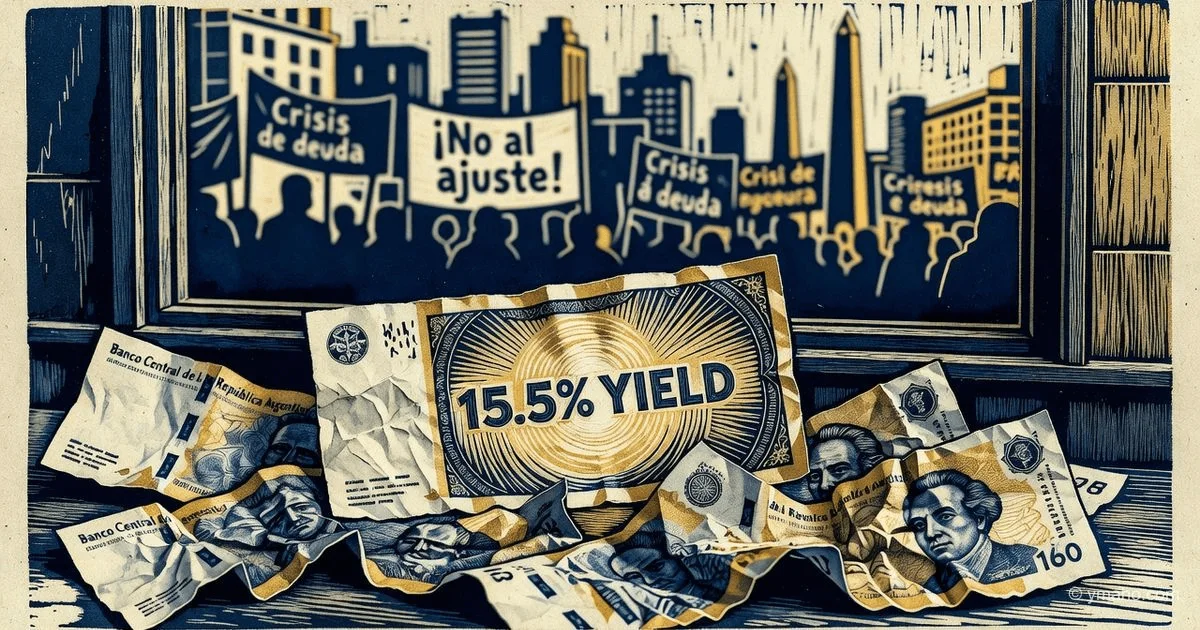
Argentina Issues Dollar Bonds with Record Yield of 15.5%
Argentina's Ministry of Finance placed a new issue of sovereign bonds worth $2.5 billion with a high coupon due to political uncertainty. Demand exceeded supply by three times, indicating persistent risk appetite among hedge funds.
Analytical Article: Argentina's Dollar Bonds at 15.5% — Why Hedge Funds Pay for Political Chaos
When I saw the news that Argentina placed sovereign bonds worth $2.5 billion at 15.5% annual yield, with demand exceeding supply three times, two questions immediately came to mind. First: where the hell did Argentina's Ministry of Finance find investors willing to take such risk for such yield, when the country just announced it would not tap international markets? Second: what do these investors know that we don't?
The answer to the first question is simple: the placement took place on the domestic market, through Argentine banks, but for dollar investors. These are not global bonds placed on Wall Street. This is local dollar held by Argentine companies and wealthy individuals who have been hoarding cash "under the mattress" for decades due to distrust of the peso. And these people are willing to take 15.5% because their alternative is 0% in a safe.
But the answer to the second question is much more interesting and alarming. The hedge funds that bought these papers through local brokers are not paying for Argentina's economy. They are paying for a political bet that Javier Milei will stay in office until 2027 and keep the country from default. And that is a bet with a probability I estimate at no more than 55-60%.
Timeline and Context
To understand what is happening, we need to look at the chronology of the last two months. On May 6, 2026, Fitch Ratings upgraded Argentina's credit rating to 'B-' from 'CCC+'. This is the first rating in the 'B range' in a long time. The market reacted instantly: sovereign bond spreads tightened to 515 basis points over Treasuries — the lowest since 2018. The yield on 10-year bonds fell to 9.7%.
And what did Milei do? Instead of tapping the international market and borrowing cheaply (by Argentine standards), he said: "We are not going to international markets as long as we have an alternative." Economist Caputo added that the government prefers to borrow at 6% on the local market rather than at 9.5% abroad.
Then, in early June 2026, a reversal occurred. Either local sources dried up, or the $4.5 billion in July payments became too hot. The government comes out with a new issue — at 15.5%. Triple demand. And the entire "cheap financing narrative" goes down the drain.
Note the dates: the placement takes place amid massive "Ni Una Menos" protests on June 3-4, 2026, and an investigation into Milei's chief of staff on charges of illegal enrichment. Milei's approval rating fell to 35.5% in April from 44% in January. This is not a backdrop for confidence. This is a backdrop for panic.
Who Wins and Who Loses
Local dollar investors win, who gained access to a paper with an effective yield of 15.5% in a currency that is not devaluing (for now). These people — owners of small and medium businesses, rentiers, former civil servants — have been waiting for years for a moment to legalize cash dollars through the purchase of sovereign bonds. Now that moment has come.
Hedge funds with local presence in Argentina win. Greylock Capital, VR Global, Moneda Asset Management — they bought these bonds through local structures, obtaining an effective yield above 15% at a spread that would be 2-3 percentage points lower for international investors due to taxes and restrictions. Their logic: if Milei holds on until the 2027 elections, these bonds will rise in price to 85-90 cents on the dollar (currently they were likely placed at 65-70). That's a potential 25-30% capital gain plus coupon.
Milei wins — temporarily. He got $2.5 billion to close the hole in the $4.5 billion July payments. With more than a year until the 2027 elections, this deal gives him room to maneuver. But the price — 15.5% — is a signal to the market that confidence in him is falling. In December 2025, he borrowed at 9.26%. In six months, the rate rose by 6 percentage points. That's more than the Fed's entire tightening cycle in 2022-2023.
International investors lose, who were waiting for Argentina to tap the global market. They have stricter mandates and cannot buy local papers. They are forced to watch as local players cream off the profits and hope that in 2027 Milei will finally conduct a liability management operation — exchanging old bonds for new ones with lower yields.
The Central Bank of Argentina loses. It has $7 billion in accumulated reserves for 2026 on its balance sheet, but these reserves are mainly from buying dollars from exporters. If the government is now placing dollar debt at 15.5%, it means domestic demand for dollars exceeds supply. The central bank will soon be forced either to devalue the peso (politically suicidal for Milei) or to tighten capital controls (which would destroy his reformist image).
What the Media Isn't Saying
First and most important: this deal is not a sign of strength, but a sign of desperation.
Until May 2026, Milei had access to financing at 6-9% through local peso-denominated instruments and repos with banks. Now he is borrowing dollars at 15.5%. This is not "opportunistic issuance," as Vontobel Asset Management called it. This is emergency issuance. The difference between 6% and 15.5% is the difference between "we have the situation under control" and "we don't have the situation under control, but we need money."
Second: 15.5% is not the market rate for Argentina.
Look at the numbers. Sovereign bonds maturing in 2035 trade at a yield of around 9.5%. Provincial bonds (e.g., BA37D) — around 14%. And this new issue — 15.5%. That's higher than the yield on bonds of the province of Buenos Aires, which is considered a riskier borrower than the federal government. That doesn't happen.
The logic is this: the market understands that the federal government could "pass on" debts to the provinces in case of default. Or it might not. Uncertainty is so high that investors demand a premium even over the riskiest sovereign instrument. This is not a normal market. This is a market waiting for a disaster.
Third: CDS on Argentina do not match bond yields.
According to Morgan Stanley, 5-year credit default swaps on Argentina imply a default probability of 22% over the next three years, and almost 60% over ten years. Meanwhile, the yield on 10-year bonds was 9.7% (before the new issue). This discrepancy means that the CDS market (where large hedge funds play) is much more pessimistic than the bond market (where retail investors and local players play). Who is right? History suggests: in a crisis, CDS holders are right.
Forecast: Next 30 Days and 90 Days
30 days (until July 6, 2026):
The key event is $4.5 billion in external debt payments in July. The government says it will cover them without a new placement. I don't believe it. Most likely, at the end of June there will be another issue — smaller ($1-1.5 billion) — at the same or even higher yield. That would be a signal that the situation is worsening.
The new issue (let's call it BONAR 2027) will start trading on the secondary market. I expect the price to drop 2-3 percentage points from the placement, as primary buyers take profits. Yield will rise to 16-16.5%.
90 days (until September 4, 2026):
By the end of August, it will be clear whether the money was enough for the July payments. If yes — spreads will tighten back to 600-650 basis points, yield will fall to 12-13%. If not — panic will set in, and yield will soar to 20%.
But there is a third scenario that is not discussed. In September, another IMF review may take place. If the fund approves the next tranche (which is $4-5 billion), Milei will get a safety cushion until the 2027 elections. If not — he will have to either implement new harsh measures or prepare for default.
My forecast: the IMF will approve the tranche, but with conditions Milei cannot meet (e.g., further subsidy cuts). Negotiations will drag on until October. And bonds will fluctuate in the yield range of 14-17% all summer.
Editorial Forecast
Asset: Sovereign dollar bonds of Argentina maturing in 2027 — short-term price decline (yield increase) in the next 24-72 hours after the primary placement. Demand was high, but primary buyers will start taking profits. We expect a price drop of 2-3 percentage points from the placement level, yield rising to 16-16.5%. Confidence level: medium (65%). Main risk: a sudden announcement of a large bond purchase by an international fund (e.g., BlackRock), which could stabilize the price and even push it up. The editorial opinion is not an investment recommendation.
— Editorial Team