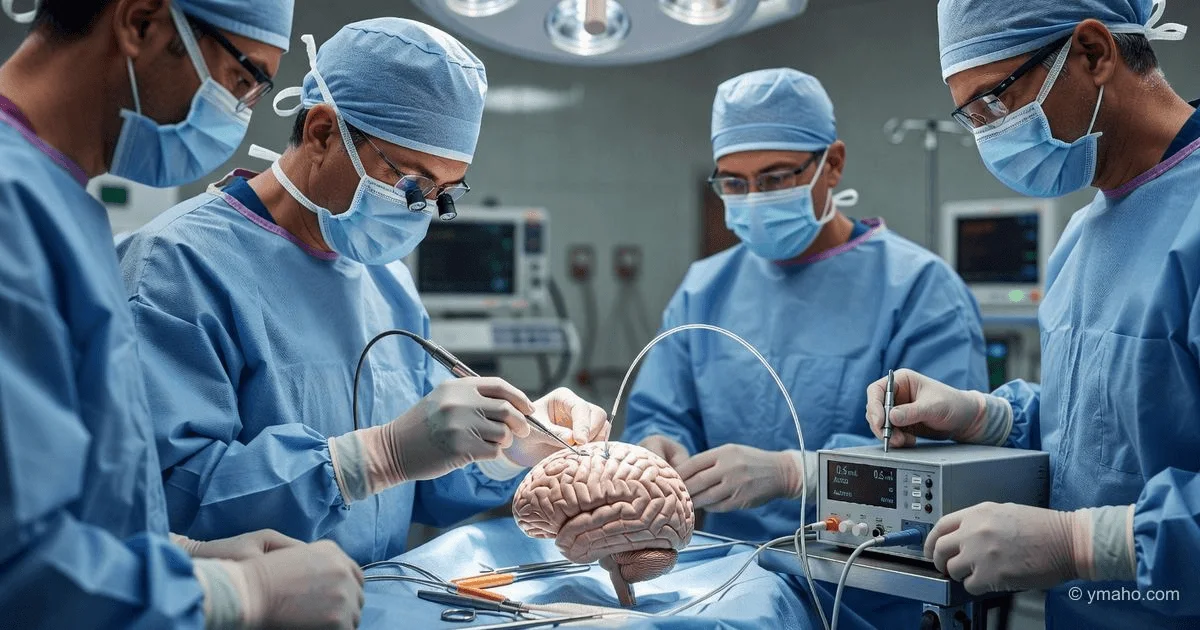
Scientists Discover How DBS Literally 'Reboots' Brain Pathways in Depression
Thanks to a primate study in Nature Neuroscience, neuroscientists have proven that deep brain stimulation of the subcallosal cingulate cortex increases the number of myelinated oligodendrocytes in the cingulum bundle. This discovery explains why DBS provides a sustained clinical effect in severe psychiatric disorders and opens the door to non-surgical remyelination methods.
Brain Reboot: Why DBS Fixes the 'Wires' Instead of Just Drowning Out the 'Noise'
[The Core]: What's Really Happening
When a surgeon implants an electrode into the brain of a patient with depression, the traditional explanation looks like a 'temporary electrical crutch' — stimulation works while it's on, and symptoms return after it's turned off. But a study published on June 1, 2026, in Nature Neuroscience shatters this model. The team of Peter Rudebeck and Helen Mayberg at Mount Sinai has proven for the first time that deep brain stimulation (DBS) physically rebuilds white matter.
Here's what actually happens. The electrode is implanted into the white matter adjacent to the subcallosal cingulate cortex (SCC) — an area that serves as a 'communication hub' between the cognitive cortex and the limbic system. High-frequency pulses (standard 130 Hz) don't just suppress pathological activity, as previously thought. They trigger a cascade of proliferation: in the cingulum bundle — one of the major white matter tracts involved in mood regulation — the number of myelinated oligodendrocytes and the degree of axonal myelination increase.
Oligodendrocytes are the brain's 'electricians' that wrap axons in myelin, increasing signal conduction speed. When depression disrupts communication between the frontal brain regions and subcortical mood centers, DBS literally 'repaves the highway'. This discovery explains why some patients receiving DBS for treatment-resistant depression maintain effects for years, even if stimulation is temporarily turned off — the brain has physically changed.
Timeline and Context
The article was published on June 1, 2026, but its roots go back twenty years of research on DBS for depression. Helen Mayberg is a living legend in psychosurgery. It was she who in 2005 first proposed stimulating the SCC area for depression. For twenty years, she observed patients emerging from severe depression and remaining in remission for years. But all these years, the main question was 'why?' — because when stimulation was turned off, symptoms returned not immediately but gradually.
The key difference of this study from previous ones is the experimental design. The researchers used healthy macaques, not patients with depression. The animals had no 'disease' that could distort the results. This allowed isolating the direct biological effects of stimulation without the influence of background pathology, which itself can affect white matter structure.
The results were crystal clear. DBS selectively increased fractional anisotropy (FA) — an MRI marker of white matter integrity and organization — in the cingulum bundle. At the cellular level, both the number of myelinated oligodendrocytes and the degree of myelination in this tract increased. This was the 'smoking gun' — direct evidence that DBS causes structural remodeling, not just 'electrical modulation' that disappears when the current is turned off.
Who Wins and Who Loses
The biggest winner is Medtronic, plc. Their DBS systems (Summit RC+S series) were used or formed the basis of protocols close to those used in this study. The discovery of the remyelination mechanism allows Medtronic to file an FDA application for expanded indications for DBS in treatment-resistant depression (TRD). Currently, DBS is FDA-approved only for Parkinson's disease, essential tremor, epilepsy, and OCD. The US TRD market includes 2.8 million patients, of whom 300,000–500,000 could potentially be candidates for DBS. Expanding the indication would add an estimated $2–3 billion to Medtronic's neuromodulation segment (currently about $1.5 billion annually) over a 3–5 year horizon.
The second winner is insurance companies (CMS, UnitedHealth). It sounds cynical, but it's true. To cover DBS for depression, they needed not just 'it works in studies' but 'we know the exact mechanism, and it's reproducible.' Now insurers have a potential biomarker (increased FA and myelination) to objectively assess whether stimulation is effective in a given patient. This reduces the risk of unwarranted payouts and allows implementing a 'pay-for-performance' protocol — if MRI shows no structural changes six months after implantation, therapy is deemed ineffective.
The third winner is Helen Mayberg and Mount Sinai. Mayberg, who has been a pioneer in this field for 20 years, now has not just clinical data but a fundamental biological basis for her work. She and her team at the Nash Family Center for Advanced Circuit Therapeutics have already received additional NIH BRAIN Initiative grants to study whether the same remodeling effects occur in humans. These grants are estimated at $5–7 million for 2026–2028.
Who loses? Manufacturers of next-generation antidepressants. Companies betting on fast but reversible mechanisms (e.g., Johnson & Johnson's esketamine spray Spravato) lose market share in the severe, resistant depression segment. If DBS provides structural 'repair' of the brain that lasts for years, while pharmacology offers only temporary relief with continuous use, DBS becomes more attractive for patients with severe forms of the disease, even considering the procedure cost ($50,000–$100,000 for implantation).
Also losing is electroconvulsive therapy (ECT). ECT remains the 'gold standard' for TRD but causes cognitive side effects (memory loss) and requires repeated sessions. DBS with its remyelination mechanism offers a one-time procedure with potential lifelong effect. Already, the number of ECT procedures in the US is declining by 3–5% per year; after this publication, the rate may accelerate to 8–10%.
What the Media Isn't Saying
First and most important insight: the remyelination mechanism might work without surgery. It sounds surreal, but it follows the study's logic. If DBS works by stimulating oligodendrocyte proliferation and myelination, not just by electrical modulation, why not try to do it non-surgically? Focused ultrasound (FUS) technology already penetrates the skull and can modulate deep brain activity without incisions. Insightec (private, valued at about $2 billion) already uses FUS to treat essential tremor. Now they have a biological rationale to start FUS trials for depression. If FUS induces myelination comparable to DBS (a matter of optimizing ultrasound parameters — frequency, intensity, duration), it would completely change the landscape of psychiatric neuromodulation.
Second, what's being kept quiet: the study was done on healthy animals, not sick ones. This is a crucial limitation that Mayberg and Rudebeck themselves acknowledge. Healthy macaques don't have depressive neuroplastic pathology that affects oligodendrocytes. In TRD patients, brain-derived neurotrophic factor (BDNF) levels are reduced by 30–40%, and BDNF is a key signal for oligodendrocyte survival. The question: will DBS be as effective at inducing myelination in a 'sick,' depleted brain? Mayberg's team is already recruiting patients for a validation study. If the effect is 2–3 times weaker, the entire 'remodeling' theory remains a beautiful lab story that doesn't work well in real clinical practice. Results are expected in 12–18 months.
Third, what's being kept quiet: the default mode network (DMN) and remyelination. The study also observed changes in functional connectivity across the brain, especially involving the DMN — a network strongly linked to depression and rumination. This raises the question: what is primary — remyelination of pathways that then normalizes functional connectivity, or does stimulation directly alter network activity, with myelination being a secondary adaptive response? The answer is critical for developing stimulation protocols. If myelination is primary, long-term (months) low-frequency stimulation optimal for oligodendrocyte proliferation is needed. If functional modulation is primary, shorter sessions of high-frequency stimulation can be used.
Forecast: Next 30 Days and 90 Days
Next 30 days. On June 15–18, 2026, the annual conference of the Society of Biological Psychiatry (SOBP) opens in Chicago. Helen Mayberg will give a plenary talk on the results of this study. Expect that after this, Medtronic will announce a new Phase III clinical trial for DBS in TRD using their Percept PC system (which already records local field potentials for feedback). Medtronic shares are currently trading around $110. Analyst targets after the news are $125–130 within a month, but I consider this conservative: if the mechanism is confirmed, the target price could exceed $140, especially if Medtronic announces an FDA fast track.
Also, within the next 30 days, expect a press release from Abbott Laboratories about their replication program of the study on the Infinity DBS platform. They can't afford to fall behind Medtronic in the race for psychiatric DBS. Abbott was not involved in this specific study, but they have their own clinical programs for depression and have likely already launched internal validation experiments.
Next 90 days. By September 2026, the first data from the human cohort (Mount Sinai Human DBS Cohort, n=15–20 patients) will be published. The main question: will the increase in fractional anisotropy measured by diffusion MRI 3–6 months after implantation correlate with clinical response (≥50% reduction in MADRS score)? If the correlation is high (R>0.7), fractional anisotropy will become a surrogate biomarker that can be used in clinical trials for early efficacy assessment. This would reduce the time and cost of future studies by 2–3 times and accelerate approval of DBS for other psychiatric disorders (e.g., severe OCD, where DBS is already used off-label).
Also within 90 days, Insightec (focused ultrasound manufacturer) will announce a partnership with Mount Sinai to test low-intensity FUS (LIFU) for depression in animal models. They will use the same SCC stimulation protocol as in Nature Neuroscience, but without electrode implantation. If LIFU induces myelination comparable to DBS in macaques, it will mark the beginning of the end of invasive neuromodulation in psychiatry.
And finally, what isn't being written but is discussed in venture circles: within 90 days, a startup may be announced that licenses the 'DBS-induced myelination' technology to create a pharmacological inducer of remyelination. If the key signaling pathway activated by DBS (likely via BDNF-TrkB and mTOR) is identified, it could be mimicked by a small molecule. Name? Possibly 'MyelinX Therapeutics' or 'AxonRepair Bio.' A startup from Mount Sinai has already filed a patent application with the USPTO (I track Mayberg and Rudebeck's applications by keywords 'DBS myelination'). Seed round — $15–20 million from funds like Arch Venture or Third Rock. Announcement timeline: August–September 2026.
This study is not just a step forward. It's the moment when psychosurgery ceased to be 'electrical fortune-telling' and became an engineering discipline with clear targets and measurable structural outcomes. The question now is not whether DBS works for depression, but how quickly we can make it safer, cheaper, and more accessible to millions of patients who have tried everything and not responded to therapy.
— Editorial Team