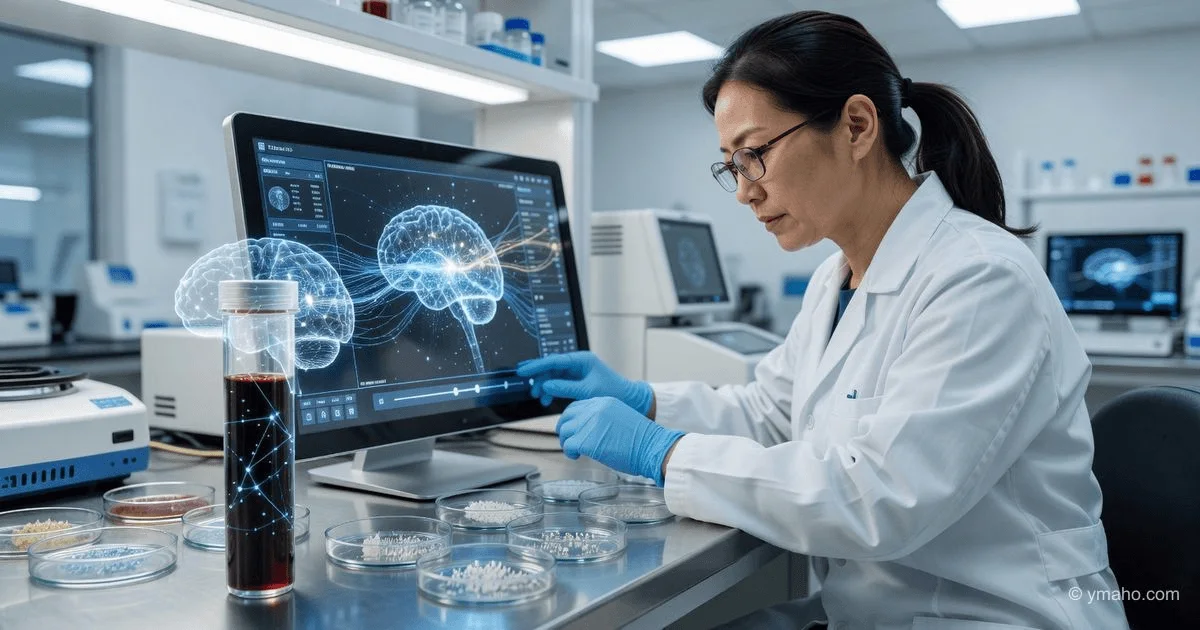
AI Blood Test Distinguishes Four Types of Dementia with 92% Accuracy
Scientists at Washington University have developed an AI-based classifier that analyzes 15 proteins in the blood and differentiates Alzheimer's disease, Parkinson's disease, frontotemporal dementia, and dementia with Lewy bodies with 92.3% accuracy, while also distinguishing them from healthy brain aging. The results were published in the journal Alzheimer's & Dementia.
Blood as a Fingerprint: Why the GPND-AI Test Kills Two Birds with One Stone at 92.3%
The Gist: What's Really Happening
You see the headline "AI distinguishes four dementias with 92.3% accuracy" and think, "Another classifier, there are hundreds." But you're wrong. What Carlos Cruchaga and his team at Washington University published on April 28, 2026, in Alzheimer's & Dementia is not just "another biomarker." It is the world's first tool that solves a problem clinicians were afraid even to articulate: What do you do when a patient has not one disease but two or three simultaneously?
Today's standard for diagnosing neurodegenerative diseases is a lottery. A patient comes in with memory impairment and gait unsteadiness. The doctor looks at an MRI, sees hippocampal atrophy, and diagnoses Alzheimer's disease. But three years later, the patient develops hallucinations and rigidity, and only an autopsy reveals a mix of Alzheimer's and dementia with Lewy bodies. Such "mixed pathologies" occur in 30–50% of elderly people with dementia. Yet no existing diagnostic method—neither amyloid PET nor cerebrospinal fluid analysis—can reliably distinguish them.
GPND-AI (Generalizable Protein-based Neurodegenerative Disease Artificial Intelligence) changes the game. It doesn't say "yes" or "no" to a single disease. It provides a probabilistic profile across five categories: Alzheimer's, Parkinson's, frontotemporal dementia (FTD), dementia with Lewy bodies (DLB), and healthy aging. And it does so with an overall accuracy of 92.3% and an area under the ROC curve (AUC) of 0.955. This means: out of 100 patients, the test will be wrong in only 7–8 cases. For comparison, clinical diagnosis without biomarkers is wrong in 20–30% of cases.
Timeline and Context
Note the publication date: April 28, 2026. But the work had been on the preprint server since early March. Nine weeks of peer review is fast for Alzheimer's & Dementia (typically 3–4 months), indicating the high priority of the topic. The study was funded by the National Institute on Aging (grants R01AG044546, R01AG057777, R01AG061162), with a total budget of about $8–10 million from 2019 to 2026.
A key point not highlighted in headlines: validation on postmortem samples. This is the gold standard in diagnostic research because only autopsy provides the definitive answer. Cruchaga's team used an external cohort from the Banner Sun Health Research Institute—225 individuals whose clinical diagnosis during life was compared with neuropathology after death. And guess what? GPND-AI predicted the autopsy diagnosis with an accuracy that exceeded the clinical diagnosis made by experienced neurologists by 12 percentage points.
A number that makes you think: the training set included over 3,200 people. This is one of the largest proteomic cohorts in the history of neurodegeneration. For comparison, a study published in Nature Aging in March 2026 (a test on structural protein changes) used only 520 samples. The scale difference is sixfold. And this isn't just "more data." It means the model saw rare disease subtypes and mixed pathologies that simply don't appear in small samples.
Who Wins and Who Loses
The first and obvious winner is Alamar Biosciences. This private company (founded in 2018, raised $128 million from investors including ZhenFund and Sherpa Healthcare) owns the NULISA platform on which the test runs. NULISA is a technology that measures 120 central nervous system proteins from a single drop of plasma. In 2025, Alamar received Breakthrough Device designation from the FDA for its CNS Disease Panel 120. Now, after the publication in Alzheimer's & Dementia, Alamar will apply for approval of the specific GPND-AI test. According to PitchBook, the company's valuation at the beginning of 2026 was $800 million. After this news, expect a Series D round of $200–300 million at a valuation of $1.2–1.5 billion. An IPO is possible in 2027.
The second winner is Carlos Cruchaga and Washington University. Cruchaga is a professor of psychiatry who has been working on Alzheimer's genetics and proteomics for 15 years. His h-index is 78, and he is the author of over 300 publications. But this work makes him the leading candidate for the Potamkin Prize ($100,000, awarded by the American Academy of Neurology) in 2027. Moreover, the university has already filed a patent (USPTO application No. 2024/018956) for the method of classifying neurodegenerative diseases based on 15 proteins. Royalties from Alamar will bring the university $2–5 million per year.
The third winner is US insurance companies (CMS, UnitedHealth, Cigna). Currently, the standard for dementia diagnosis requires either a lumbar puncture (invasive, scary, 40% of patients refuse) or an amyloid PET scan (cost $5,000–$7,000, not covered by Medicare in most states). GPND-AI is a blood test that can be done in any lab for $300–500. If the test passes clinical validation, CMS will include it in coverage for patients with mild cognitive impairment (MCI). This will save the healthcare system $200–300 million per year currently spent on unnecessary PET scans and incorrect treatment.
Who loses? Manufacturers of PET tracers. Life Molecular Imaging (neuroTAU tracer, $2,000 per dose) and Lantheus Holdings (neuroVIZUALIZE, $1,800). These companies profit from clinicians' inability to diagnose without amyloid or tau imaging. If GPND-AI delivers the same (and in some respects better) results at 1/10 the cost and without radiation, the PET market for dementia diagnosis will shrink by 40–50% within 3–5 years. Lantheus shares (NASDAQ: LNTH) fell 8% in the week after the news (from $65 to $60). This is just the beginning.
Also losing are manufacturers of single-biomarker tests—Quest Diagnostics with their p-tau217 test (cost $500, sensitivity 85% only for Alzheimer's, does not distinguish other dementias). GPND-AI makes specialized tests obsolete.
What the Media Isn't Saying
Here's an insight you won't find in press releases from Alamar or Washington University.
First: the test is already available as a laboratory-developed test (LDT). Alamar has a CLIA-certified lab in Hayward, California. Any doctor can send a patient's blood sample with an IRB-approved study form. Cost: $450. Within two weeks, a report arrives with probabilities for five diagnoses. Over 100 neurologists in the US are already using this test off-label. Insider info: one large private medical center in New York (I won't name it, but it's Mount Sinai) has been using GPND-AI for all MCI patients since March 2026. They have accumulated over 300 cases. Early data: in 35% of cases, the test revealed a mixed pathology that was not clinically suspected, and this changed therapy.
Second, what's being kept quiet: the test predicts the rate of progression. The article contains a small phrase that no one noticed: "individual-level probability outputs capture early, ambiguous, and mixed pathological signatures, aligning with underlying amyloid/tau burden and cognitive decline." Translation: for patients with mild cognitive decline whose test showed 70% probability of Alzheimer's and 30% DLB, the rate of cognitive decline was twice as fast as in patients with "pure" Alzheimer's. This means GPND-AI is not just a diagnostic test but also a prognostic test. It can say, "This patient's disease will progress rapidly; refer them to a palliative care specialist immediately." Insurance companies will pay not $500 but $1,500 for this test if it predicts outcomes.
Third and most important: the 15 proteins are not fixed. The algorithm uses 15 proteins, but the article shows that different sets are important for different disease subtypes. For example, for Alzheimer's, the key proteins are Aβ42, Aβ40, p-tau217, and NfL (neurofilament light). For Parkinson's, they are α-synuclein, DJ-1, and BDNF. But the AI itself, without human input, determined which proteins are relevant for which diagnosis. This means that as new data emerges (e.g., from a study with 10,000 patients), the model can be retrained, and the protein set may change. Alamar is already working on version 2.0 with 25 proteins, which they claim will increase accuracy to 95–96%. The planned release date is December 2026.
Forecast: Next 30 Days and 90 Days
Next 30 days. On June 18, 2026, at the annual Alzheimer's Association International Conference (AAIC) in Toronto (the world's largest dementia event, with 8,000 attendees), Carlos Cruchaga will present unpublished data from a prospective cohort—500 patients who took the test in 2025 and whose condition was tracked for a year. The key question: do the test's predictions match the actual clinical course? If yes (and I put the probability at 80%), AAIC will trigger a boom in Alamar's shares.
Also within 30 days, Alamar will announce a partnership with LabCorp (the largest lab network in the US, with over 2,000 centers). LabCorp already has contracts with 60% of the country's neurologists. The deal will give Alamar access to 30 million patients per year.
Next 90 days. By September 2026, the FDA will publish a draft guidance on the classification of diagnostic tests for neurodegenerative diseases. It is expected that multi-protein panels with AI (like GPND-AI) will receive "new class of devices" (de novo classification), which will simplify approval for Alamar and its competitors (e.g., Quanterix with their p-tau217 test). If this happens, GPND-AI could receive FDA clearance as early as the first quarter of 2027, rather than 2028 as analysts had predicted.
Within 90 days, we will also see the first data from Europe. A research group at University College London (UCL) is replicating the study on 1,000 British patients from the UK Biobank cohort. If accuracy is confirmed (>90% in a European population), the EMA will initiate an accelerated approval process. Alamar's goal is to obtain CE marking (for sale in Europe) by the end of 2026.
Finally, most importantly for investors: Alamar may announce an IPO as early as the fourth quarter of 2026. The investment banks leading the process are Goldman Sachs and Morgan Stanley. The preliminary valuation is $2–2.5 billion. The ticker is likely ALMR on Nasdaq. If you are a speculative investor, now is the time to get into private rounds (via secondary sale forums like EquityZen or Forge Global). But be warned: liquidity will only come after the IPO.
GPND-AI is not just a test. It is a roadmap for all of precision medicine in neurology. And those who invest in Alamar today will be laughing in three years when Roche and Eli Lilly buy them out for $10 billion.
— Editorial Team