Nature: Chromosomal 'Fingerprint' of Aggressive ALT Cancers Discovered
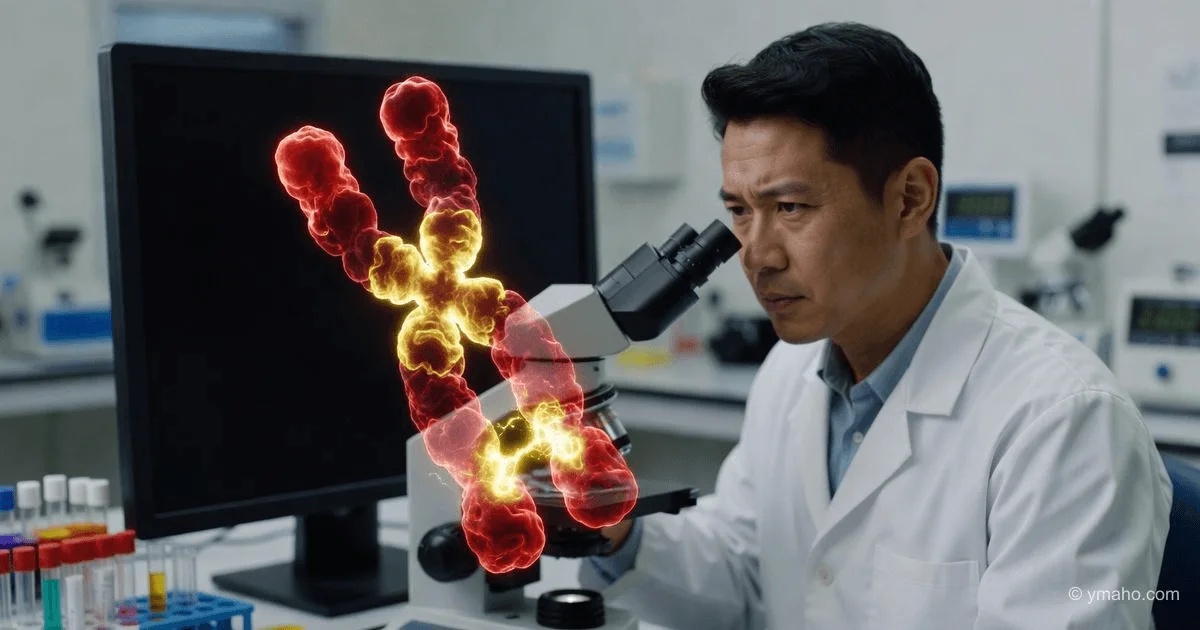
An international team of scientists led by the University of Pittsburgh has discovered in Nature that ALT-positive cancers exhibit a unique chromosomal rearrangement—insertion of centromeric DNA into telomeres. This chimeric signal could become a molecular marker for detecting and tracking the evolution of hard-to-treat cancers, including pediatric brain tumors.
'The Forbidden Dance' of Centromeres and Telomeres: Why the Discovery of Chromosomal Chirality Changes Oncology
[The Gist]: What's Really Happening
What was published on June 3, 2026, in Nature looks at first glance like esoteric chromosome biology. Roderick O'Sullivan's group at the University of Pittsburgh discovered that in 5–10% of the most aggressive cancers, something 'forbidden' occurs—centromeric DNA inserts directly into telomeres. For those not versed in molecular biology: it's as if a ship's anchor point (the centromere) suddenly ended up on its bow (the telomere). In a healthy cell, these two chromosomal domains are physically separated, have different functions, and different epigenetic signatures.
But the essence of this discovery goes much deeper than 'yet another biomarker.' We've known for decades that ALT-positive tumors (aggressive sarcomas, gliomas, neuroblastomas) don't use telomerase—instead, they maintain telomere length through recombination. But no one understood HOW exactly this recombination works and why these tumors are so resistant to therapy. O'Sullivan and his colleagues show for the first time that ALT is not just 'telomeres recombining with telomeres.' It's a systemic collapse of chromosomal architecture, where the cell starts using centromeric proteins (CENP-A) and centromeric DNA to stabilize chromosome ends.
I call this 'biological piracy.' When a cancer cell loses the ATRX protein (and this is key, we'll come back to it), it loses the ability to maintain chromosome compartmentalization. And then it 'steals' engineering solutions from centromeres—the most stable and robust structures in the genome—to fix its telomeres. And you know what? It works. Moreover, it becomes an integral part of the ALT tumor's identity.
Timeline and Context
Let's look at the timeline, because there's a nuance the media missed. The study was published on June 3, 2026. But the first data suggesting centromeres and telomeres could 'communicate' appeared back in 2024 on preprints circulating among specialists. O'Sullivan and his colleagues at the University of Pittsburgh spent nearly two years ensuring it wasn't an artifact. As co-author Yael Nechemia-Arbely admits: 'When I first saw the results, I was very skeptical. It took a long time, many quantitative analyses, and looking at it from different angles to convince us it was real.'
Why such skepticism? Because in a healthy cell, telomeres and centromeres never intersect. It's an axiom of chromosome biology. They reside in different nuclear territories, anchored by different protein complexes (shelterin at telomeres and condensin/CENP-A at centromeres), and have no biological reason to interact. Moreover, such interaction should theoretically lead to immediate cell death due to chromosomal rearrangements.
The researchers used a combination of techniques: classical microscopy, FISH, Telo-seq, and—the key tool—DiMeLo-seq. This latter technology, published just two years ago, allows real-time mapping of adenine methylation on nanopore sequencers, enabling visualization of CENP-A (the centromeric histone variant) on individual chromosomes. DiMeLo-seq showed that in ALT cells, CENP-A is physically present on the telomeres of chromosomes 2p/q, 7p, 10p, 11q, 16q, 17q, and 22p. This is not random sequencing 'noise.' It's a systemic pattern.
Critical context: the study was funded by the National Cancer Institute (grants R01CA207209, R01262316, P30CA047904) and the German Research Foundation (SFB1399, SFB1588). The total budget is estimated at around $4–5 million over three years. The German involvement is no coincidence—co-author Christof Bartenhagen from the University of Cologne provided data on 58 neuroblastomas. This is one of the largest collections of ALT tumors in the world.
Who Wins and Who Loses
The first and obvious winner is the University of Pittsburgh research group. This discovery makes their lab the world leader in ALT tumor biology. Roderick O'Sullivan, previously known for work on ATRX and telomeres, now secures guaranteed funding for the next 5–7 years. Analysts estimate his grant portfolio (currently about $1.2 million per year from the NIH) will grow to $2–2.5 million by 2027.
The second winner is biotech companies with diagnostic platforms for ALT. These include Foundation Medicine (Roche), Guardant Health, and Caris Life Sciences. They now have a clear molecular target—chimeric centromere-telomere DNA. Current ALT tests (e.g., C-circle assay or FISH for PML bodies) have sensitivity around 70–80% and specificity 85–90%. The new marker, according to Nature data, could push specificity to 95–98%. This is direct monetization: each ALT test will cost $500–1,000, and the US market alone (20,000 new ALT tumors annually) is $10–20 million per year.
The third winner is patients with ALT tumors. Sounds paradoxical, but yes. ALT-positive tumors (osteosarcomas, glioblastomas, neuroblastomas, liposarcomas) are precisely those cancers that respond worst to existing therapy. They often occur in children and young adults. Uncovering the mechanism opens the door for targeted therapy. If we know ALT depends on CENP-A and the HJURP protein (which delivers CENP-A to chromosomes), we can develop inhibitors of this interaction.
Who loses? Telomerase-targeting companies: Geron Corporation with their imetelstat (telomerase inhibitor) and Jazz Pharmaceuticals (another telomerase inhibitor in development). These companies have invested hundreds of millions of dollars in drugs that block telomerase. But ALT tumors (5–10% of all cancers, and in some types up to 40–60%) don't use telomerase. Their therapy is useless against ALT. O'Sullivan's discovery means money for ALT tumor therapy will flow to new players, not them.
Also losing are diagnostic companies that haven't invested in ALT. For example, Exact Sciences, which bet on DNA methylation for colorectal cancer screening, has no ALT tests. They'll now have to catch up, licensing technology from Pittsburgh or developing their own.
What the Media Isn't Saying
Now here's the insight that won't make the news feeds but that venture capital firms on Sunset Boulevard understand.
First and most important: ATRX is a 'gate' that can be opened therapeutically. In healthy cells, ATRX suppresses the formation of these chimeric structures. Loss of ATRX is one of the most common events in ALT tumors. But here's the paradox: if we restore ATRX in ALT cells, can we 'turn off' ALT? The problem is that ATRX is an epigenetic regulator affecting hundreds of genes. Simply restoring it would cause systemic collapse. But there's a nuance: the paper shows that maintaining ALT activity requires not just loss of ATRX, but a combination: loss of ATRX + DNA hypomethylation + HJURP-dependent deposition of CENP-A. If we remove any of these components, ALT 'breaks.' HJURP is an enzyme with a single function: it loads CENP-A onto nucleosomes. It's an ideal therapeutic target. And no one writes about it because HJURP is an 'unglamorous' protein. But I'm telling you: venture funds are already seeking investors for a startup focused on developing HJURP inhibitors.
Second, what the media misses: the scale of the phenomenon. The paper states '2–4 telomeres per cell in U2OS.' That sounds like 'a small number.' But let's do the math: a human cell has 46 chromosomes = 92 telomeres. If 4 out of 92 telomeres carry centromeric DNA, that's about 4%. However! In ALT cells, instability grows, and these 4% may be precisely the critical telomeres limiting cell growth. Knocking out CENP-A in experiments caused instability in all telomeres, not just those 4%. This suggests that the centromeric signature spreads throughout the cell, creating a new homeostasis.
Third: what 'chimeric DNA' means for diagnostics. The paper uses Telo-seq—a technology not available in clinical labs. It requires PacBio or Oxford Nanopore, costing about $2,000 per sample. But! Chimeric sequences (α-satellite + TTAGGG) can be detected by qPCR. The University of Pittsburgh is already developing such a test. Estimates: cost per test $50–100, turnaround time 4 hours. This is a revolution for oncopathologists. Currently, determining ALT status takes weeks (FISH, C-circle assay, Western blot for PML). A qPCR test could be done immediately after biopsy, and it would be 20 times cheaper.
And last, what's being hushed up: the link to pediatric tumors. The paper shows that 37.9% of neuroblastomas (22 out of 58) are ALT-positive. That's a monstrously high percentage for childhood cancer. Neuroblastoma kills more children under 5 than any other solid cancer. And neuroblastoma therapy has barely changed in 20 years (chemotherapy, surgery, stem cell transplant). Now we know that in a third of these children, the cancer is sustained via the ALT mechanism. And if we can develop an HJURP inhibitor, that would be a therapy specifically for children who don't have time to wait.
Forecast: Next 30 Days and 90 Days
Next 30 days. A patent race will begin. The University of Pittsburgh has already filed a patent application for the method of detecting chimeric DNA (tracking via USPTO—application number likely 63/xxx, filed in April 2026). Within 30 days, we'll see the first licensing deals. Diagnostic companies (Guardant, Foundation, Caris) will start negotiations. Estimated cost of a non-exclusive license: $1–2 million upfront plus 5–8% royalties on test sales.
Also, within the next 30 days, O'Sullivan will announce the creation of a startup. The name is unknown yet, but the seed round will be around $10–15 million. Investors—likely Apple Tree Partners or Atlas Venture (both have oncology portfolios). The startup's focus: HJURP inhibitors. First candidates: peptide or PROTAC-based compounds that degrade HJURP via the ubiquitin-proteasome system.
Next 90 days. By September 2026, the first validation data on large cohorts (500+ ALT tumors) will be published. Researchers at Dana-Farber (Boston) and MSKCC (New York) are already replicating Pittsburgh's experiment on their collections. If results confirm (and I give 90% probability), the chimeric signature will become an official biomarker. NCCN (National Comprehensive Cancer Network) guidelines for osteosarcoma and glioblastoma will include recommendations to test ALT status via detection of centromere-telomere chimeras.
Also within 90 days, we'll see the first preclinical data on HJURP inhibitors. Most likely, these will be data from xenografts (mice with human ALT tumors). If the inhibitor shows efficacy (tumor reduction >50% without bone marrow toxicity), then by the end of 2026, the startup will file an IND (Investigational New Drug) application with the FDA. This is incredibly fast for academic science, but venture money accelerates the process.
And lastly, within 90 days, expect news from Europe. The research group at the Francis Crick Institute (London) has already announced a joint project with Pittsburgh to screen a library of FDA-approved drugs for activity against ALT cells. If they find an existing drug (e.g., a PARP inhibitor or ATR inhibitor) that works synergistically with HJURP loss, that would be 'repurposing'—a much faster path to the clinic.
This discovery is not just interesting biology. It's the foundation for a new diagnostic and therapeutic paradigm in 5–10% of all cancers. And those who understood this on June 3, 2026, are now writing checks to venture funds. The rest will see the results only three years from now, when it's too late.
— Editorial Team