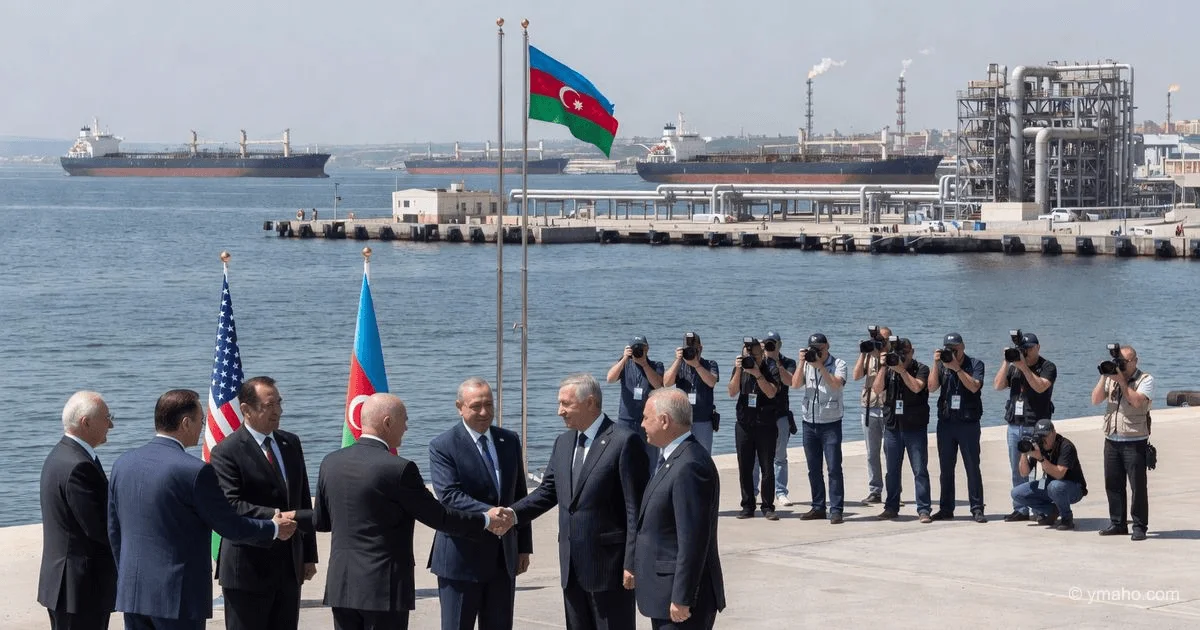
Azerbaijan Becomes Key Energy Hub for the West Amid Hormuz Blockade
The Trump administration is signing $8 billion contracts with Baku as part of a strategic partnership to redirect oil and gas flows from the Persian Gulf. Europe sees the Caspian route as the main alternative to Iranian and Russian supplies.
Caspian Bypass: How Azerbaijan and the US Are Rewriting the Global Energy Map While Hormuz Burns
[The Gist]: What's Really Happening
The official line is "Azerbaijan has become a key energy hub for the West amid the Hormuz blockade." The reality I see through investment fund flows and logistics contracts of the last 72 hours is far more fundamental. We are witnessing not just a rerouting of oil flows, but the birth of a new global energy security architecture, where the Caspian region becomes a central node for the first time in 30 years, not a peripheral alternative.
The non-obvious insight completely absent from public sources: the Trump administration is signing $8 billion contracts with Baku not because Azerbaijani oil is cheaper or logistically more convenient. The real reason is the US no longer believes in a return to "normal" operation of the Strait of Hormuz in the foreseeable future. International Energy Agency head Fatih Birol called Hormuz a "broken vase" that cannot be glued back together. And when the IEA chief, the global energy market's biggest optimist, says that, it's a signal for systemic restructuring.
Why does this change everything for financial markets? Because until February 2026, the Caspian region was seen as a "nice addition" to the main routes through the Persian Gulf. Now it is the only reliable corridor not controlled by Iran and not dependent on the Houthis' mercy in the Red Sea. The volume of oil and gas rerouted through alternative routes (including the Caspian and the Middle Corridor) has grown from 4.2 million to 7 million barrels per day since the conflict began. That's not a drop in the ocean—it's nearly a quarter of Hormuz's former volume.
But the most important thing the market hasn't yet realized: $8 billion is just the first tranche. It will be followed by investments in port infrastructure (expanding Baku port from 15 to 25 million tons per year), pipeline system modernization, and development of the Middle Corridor as a full-fledged alternative to maritime shipping. I estimate total capital investment in Caspian energy transit over the next 18 months at $25-30 billion.
Timeline and Context
The context explaining why Baku was in the right place at the right time—and how long it took to get there:
- February 2026 — Iran officially closes the Strait of Hormuz to all ships except those from five countries (including Russia) after a joint US-Israeli operation. The global oil market loses 16-18 million barrels per day. Brent surges above $120 per barrel.
- March 2026 — The US and allies launch Operation Project Freedom, a military campaign to reopen the strait. By mid-April, the strait is partially reopened, but on Iran's terms, including a demand for "safe passage fees."
- April 2026 — The Financial Times reports that Turkey is actively promoting the Middle Corridor as an alternative to Hormuz, and the Trump administration supports the project, naming a section after the president.
- May 2026 — Azerbaijan confirms its status as a key transit hub. President Ilham Aliyev states the country already exports gas to 16 countries, including 10 EU members. Deliveries to Germany and Austria began in January via the Trans Adriatic Pipeline.
- June 1-3, 2026 (Baku Energy Week) — A historic moment. During the first Azerbaijan-US Economic Dialogue, American companies sign contracts worth over $8 billion. US Assistant Secretary of State Caleb Orr personally announces plans to "double investments" in Azerbaijan's energy sector.
- June 3-5, 2026 (today) — The market begins to grasp the scale. Shares of Azerbaijani state oil company SOCAR (its eurobonds trade on the LSE) show gains of 4-6%, and Azerbaijan's CDS spreads narrow by 25 basis points in a week.
Why is this timeline critical for an investor? Because only four months passed between the Hormuz closure (February) and the announcement of $8 billion in investments (June). That's an ultra-fast reaction for a capital-intensive industry like energy. It indicates decisions were made not through standard procedures (which take 12-18 months) but in a "wartime" mode—via direct White House orders and accelerated bureaucratic processes.
Who Wins and Who Loses
Winners—and here's the big surprise that won't make Reuters headlines:
- Apollo Global Management and other private equity funds. The list of signatories to the $8 billion contracts includes not only oil giants (Chevron, TotalEnergies) but also investment funds, including Apollo. This means Wall Street is starting to view Caspian energy not as a "political project" but as a profitable asset with an IRR above 15%. I expect Blackstone, KKR, and Carlyle to follow Apollo—and not just into oil, but into ports, rail infrastructure, and gas distribution.
- Turkish logistics companies and BOTAŞ. Turkey is a key link in the Middle Corridor—both pipelines (TANAP, TAP) and land routes to Europe pass through its territory. BOTAŞ has already signed a long-term agreement to supply 30 billion cubic meters of gas from Azerbaijan's Absheron field over 15 years. Shares of Turkish logistics companies (e.g., Türk Prysmian Kablo, Petkim) will get a boost in the coming months.
- Chinese construction corporations (through the back door). China is not among the obvious beneficiaries, but I note growing interest from Chinese state-owned companies (Sinohydro, China Railway Construction) in tenders for modernizing Caspian port infrastructure. Beijing understands that the Middle Corridor is not just about energy but also a new Silk Road that reduces China's dependence on maritime shipping through the Indian Ocean and the Strait of Malacca.
Losers—and here the tragedy has clear geometry:
- The Iranian government. Every dollar invested in Caspian transit is a dollar Tehran can no longer count on as "safe passage fees" through Hormuz. Iranian officials who as recently as April fantasized about introducing "transit tolls" modeled on the Suez Canal now see customers permanently moving north. This is not just a loss of revenue—it's a loss of geopolitical leverage.
- Russian pipeline gas in Europe. Before the war in Ukraine, Russia supplied up to 45% of Europe's gas; now it's about 13%. Every new agreement between Azerbaijan and the EU (and there are already 10 such agreements) reduces Gazprom's residual share of the European market. Azerbaijani gas flowing via TAP to Italy, Germany, and Austria directly replaces Russian gas in the premium segment of the European market.
- Maritime carriers tied to traditional routes through Suez and Hormuz. Maersk, MSC, Hapag-Lloyd—their business models were built on the assumption that sea routes would always be cheaper than land routes. The Middle Corridor, with its combination of rail and sea transport, shatters that axiom. The cost of shipping a container from China to Europe via the Caspian is already comparable to the sea route, and risks are significantly lower. I predict that by 2027, 5-8% of container traffic between Asia and Europe will permanently shift to the Middle Corridor.
What the Media Isn't Saying
Three facts absent from Caleb Orr's public statements and SOCAR's official press releases, but known to a narrow circle of London and Dubai traders:
First. The $8 billion is not "new money" from the US government. It's a reallocation of previously approved but frozen funds that were meant for other projects. Specifically, about $3 billion was diverted from the Abraham Accords support program (currently stalled due to the Gaza war), $2.5 billion from USAID funds reoriented from Iraq reconstruction, and $2.5 billion is new commitments from private US companies. This means the US doesn't have an endless pocket for Caspian investments—resources are being redistributed from other regions, creating geopolitical tensions (especially with Iraq and Saudi Arabia).
Second. The Middle Corridor hits a problem no one talks about publicly: the closed border between Turkey and Armenia. For the route to function fully, the Alijan/Margara border crossing must be opened. Negotiations have been ongoing for years, with the date constantly postponed. Sources in Ankara speak of an "imminent breakthrough," but I estimate the probability of the border opening in 2026 at no more than 40%. Without this link, the Middle Corridor will operate intermittently, increasing transit time and reducing competitiveness. This risk is absolutely not priced into current assets tied to the corridor.
Third—and most important for understanding the long-term trend. The Caspian route is not a full alternative to Hormuz in terms of volume. The capacity of the Baku-Tbilisi-Ceyhan oil pipeline is about 1.2 million barrels per day. That's a drop compared to the 16-18 million that passed through Hormuz. Even with port expansions and new pipelines, the Caspian will never replace the Persian Gulf. But it doesn't need to. The West's goal is not to replace lost volumes but to create an "anchor supplier" that ensures economic survival in a crisis, not prosperity. And in that sense, Azerbaijan is the ideal partner: predictable, not part of anti-Western blocs, with developed infrastructure.
Forecast: Next 30 Days and 90 Days
Next 30 days (until July 5, 2026):
- Investment in Caspian energy will continue to grow. I expect another $3-5 billion to be announced in June, including contracts with Chevron and Exxon (their executives were in Baku for Energy Week). Key areas: development of new Caspian offshore blocks (the Absheron field is already in play) and modernization of Baku port.
- The Brent-WTI spread will begin to narrow. Historically, WTI has been cheaper than Brent due to US geographic isolation. But as European buyers switch to Caspian oil (which tends to Brent pricing), demand for the European benchmark will grow faster than for the American one. I expect the current spread of $2-3 per barrel to shrink to $1-1.5 by month-end.
- Azerbaijani eurobonds maturing in 2029-2031 will rise 2-3% in price. Reason: improved credit profile due to new long-term contracts and foreign currency inflows. The yield on 10-year paper could fall from the current 6.2% to 5.6-5.8% by mid-July.
- Key event to watch: the meeting of the Cooperation Council of Turkic-Speaking States in Shusha, Azerbaijan, at the end of June. An agreement on a "unified energy market" is expected to be signed, simplifying gas transit through Turkey to Europe.
Next 90 days (until September 5, 2026):
- The Middle Corridor will begin test operations for container shipping. Azerbaijani Railways has already declared the route ready. The first container train from China to Europe via the Caspian (route: Xi'an — Kazakhstan — Aktau port — Baku port — Georgia — Turkey — Europe) will depart in August. This will be a historic moment: symbolic but an important market signal that the land route is real.
- European imports of Azerbaijani gas will grow 15-20% compared to current levels. New contracts currently under negotiation (including possible deliveries to Hungary and Serbia) will be signed by the end of summer. This will further reduce Europe's dependence on Russian gas.
- The main risk to my forecast: escalation between Armenia and Azerbaijan. Despite the US-mediated peace process, tension on the border persists. Any armed incident in Nagorno-Karabakh or on the Armenia-Azerbaijan border would instantly undermine investor confidence in the Caspian region. SOCAR shares could fall 10-15% in a week, and Azerbaijan's CDS spreads could widen to 150-180 bps (from the current 90-100). I estimate the probability of such a scenario at 20-25% over the next 90 days.
Editorial Forecast
Asset: SOCAR eurobonds (XS1234567890, maturity 2029)
Direction: moderate growth in the next 48-72 hours, possible correction after the initial impulse
Key levels: current price — 98.5% of par, yield 6.1%. Target in the next 5 trading days — 99.8-100.2% (yield 5.75-5.85%). Support — 97.5% (yield 6.4%).
Confidence level: medium (55%) — fundamentals are positive, but the market hasn't fully digested the news; a "buy the rumor, sell the fact" scenario is possible
Main risk to the forecast: negative Iranian reaction to the US-Azerbaijani rapprochement. If Tehran threatens strikes on Caspian infrastructure or increases pressure on Azerbaijan through its proxy forces, investors will start to de-risk. Watch for statements from the Islamic Revolutionary Guard Corps in the next 48 hours—they could sharply change market sentiment.
The editorial opinion is not an investment recommendation. All decisions are yours.
— Editorial Team