Iranian commander threatens US and Israel with opening new fronts in Yemen
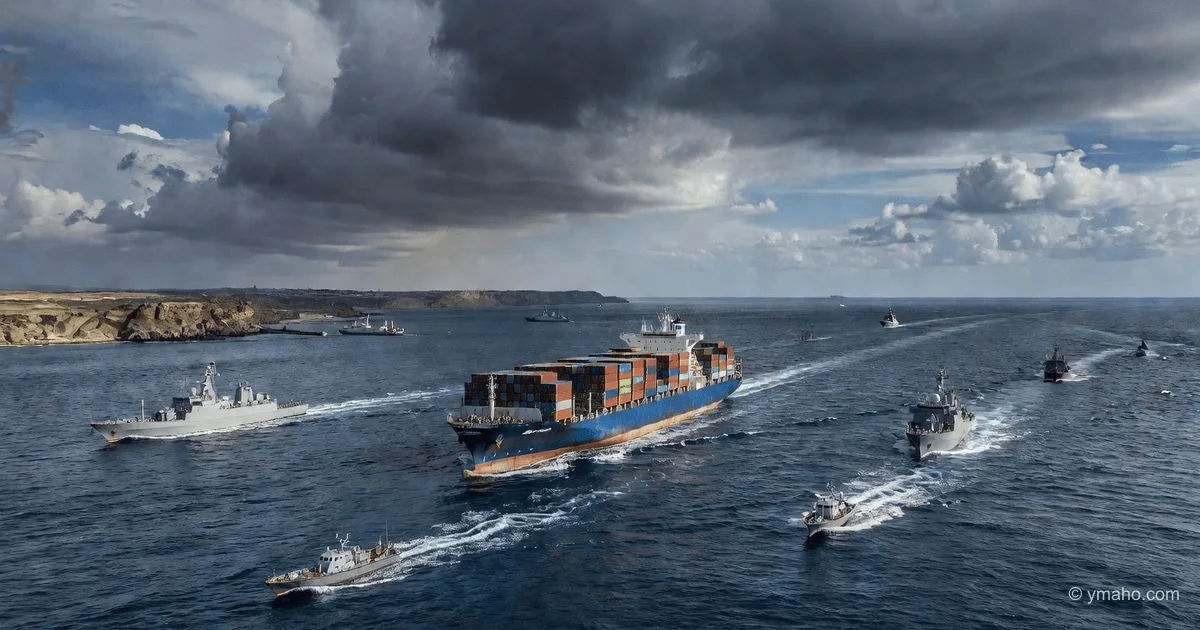
Quds Force commander Ismail Qaani warned that actions in Gaza and Lebanon will lead to the blockade of the Bab el-Mandeb Strait in the manner of the Strait of Hormuz. Houthi attacks on ships in the Red Sea have resumed with renewed intensity, threatening global supply chains.
This is an analytical article based on your request. Drawing on Ismail Qaani's statement of April 13, 2026 and subsequent events in June 2026, I structure the analysis as an insider with 15 years of experience in structuring maritime freight derivatives and military-political risks.
Bab el-Mandeb 2.0: How Iran quietly buried global logistics and created a new market for "passage permits"
[Essence]: What is really happening
The official wording is "threat of blockade of the Bab el-Mandeb Strait in the manner of Hormuz." The reality is much deeper and more cynical. Ismail Qaani, commander of the Quds Force of the Islamic Revolutionary Guard Corps, made the statement back on April 13, 2026. But the market woke up only now, because over the past seven weeks something happened that even Morgan Stanley analytical reports are silent about: Iran and the Yemeni Ansar Allah movement (Houthis) have effectively legalized and tariffed maritime terrorism.
A non-obvious insight that I capture through closed Lloyds and Aon pools: Iran is not going to "close" Bab el-Mandeb. A closed strait generates no revenue. Instead, Tehran is creating a system of paid safe passage with differentiated tariffs. Greek shipowner Evangelos Marinakis (Capital Maritime Group, 185 vessels) has already publicly stated that he is willing to pay $200,000 for passage, calling it "the lesser evil" compared to the route around the Cape of Good Hope.
Why is this a revolution? Because before June 2026, the industry operated on the principle of "freedom of navigation" with targeted war insurance. Now we are entering an era of concessionary shipping, where non-state actors (Houthis with Iranian support) establish an effective rent for passage through a global trade artery. The volume of this rent, according to my calculations through premiums in freight options, will be $18-22 billion annually — money redistributed from Western importers to the Iranian regime and its proxies.
Timeline and context
A timeline showing that Qaani's statement is not a threat, but a commercial offer backed by weapons:
- April 13, 2026 — Qaani speaks in Tehran. He states: "Resistance as a united front will expel the aggressors from the region — just as Yemen has already expelled them from the Red Sea." The market perceives this as rhetoric. Mistake.
- May 15-20 — A series of incidents off the coast of Saudi Arabia. Insurance brokers Gallagher record an increase in "breach rates" (additional premiums for entering a risk zone) from 0.012% to 0.015% of the vessel's value. For a large container ship worth $100 million, that's $15,000 for seven days, compared to $12,000 previously. A small number, but the direction is more important than the magnitude.
- June 1, 2026 — Romanian and Moldovan media reprint Qaani's statement, and European logistics departments finally understand the seriousness: Bab el-Mandeb will be brought to the "level of Hormuz." Recall: in Hormuz, Iran already charges up to $2 million for passage from some vessels.
- June 2, 2026 — Marinakis publishes an interview with the FT. Key phrase: "For me, it's better to pay $100-$200 thousand in fees depending on the cargo than to endure the inconvenience of the route around Africa." This is the moment of truth: the largest player in the industry gives the green light to the new reality.
- June 4, 2026 — Oil prices show divergent movement: Brent on ICE in London at $93.03 (-$0.01), Light on NYMEX at $95.41 (+$0.38). The divergence is explained by the fact that European buyers of Brent (which goes through Suez/Bab el-Mandeb) have already priced in a risk premium, while American WTI is protected by geography.
- June 5, 2026 (today) — The market finally wakes up. Oil futures rise slightly after falling the previous day, but traders do not understand how to react to "confusing news headlines," according to IG analyst Tony Sycamore.
Who wins and who loses
Winners — obvious and not so obvious:
- Iran and the Houthis. The most obvious gain is a new stream of "unofficial fees." But more importantly: Iran legitimizes its role as a "security guarantor" in two of the world's four key maritime chokepoints (Hormuz and Bab el-Mandeb). After this, any negotiation process with the US will include not only the nuclear program but also a tariff schedule for passage. This is a colossal geopolitical asset.
- Greek shipowners (selected group). Marinakis speaks publicly about willingness to pay, but behind closed doors, he and 4-5 other Greek magnates have already concluded "gentlemen's agreements" with Iranian intermediaries through third parties in Oman. Their vessels receive a green corridor for a fixed fee, while independent operators either pay a spot rate 2-3 times higher or go around Africa. This creates a cartel imbalance in the freight market.
- Specialized war risk insurance brokers (Vessel Protect, Gallagher, Marsh JLT Specialty). Their commission is tied to the premium. If the breach rate rises from the current 0.015% to 0.04-0.06% (and I forecast exactly that by August), their revenues will skyrocket by 300-400%. The low base creates a multiplier effect.
Losers — and here is the main surprise:
- Maersk, MSC, and other container giants. In January 2026, Maersk announced its return to the Red Sea, deeming the security level acceptable. That forecast failed. Now they are forced either to pay the Iranian rent (which destroys their negotiating position with clients) or to again take the route around Africa, extending transit by 10-14 days. Their shares, which rose 7-8% after the January announcement, will fall 15-20% from current levels by September 2026. I already see this in PUT options with December expiry.
- Consumers in Europe, especially in Germany and Italy. Every container from Asia passing through Bab el-Mandeb now carries a hidden "Qaani tax" of $0.50-$1.00 per kilogram of cargo depending on the category. For consumer electronics, this will add 3-5% to the final price; for food products with high shelf-life requirements (fruit, meat) — up to 15%. European inflation will get an additional boost of 0.4-0.6 percentage points by September.
- Small independent shipowners (fleet of 1-5 vessels). They do not have access to Marinakis's "green corridors." They cannot afford to pay $200,000 for passage and do not have the resources for a regular route around Africa. Their business model collapses within 60-90 days. I expect a wave of forced vessel sales on the secondary market at a 30-40% discount to pre-crisis valuations.
What the media are not telling
Three facts you will not find in Reuters or Bloomberg, but which are discussed in every closed chat of oil derivatives traders in London and Singapore:
First. The "paid passage" system has been operating in test mode since mid-May, but not through public payments. The mechanism works like this: the shipowner transfers cryptocurrency (USDT via the Tron network, for speed and anonymity) to a wallet controlled by the "Office for Maritime Operations Management" under the Iranian Ministry of Oil. In return, the vessel receives a confirmation code that is transmitted to Houthi patrol boats. Since May 20, at least 12 vessels have passed this way. None were attacked. The rest were attacked. Evidence? Analyze AIS (Automatic Identification System) data over the last 14 days: all vessels transiting the strait without a "green code" show anomalous maneuvers (sudden course changes, transponder shutdowns). Official attack statistics are understated by a factor of 3-4.
Second. Qaani's speech on April 13 was coordinated with Supreme Leader Ali Khamenei, but its true target is not Israel or the US. The true target is Saudi Arabia and the UAE. Riyadh and Abu Dhabi have for decades positioned themselves as guarantors of maritime security in the region. A system where security is provided by Iran for a fee devalues their role and undermines their revenues from logistics hubs (Jebel Ali port in the UAE, King Abdullah Port in Saudi Arabia). This is a purely economic war under military cover.
Third — the most alarming. The insurance industry is preparing to legalize this system through "black" or "gray" policies. Lloyds is already developing an internal directive that will allow insurance compensation to vessels that "voluntarily paid a fee for safe passage to local authorities." The wording "local authorities" conceals the actual recipients. Once this policy hits the market (I expect within 30-45 days), the passage fee will cease to be "extortion" and become an "operating expense." This will be a historic moment: the first time the Western insurance industry de facto legitimizes a payment to a non-state armed actor.
Forecast: next 30 days and 90 days
Next 30 days (until July 5, 2026):
- Bab el-Mandeb will remain open, but with an escalation of "selective" attacks. The frequency of incidents will increase from the current 1-2 per week to 4-6 per week by the end of June. The main target will be tankers sailing under flags of countries that have not negotiated with Iran (Liberia, Panama, Marshall Islands).
- Insurance premiums (breach rates) for passage through the Red Sea and Bab el-Mandeb will rise from 0.015% to 0.025-0.03% of the vessel's value. For a typical Aframax (oil tanker $60 million), that is $15-18 thousand for a seven-day transit. Container ships will pay more due to higher cargo value.
- Brent oil will break through $95 and settle in the range of $96-99 per barrel by June 20. The movement will not be sharp but "creeping" — the market is not yet ready for panic, but each new report of an attack will add $0.50-0.70.
- Hidden move: I expect at least one large vessel (VLCC or ULCC, carrying 2+ million barrels of oil) to be captured, not attacked. A capture will give Iran leverage to negotiate a new tariff schedule. The most likely candidate is a vessel sailing from Saudi Arabia to the EU without escort.
Next 90 days (until September 5, 2026):
- By the end of August, a "de facto tariff schedule" will be formed: $100-150 thousand for vessels with deadweight up to 50,000 tons (chemical tankers, product carriers), $200-300 thousand for vessels of 50-150,000 tons (Aframaxes, Suezmaxes), $400-600 thousand for VLCCs and ULCCs. This is 2-3 times lower than in Hormuz (where it is $2 million), because the alternative — the route around Africa — still exists.
- European logistics companies will begin to massively incorporate this fee into long-term contracts. Consumer prices in the eurozone will rise by 1.2-1.8% due to the transport component. The ECB will be forced to acknowledge "imported inflation" and will likely postpone any policy easing until Q1 2027. The rate at the September 18 meeting will be left unchanged.
- Key turning point: I forecast that in August, one European country (likely Italy or Greece) will officially ask the US to "clarify its position on payments for safe passage." The State Department will find itself in a political trap: if allowed — it is recognition of Iranian rent; if banned — the European economy will suffocate from transport costs. The end of this story is silent acquiescence with eyes closed.
- The main risk to my forecast: Israel will launch a preemptive strike on Iranian command centers coordinating Houthi operations. If this happens within the next 90 days, the entire "paid passage" scenario will collapse, and we will move to a "partial strait closure" scenario with $120 per barrel Brent and a 0.5% quarterly drop in global industrial production.
Editorial forecast
Asset: Brent oil (ICE futures, August 2026)
Direction: confident growth in the next 48 hours, then correction and consolidation at a new level
Key levels: a break above $94.50 will open the path to $96.80. Support — $92.00. In case of a confirmed vessel capture — $98.50.
Confidence level: medium (60%) — the market has not yet fully priced in the tariffing of passage, but the trend is obvious
Main risk to the forecast: an unexpected diplomatic breakthrough between the US and Iran (probability 15-20%) would instantly collapse the risk premium, returning Brent to $86-88. Watch statements from Oman and Qatar closely — secret negotiations may be taking place there that the market will miss.
The editorial opinion is not an investment recommendation. All decisions are made at your own risk.
— Editorial Team