Eurozone Economy Shows Stagnation Amid Energy Crisis
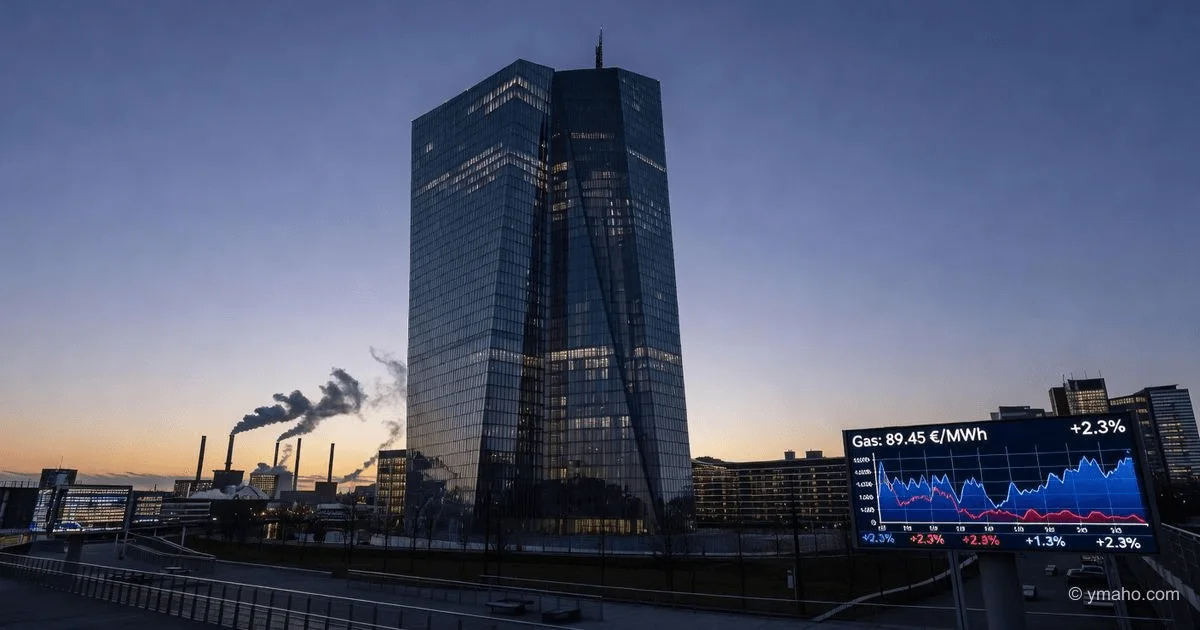
Industrial production in Germany and Italy has fallen amid record gas prices and disruptions in the Red Sea. The ECB signals a possible shift away from dovish policy, not ruling out another rate hike in the fourth quarter.
Stagflation European-style: Why the ECB will raise rates amid falling industrial output
[The Gist]: What's Really Happening
The official line is "the eurozone economy shows stagnation amid the energy crisis." The reality I see through German and Italian government bond spreads is far more alarming and paradoxical. Europe is entering classic stagflation—GDP falling by 0.9-1.1% combined with inflation at 3.2%, and the ECB, instead of cutting rates, is preparing to raise them. This is not just an economic downturn—it's a structural breakdown of a model built on cheap energy from Russia and uninterrupted trade through the Red Sea.
A non-obvious insight missing from public Eurostat reports: the drop in industrial production in Germany and Italy is caused not only by gas prices but also by the simultaneous closure of their export markets in China and the US. New US tariffs of 10-12.5% on European goods [previously in our compilation] are compounded by weak demand in China, where GDP is growing at only 4.5%. As a result, German machine builders and chemical conglomerates are losing their two largest sales markets at once. This is an export crisis disguised as an energy crisis.
Why is this critically important for all markets? Because the ECB is trapped with no good way out. If the bank raises rates (and Nordea forecasts four 25 bps hikes by October, bringing the deposit rate to 3%), it will kill the remnants of industrial growth and increase debt servicing costs for peripheral countries (Italy, Greece). If the ECB keeps rates unchanged, inflation will accelerate further, and by year-end we could see 4% CPI, destroying household purchasing power. The ECB is choosing the lesser evil—and that evil will be rate hikes. Expect the announcement on June 14-15.
Timeline and Context
Statistics and events painting a picture of a systemic, not cyclical, crisis:
- March 2026 — Iran closes the Strait of Hormuz. Gas prices at the TTF hub surge to €74 per megawatt-hour—the highest since January 2023.
- April 2026 — Ursula von der Leyen states the energy crisis has cost the EU €22 billion in additional expenses. Germany introduces an emergency plan with heating limits and digital fuel cards.
- May 2026 — The European Commission downgrades its eurozone GDP growth forecast from 1.5% to 0.9%. Inflation reaches 3.2% year-on-year, with the energy component jumping to 10.9%.
- May 2026 (industry) — According to an S&P Global survey, the eurozone composite PMI falls to 48.5—the lowest since November 2024. Germany and France show contraction, while Italy and Spain see only symbolic growth. New export orders fall at the fastest pace since the start of the year.
- May 2026 (gas storage) — The fill level of European gas storage facilities drops to 35%—15 percentage points below the seasonal norm of 50%. Equinor warns: if the Hormuz blockade lasts 1-3 months, the situation will become critical.
- June 2026 (ECB expectations) — A Bloomberg survey conducted May 4-7 shows economists expect two ECB rate hikes in 2026—in June and September. Nordea goes further, forecasting four hikes, bringing the rate to 3% by October. BNP Paribas also does not rule out a hike, albeit in a more distant perspective (Q3 2027).
- Today, June 5, 2026 — The market prices in an 80-90% probability of a 25 bps rate hike at the June 14-15 meeting. The EUR/USD pair is trading near 1.09, but could strengthen to 1.10-1.11 after the hike announcement.
Who Wins and Who Loses
Winners—and here's the big surprise:
- US LNG exporters (Cheniere Energy, Sempra Infrastructure, Venture Global). Europe is replacing Iranian and Qatari gas with American liquefied natural gas. Spot prices for US LNG in Europe (DES Northwest Europe) have risen to $12-13 per million BTU, 40-50% above 2025 averages. Cheniere has already reported record utilization of its export terminals in Louisiana. Supply contracts are locked in through 2030.
- European coal producers and coal-fired power plant operators (PGE Polska, Uniper, LEAG). With gas prices at €60-70 per MWh, coal becomes economically competitive. Germany, which planned to shut down coal plants by 2030, is now extending their operation. Shares of Poland's PGE have risen 15% since early May, and Germany's Uniper by 8-10%. It's dirty but profitable business.
- Traders of options on the spread between European TTF gas and US Henry Hub (the spread). The spread has widened from a historical $4-5 to $8-10 per million BTU. Traders who went long on TTF and short on Henry Hub back in April are now locking in profits of 150-200%. This arbitrage will work as long as Hormuz remains closed and European storage stays empty.
Losers—and here the list is long and systemic:
- German automotive and chemical sectors (Volkswagen, BASF, Siemens Energy). Hit from three sides: energy prices up 50-70% compared to 2025, exports to the US subject to 10% tariffs, and demand in China falling due to local competition and weak GDP growth. BASF has already announced the closure of two plants in Ludwigshafen, and Volkswagen is moving EV production from Saxony to the US. Job losses in German industry in Q3 2026 could reach 50,000-70,000.
- Holders of Italian and Greek government bonds. The spread between 10-year BTPs (Italy) and German Bunds has widened to 180-190 bps. If the ECB raises rates, this spread could rise to 220-250 bps, making debt servicing for Italy (€2.7 trillion) even more painful. Holders of Italian bonds have lost 3-5% of value over the past two weeks.
- European consumers and small businesses. Heating limits in Germany (no higher than 17°C in public buildings), fuel prices up 30-40%, inflation eating away real incomes. Sales of electric blankets in Europe have risen 400% year-on-year—a symptom of systemic crisis, not a joke. Small businesses, especially in hospitality and retail, face revenue declines of 15-20% amid rising costs.
What the Media Isn't Saying
Three facts absent from official ECB reports and Bloomberg press releases but known to a narrow circle of London and Frankfurt traders:
First. The 35% fill level of European gas storage is not just "below average"; it's a disaster. According to Gas Infrastructure Europe, to reach the target of 90% by the start of the heating season (October), Europe needs to import a record 120 billion cubic meters of gas in four months. This is physically impossible given current LNG terminal capacities and constraints on pipeline gas from Norway and Azerbaijan. Even if Hormuz opens tomorrow, Europe won't fill storage before winter. Winter 2026-2027 will bring either gas rationing for industry or prices above €100 per MWh.
Second. ECB Executive Board member Isabel Schnabel, at a closed meeting with investors in London on June 2, stated that "the disinflation process in the eurozone has virtually stalled." She directly linked this to the energy shock from the Hormuz closure and warned that the ECB is ready to act "decisively and promptly." This was a signal to the market that (as usual) was ignored. Schnabel is the most influential hawk on the Governing Council. When she says "decisively," it could mean a hike of not 25 but 50 bps.
Third—and most important for understanding the long-term trend. The European Commission is already preparing an emergency package for a complete halt of gas supplies through Hormuz. The plan includes mandatory 15% gas consumption cuts for industry (with compensation for critical sectors like fertilizer and steel production) and a gas price cap for households at €70-80 per MWh. This plan will be activated in August-September if storage fill levels do not reach 60% by September 1. I estimate a 70-80% probability of activation. This would be another blow to European industry, which is already barely breathing.
Forecast: Next 30 Days and 90 Days
Next 30 days (until July 5, 2026):
- The ECB will raise the deposit rate by 25 bps to 2.25% at the June 14-15 meeting. The decision will be passed by a majority (8-2 or 9-1), with a lone dovish vote likely from a representative of Italy or Greece. The ECB statement will contain a hawkish signal of readiness for further hikes but without specific commitments.
- Market reaction: EUR/USD will strengthen to 1.10-1.11 in the first 24 hours after the announcement, then correct to 1.08-1.09 as the market realizes the rate hike is killing the economy. European stock indices (Euro Stoxx 50, DAX) will fall 2-3% on the announcement day, with financial and industrial sectors hit hardest.
- Key event to watch: gas storage fill data as of July 1. If the level is below 45% (likely), TTF gas prices will jump to €65-70 per MWh, giving the ECB an additional argument for a second hike in July.
Next 90 days (until September 2026):
- The ECB will deliver a second rate hike in July or September (70% probability). The deposit rate will reach 2.50-2.75% by end of Q3. Two consecutive hikes would be the most aggressive ECB tightening since 2023.
- The eurozone economy will enter a technical recession (two consecutive quarters of negative growth) in Q3 2026. GDP will contract by 0.1-0.2% quarter-on-quarter. Germany will suffer the most—industrial output in Q3 could fall 1.5-2.0% compared to Q2.
- The spread between Italian and German 10-year bonds will widen to 230-250 bps. This will cause concern at the ECB, which may activate the Transmission Protection Instrument (TPI) to buy Italian bonds on the secondary market. If TPI is activated, the spread will stabilize at 200-220 bps, but this will require the ECB to purchase €50-80 billion in bonds—monetary expansion that contradicts tightening policy. A contradiction that can only be resolved politically.
- Main risk to my forecast: a sudden reopening of the Strait of Hormuz due to a diplomatic breakthrough between the US and Iran. If this happens in July-August, gas prices will collapse to €35-40 per MWh, inflation expectations will drop sharply, and the ECB will freeze its rate hike cycle after the first step. I estimate the probability of this scenario at 20-25%—low, but enough to keep in mind. In this case, the German DAX could rebound 10-12% in a month.
Editorial Forecast
Asset: EUR/USD pair
Direction: Short spike up on the ECB rate hike news (to 1.1050-1.1120), then reversal and decline to 1.0650-1.0750 within 2-4 weeks
Key levels: resistance—1.1030 (May high), support—1.0780 (current). A break below 1.0730 opens the way to 1.0650.
Confidence level: Medium (55%)—the market has already partially priced in the rate hike but not yet the recession and drop in business activity.
Main risk to the forecast: If the ECB hikes by 50 bps (outside consensus), the euro could rise to 1.1150-1.1200 as the market reprices the rate differential between the ECB and the Fed. However, I consider this scenario unlikely (10-15%) as the ECB will not resort to shock therapy in a stagnating economy.
The editorial opinion is not an investment recommendation. All decisions are made by you independently.
— Editorial Team