US Inflation Accelerates to 3.8% Due to Triple Blow: War, Tariffs, and AI
A new surge in prices, driven by energy supply disruptions, protectionist tariffs, and capital spending on data centers, leaves the Fed perplexed. Dallas Fed President hints at a rate hike, while the market expected signals of a cut.
Inflation 3.8%: Why the Fed Has Painted Itself into a Corner, and the Market Still Believes in Fairy Tales
[The Gist]: What's Really Happening
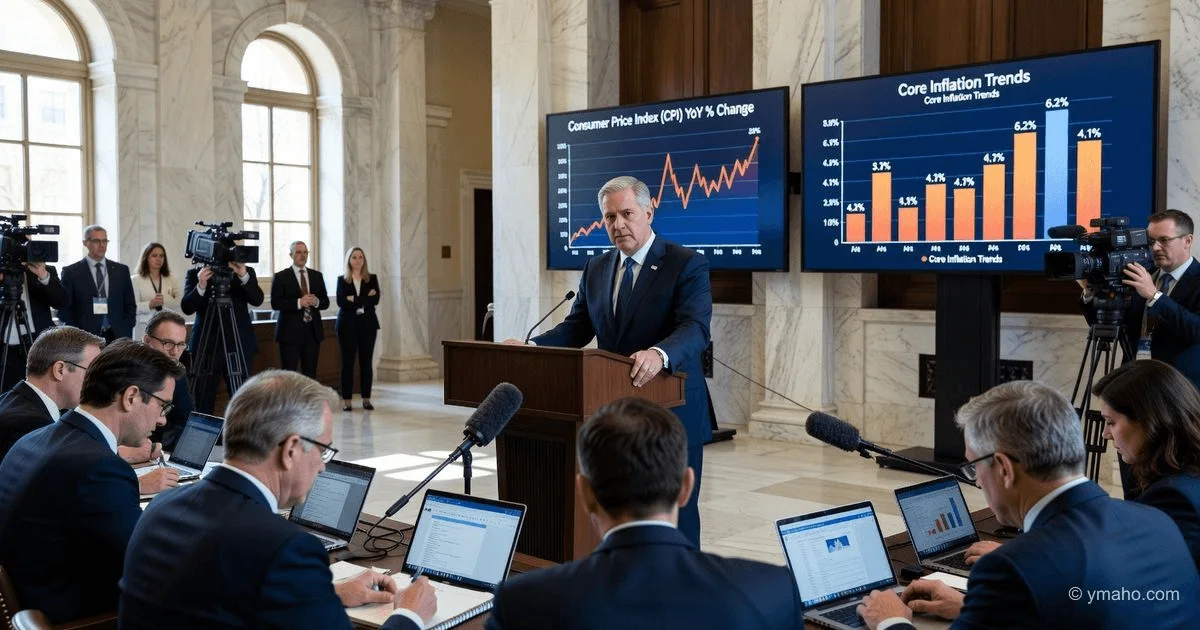
The official figure — the US Consumer Price Index rose to 3.8% year-over-year, hitting its highest level since 2023. The official reason is a "triple blow": the war in the Middle East, protectionist tariffs, and a boom in AI investment. The reality I see through bond options and forward curves is far more alarming and cynical. The Fed no longer controls inflation. Not because policy is wrong, but because the drivers of prices are beyond its reach — geopolitics and fiscal policy, not interest rates.
A non-obvious insight missing from Bloomberg and Reuters headlines: the AI investment boom is not a cause of inflation, but a distraction. The real shock comes from three structural shifts the market is silent about. First, the restructuring of global supply chains (friend-shoring) raises costs by 15-20% compared to the era of cheap Chinese goods. Second, Trump's tariffs are not a "temporary measure" but a new tax regime already embedded in contracts for 2026-2027. Third, and most importantly, the Fed itself created this trap by keeping rates too low for too long, and now it's forced to play catch-up.
Why is this critical for markets? Because Dallas Federal Reserve Bank President Lorie Logan, one of the most influential hawks on the FOMC, stated outright: "I am increasingly concerned that higher interest rates may be needed later this year." She called current monetary policy "neutral or even slightly accommodative." This means the Fed has officially acknowledged that the 3.50%-3.75% rate, which the market considered "high enough," is actually not restraining the economy. We stand on the brink of a new rate hike cycle — precisely when everyone expected cuts.
Timeline and Context
Numbers that paint a picture of systemic failure, not a temporary spike:
- April 2026 — Annual CPI reaches 3.8% versus 3.3% in March. Gasoline prices surged 28.4% year-over-year, and fuel oil rose 54.3%. This is a direct consequence of the conflict with Iran and the blockade of the Strait of Hormuz.
- May 2026 — The Federal Reserve Bank of Cleveland publishes a forecast: May CPI will rise to 4.2% year-over-year — the highest since April 2023. Inflation is not just staying high; it's accelerating.
- April FOMC meeting — Three committee members (including Logan) vote against the language that "the next step is likely a rate cut." This is the highest level of dissent in many months.
- May 2026 — A survey of CEOs in manufacturing and services shows they expect inflation of 3.7% over the next 12 months, up from the previous forecast of 3.1%. Business does not believe inflation will return to 2%.
- June 2-4, 2026 — Logan speaks in El Paso, Texas, and at the University of Texas with two key statements. She calls financial conditions "accommodative" and the labor market "balanced." Her main phrase: "Current monetary policy is not restraining the economy."
- Today, June 5, 2026 — The futures market now prices in a 55% probability of a rate hike by year-end. A month ago, that probability was just 9%. Sentiment has flipped 180 degrees.
This timeline shows how quickly consensus forecasts collapse. As recently as March, leading investment banks (Goldman, JPMorgan) predicted three rate cuts in 2026. Today, those forecasts are in the trash. But the key point: the bond market still believes in 2.5% inflation in the long term. This gap between reality (3.8% here and now) and expectations (2.5% in the future) is the biggest risk for all asset classes.
Who Wins and Who Loses
Winners — and here's the big surprise that won't make it into mainstream analysis:
- Energy companies and physical commodity traders (Vitol, Trafigura, Glencore). High oil prices ($109 Brent as of May) and rising rates create a perfect storm for traders with access to warehouse financing. Companies that can buy oil today, store it on tankers, and sell it 3-6 months later at a higher price (contango) earn hundreds of millions of dollars on the spread. This arbitrage is unavailable to retail investors, but it explains why physical traders are posting record profitability.
- Stocks of companies with pricing power. In a 3.8% inflation environment, those who can pass costs to consumers without demand destruction win. These sectors: consumer staples (Procter & Gamble, Coca-Cola, Colgate-Palmolive), healthcare (UnitedHealth, Pfizer), and some industrial niches (Caterpillar, Deere). Their margins may even rise, while companies with low pricing power (retail, airlines, auto dealers) will be crushed.
- US Dollar (DXY). Every signal of a possible Fed rate hike strengthens the dollar. The NZD/USD pair fell more than 1% on the day of Logan's speech. I expect the dollar to continue rising against most currencies, especially the euro and yen, whose central banks lag the Fed in the tightening cycle.
Losers — and here the list is long and painful:
- Holders of long-duration bonds (TLT, EDV). This is the biggest trap in the market today. The bond market still believes in 2.5% long-term inflation, so 10-year Treasury yields remain at 4.2-4.5%. If the Fed starts hiking, yields will go to 5-6%, and long bond prices will crash 15-20%. This is a disaster for pension funds and insurance companies that have piled into "safe" Treasuries.
- Tech companies with high multiples (especially unprofitable growth stocks). High rates kill the present value of future cash flows. Even the "Magnificent Seven" (Apple, Microsoft, Nvidia, Alphabet, Amazon, Meta, Tesla) are not immune. The S&P 500 historically shows significantly lower real returns when inflation is above 3%. Investors who think "this time is different" are sorely mistaken.
- Consumers with floating-rate loans and mortgages. Credit card rates have already reached 22-25% APR. Adjustable-rate mortgages (ARMs) will become unaffordable for millions of Americans if the Fed raises rates another 50-75 bps. I expect consumer loan delinquencies to rise 30-40% over the next six months.
What the Media Isn't Saying
Three facts absent from Logan's public remarks and official Fed statements, but common knowledge in New York and London trading floors:
First. Analysts at Citadel Securities and former New York Fed President Bill Dudley have directly warned: the Fed risks losing control of inflation, and its reputation as an "inflation fighter" is at stake. Dudley emphasized that inflation has exceeded the 2% target for over five years, long-term inflation expectations are rising, and "there is now almost no case for rate cuts." When a former head of a key regional Fed says this, it's a signal that a hawkish pivot is inevitable — the question is only timing and magnitude.
Second. The gap between what the Fed sees and what the bond market prices is enormous. Logan directly criticized an alternative inflation measure praised by new Fed Chair Kevin Warsh (Trimmed Mean PCE), saying it can be misleading due to technical factors. In her assessment, inflation is "trending toward the mid-2% range, not 2%." But the market stubbornly ignores this signal, pricing 10-year breakeven inflation at 2.48%. This is a classic case of "peacetime" thinking in "wartime." When the market finally wakes up, the correction will be sharp and painful.
Third — most important for traders. The 3.8% inflation figure is an average. But real price pressure is concentrated in a few critical sectors. Fuel prices rose 54.3% year-over-year, airline fares 20.7%. And clothing tariffs added 0.6% in April alone. This means "core inflation" (excluding food and energy) at 3.3% is also rising. The energy shock has already begun to spill over into other categories. The Fed can no longer talk about "transient factors." This is structural inflation, and rates must be structurally higher.
Forecast: Next 30 Days and 90 Days
Next 30 days (through July 5, 2026):
- The FOMC will hold rates steady at the June meeting (June 14-15), but it will be a "hawkish pause." The statement language will change: the phrase about "further cuts" will disappear, replaced by wording about "readiness to act" to achieve the 2% target. Two committee members will vote for an immediate rate hike (Logan, Hammack, possibly Kashkari).
- The stock market will continue to ignore risk in the short term, keeping the S&P 500 near all-time highs. This is a trap for bulls. I expect a 5-7% correction over 2-3 weeks after the FOMC meeting, once investors realize there will be no rate cuts in 2026.
- Key event to watch: May inflation data (release around June 10-12). If CPI exceeds 4% (and the Cleveland Fed forecast is 4.2%), the Fed may go for an unscheduled rate hike in July, not September. I estimate a 25% probability of an unscheduled hike — a non-consensus scenario that would completely break all models.
Next 90 days (through September 5, 2026):
- The Fed will raise rates by 25 bps in September (80% probability). But a more aggressive scenario is a 50 bps hike in September and another 25 bps in November (30% probability). The rate could reach 4.50%-4.75% by end-2026 — levels the market is not pricing.
- The US dollar will strengthen 4-6% on the DXY index, reaching 108-110. The euro will fall to 1.02-1.04, the yen to 165-170 per dollar. Gold, contrary to logic, may fall to $2,200-2,300 per ounce because a strong dollar and high rates make it less attractive as an alternative to yield.
- Key risk to the economy: the combination of high rates and high inflation ("stagflation-lite") will begin to pressure corporate profits. I expect company guidance to be lowered for Q3 in July earnings reports. This will catalyze a deeper market correction (10-15%) in August-September.
- Main risk to my forecast: if the geopolitical situation in the Middle East suddenly normalizes (ceasefire in Lebanon, opening of Hormuz), oil could crash to $80 per barrel, and inflation expectations would drop sharply. The Fed would then have room to pause, and the hawkish scenario would be canceled. But the probability of this is less than 15%.
Editorial Forecast
Asset: 10-year US Treasury bonds (TLT, ETF on long Treasuries)
Direction: Bond price decline (yield increase) over the next 48-72 hours
Key levels: Current yield — 4.35%. Target in the next 5 trading days — 4.55-4.60% (TLT down 2-3%). On a break above 4.60%, next target is 4.80%.
Confidence level: High (70%) — the futures market already prices a 55% probability of a rate hike by December, but bond prices are still too optimistic and do not reflect the risk of an unscheduled hike.
Main risk to forecast: Weak labor market data (Friday's NFP report) could temporarily weaken the dollar and lower yields. But any yield drop below 4.20% I will view as an opportunity to enter short bond positions — the fundamental trend remains bearish.
The editorial opinion is not an investment recommendation. All decisions are yours alone.
— Editorial Team