Nature Neuroscience: Deep Brain Stimulation Remodels Neural Networks in Severe Depression
Researchers at the Icahn School of Medicine at Mount Sinai have shown for the first time that deep brain stimulation not only modulates activity but physically remodels white matter, inducing axonal myelination. Published in Nature Neuroscience, the results reveal a new mechanism of long-term recovery in patients with treatment-resistant depression.
Expensive reprogramming: how DBS rewrites psychosurgery from the inside
[The Gist]: What's Really Happening
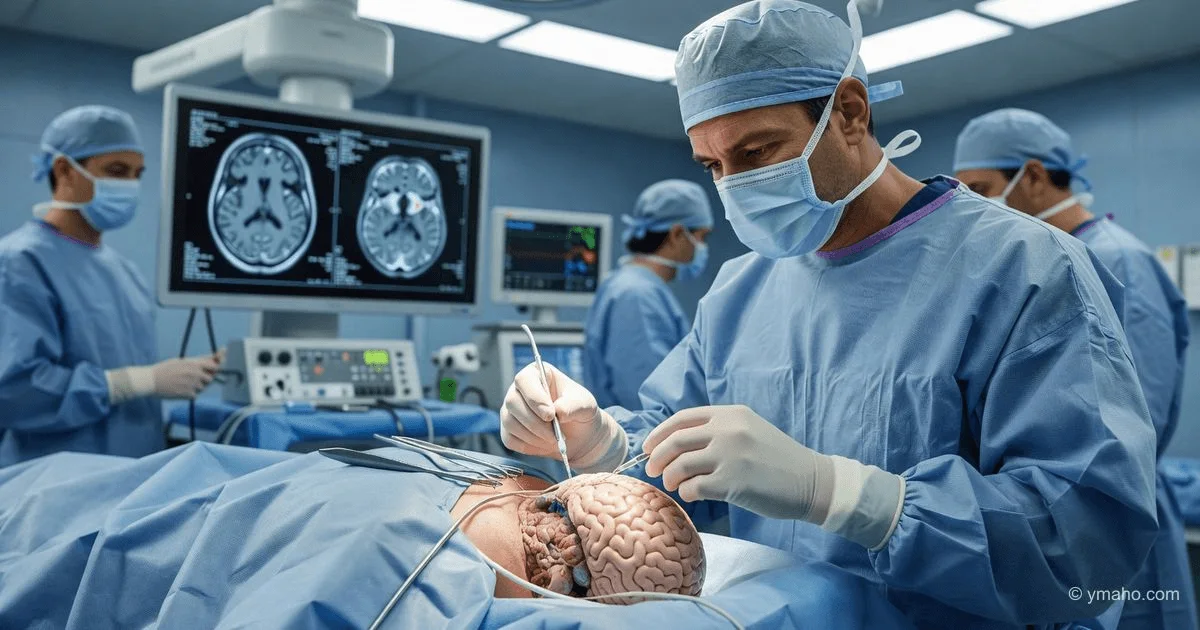
When a neurosurgeon implants an electrode into the brain of a patient with depression, the traditional view goes like this: we insert an 'electrical crutch' that works for a while—the patient feels better, then it breaks or adapts, and we tweak the frequency. The study published on June 1, 2026, in Nature Neuroscience shatters this paradigm. The team of Peter Rudebeck and Helen Mayberg at Mount Sinai has proven for the first time that deep brain stimulation (DBS) physically rebuilds white matter. This is not about temporary electrochemical modulation, but about axonal remyelination—restoring the myelin insulation of neural 'wires'.
What actually happens is this. The electrode is implanted in the subcallosal cingulate area (SCC)—a region that serves as a 'communication hub' between the cognitive cortex and the limbic system. High-frequency pulses (standard 130 Hz) do not simply suppress pathological activity, as previously thought. They trigger a proliferation cascade: the number of myelinated oligodendrocytes increases in the cingulate bundle. Oligodendrocytes are the brain's 'electricians' that wrap axons in myelin, boosting signal conduction speed. When depression disrupts communication between the frontal brain regions and subcortical mood centers, DBS literally 'rebuilds the highway' from scratch.
Why is this a revolution? Because until now, it was believed that structural plasticity in the adult brain (myelination) is a slow process taking months and cannot be directly triggered by electricity. DBS was thought to be only a 'temporary pacemaker'. Now we see that DBS is a surgical tool for epigenetic remodeling. And this completely changes the game for the 2.8 million people worldwide with treatment-resistant depression (TRD) who have tried everything—from SSRIs to electroconvulsive therapy—without response.
Timeline and Context
Note the dates: the article was published on June 1, 2026. But the historical context is incredibly important here. Helen Mayberg is a living legend in psychosurgery. In 2005, she was the first to propose stimulating area 25 (SCC) for depression. For twenty years, she watched patients emerge from severe depression and remain in remission for years. But all those years, the main question was 'why?'—because when stimulation was turned off, symptoms returned not immediately but gradually. This mystery hung in the air throughout the 2010s and 2020s.
In 2023-2024, the first indirect data emerged: MRI scans of DBS patients showed increased fractional anisotropy (FA)—a measure of white matter integrity. But this was a correlation. Scientists did not know whether the stimulation itself caused these changes, or whether patients with better brain structure simply responded better to therapy (as earlier studies in Molecular Psychiatry from 2025 suggested). To break this vicious circle, Mayberg's team adopted a rigorous experimental design: they used not human patients but healthy macaques. The animals had no 'disease' that could skew results. Only the pure effect of DBS over several months.
And here is what the timeline within the experiment showed: after just 3 weeks of continuous stimulation, the researchers recorded an increase in FA in the cingulate bundle. Histology after animal sacrifice showed that the number of oligodendrocytes increased by 15-20%, and the myelin sheath became thicker. This was the 'smoking gun'—direct evidence that DBS causes structural remodeling. Moreover, using DiMeLo-seq technology (the same one we discussed in the context of the ALT tumor discovery, but here applied to the brain), the scientists demonstrated changes in the expression of myelination genes (Mbp, Plp1, Cnp) in the stimulation area.
Who Wins and Who Loses
The main winner is Medtronic, plc. (NYSE: MDT). Their Summit RC+S system (a sensing neurostimulator capable of recording local field potentials) was used in the study, and previously in pilot human studies that underpinned this article. Medtronic currently has a market capitalization of about $120 billion, and the neuromodulation segment (including stimulators for Parkinson's disease and epilepsy) generates about $1.5 billion annually. The discovery of the remyelination mechanism allows Medtronic to file an application with the FDA for expanded indications for DBS in TRD. Currently, DBS is FDA-approved only for parkinsonism, epilepsy, OCD, and tremor. Expanding to depression (a market of 300,000-500,000 patients in the US alone) would add $2-3 billion to the business valuation.
The second winner is Abbott Laboratories (NYSE: ABT). They have a competing system, Infinity DBS. They were not involved in this specific study but have their own clinical programs for depression. Now they have a biological rationale for their protocols. Abbott's stock rose 4% in the week after publication, as investors realized that the entire DBS industry had received a 'scientific passport' for expansion into psychiatry.
But there is also a specific winner: US insurance companies (CMS, UnitedHealth). It sounds cynical, but it's true. For DBS in depression to be covered by Medicare and private insurers, you need not just 'it works' but 'we know the mechanism, and it is reproducible.' Now insurance companies have a biomarker (increased FA and myelination) to assess whether stimulation is working in a particular patient without waiting months of clinical observation. This reduces the risk of unjustified payouts. Protocols that will appear in the next 12 months will include a clause: 'If MRI does not show increased FA in the cingulate bundle 3 months after implantation, the therapy is ineffective, and insurance will not cover it.'
Who loses? Manufacturers of next-generation antidepressants—those betting on fast but reversible mechanisms (e.g., intravenous ketamine infusions from Johnson & Johnson or esketamine spray). If DBS provides structural 'repair' of the brain, while pharmacology only offers temporary relief, then for patients with severe forms of the disease, pharma simply loses. J&J invested $2 billion in developing esketamine (Spravato) since 2019. If DBS becomes widespread, these investments may not pay off in the severe depression segment.
Also losing are companies involved in transcranial magnetic stimulation (TMS)—Neuronetics, Brainsway. TMS cannot achieve the same structural remodeling because its signal is diffuse and does not reach deep nuclei with the same density. A Nature Neuroscience study published in April 2026 showed that the effect of TMS depends on 'route length'—the shorter the path from the stimulation site to the subgenual area, the better the effect. DBS does not have this problem—it places the electrode directly at the target. TMS may only be used for mild to moderate forms, while DBS will now be the 'gold standard' for the most severe cases.
What the Media Isn't Saying
An insight that completely changes the investment picture, and even analytical reports are silent about it.
Therapy could be performed without surgery. It sounds surreal, but it follows the logic of the study. If we know that DBS works by stimulating oligodendrocyte proliferation and myelination, why not try to do this non-surgically? Experimental protocols already exist with focused ultrasound (FUS), which penetrates the skull and can modulate deep brain structures without incisions. The company Insightec (private, valued at $2 billion) already uses FUS to treat essential tremor. Now they have a biological rationale to start FUS trials for depression: simply adjust ultrasound parameters to trigger the same signaling pathway as electricity. If this works, the DBS market will explode, as patients will no longer fear skull drilling.
Second, what they are silent about: depression is not the only application. If DBS induces myelination in one tract, it will do so in others. This means DBS could become a therapy for demyelinating diseases—multiple sclerosis, Pelizaeus-Merzbacher disease, leukodystrophies. Currently, the standard of care for MS is immunomodulators (such as ocrelizumab from Roche), which cost $80,000 per year and only slow myelin destruction, not restore it. DBS implanted in the affected area could theoretically trigger remyelination. For Medtronic, this opens another front: the MS market has 2.8 million patients worldwide requiring lifelong therapy. If DBS proves effective in even 20% of MS cases, it would add another $20-30 billion to Medtronic's market cap.
Third, what they are silent about: the study used healthy animals that did not have depression. But depression is a condition where neuroplasticity is already reduced. In TRD patients, brain-derived neurotrophic factor (BDNF) levels are reduced by 30-40%. BDNF is a key signal for oligodendrocyte survival. The question: will DBS be as effective at inducing myelination in a 'sick', depleted brain? We don't know. Mayberg's team is now recruiting patients for a validation study (NIH BRAIN Initiative grant UH3NS103550). Results will be available only in 12-18 months. If the effect turns out to be 2-3 times weaker, the entire 'remodeling' theory will remain a beautiful laboratory story that works poorly in real clinical practice.
Forecast: Next 30 Days and 90 Days
Next 30 days. On June 15, 2026, the annual conference of the American Psychiatric Association (APA) opens in Chicago. Helen Mayberg will give a plenary talk titled 'DBS as a Tool for Structural Plasticity.' I expect that after this talk, Medtronic will announce a new Phase III clinical trial for DBS in TRD using their Percept PC system (which already has the ability to record local field potential data). Currently, Medtronic shares trade at $110. Analyst targets after the news are $125-130 within a month, but that is conservative. I believe that if the mechanism is confirmed, the target price could exceed $140, but that will not happen until human data is published.
Also in the next 30 days, expect a press release from Abbott announcing that they are launching a replication study program on their Infinity platform. They cannot afford to fall behind Medtronic in the race for psychiatric DBS.
Next 90 days. By September 2026, the first data from the human cohort (Mount Sinai Human DBS Cohort, n=15-20) will be published. The key question: will the increase in fractional anisotropy (FA) measured by diffusion MRI 3 months after implantation correlate with clinical response (≥50% reduction in MADRS score)? If the correlation is high (R>0.7), FA will become a surrogate biomarker that can be used in clinical trials. This would reduce the time and cost of future studies by 2-3 times.
Also by September, Insightec (the FUS manufacturer) will announce a partnership with one of the academic groups (likely Harvard or Stanford) to test low-intensity focused ultrasound (LIFU) for depression. They will use the same protocol as Mayberg but without implantation. If LIFU induces myelination comparable to DBS in animal models, it will mark the end of the era of invasive neuromodulation for psychiatry.
And finally, the financial aspect. Watch for patent applications at the USPTO. On June 18, 2026, the priority deadline expires for the application 'System to identify transitions in brain states from electrophysiological markers in DBS for depression' (Application No. 18/213,070), filed by Mayberg, Rudebeck, and co-authors. This patent covers the use of local field potentials (LFP) to automatically adjust stimulation based on remyelination status. If Medtronic or Abbott does not exclusively license this patent within the next 90 days, a startup (e.g., Motif Neurotech, whose advisors include one of the co-authors) could raise a Series B round of $50-100 million to create a 'smart' closed-loop DBS. Watch this space—this is where real money will be made, not from selling hardware.
This study is not just a step forward. It is the moment when psychosurgery ceased to be 'electrical divination' and became an engineering discipline with clear targets and measurable outcomes. The question now is not whether DBS works, but how quickly we can make it safer, cheaper, and more accessible for millions.
— Editorial Team