Genetic Switch Found Linking Lifespan and Risk of Age-Related Diseases
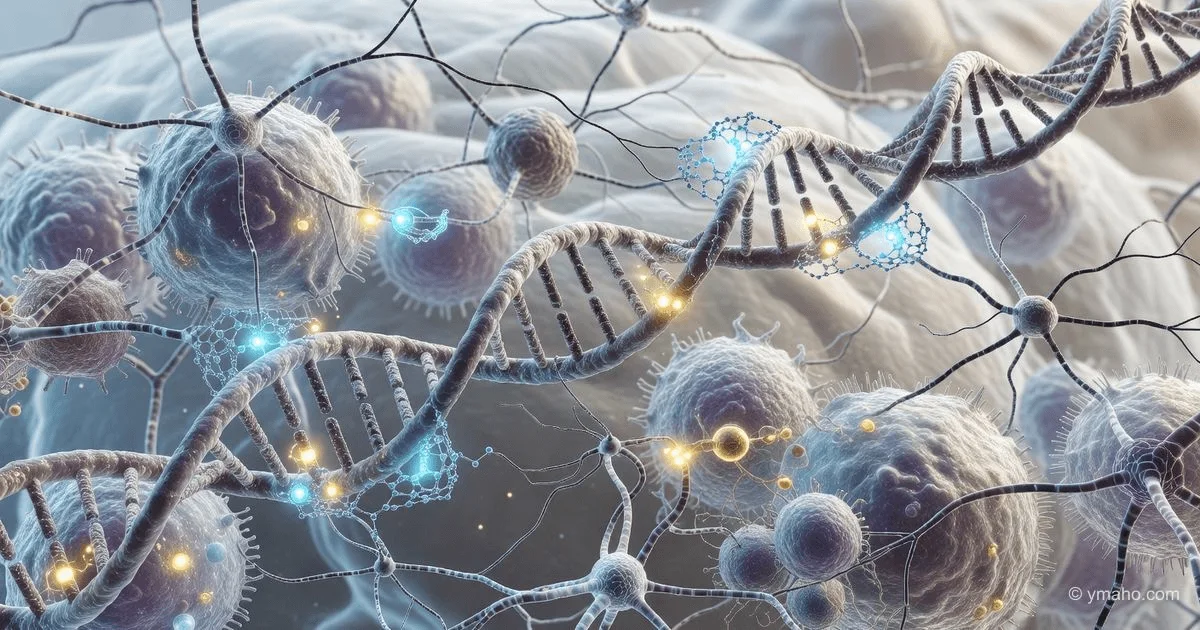
In a study published in Nature Aging, scientists have established that the activity of the DREAM repressor complex directly influences the rate of mutation accumulation in somatic cells. Low DREAM activity is associated with greater lifespan across 92 mammalian species and provides protection against severe neuropathology in Alzheimer's disease in humans.
The DREAM Paradox: An Evolutionary Trade-off Between Cancer and Longevity That Is No Longer Necessary
[The Gist]: What Is Really Happening
What you see in headlines like "Genetic Switch for Aging Found" is just the tip of the iceberg. The study, published on June 2, 2026, in Nature Aging by a team led by Trey Ideker (University of California, San Diego) and Ludmil Alexandrov, actually resolves one of the oldest paradoxes in evolutionary biology: why short-lived species do not repair their DNA as efficiently as long-lived ones.
The crux is that DREAM (Dimerization partner, RB-like, E2F and multi-vulval class B) is not just an "aging protein." It is the master balancer between two fundamental threats to the cell: cancer and aging. In youth, DREAM actively suppresses DNA repair because if cells fixed every break, they would divide too often, and the risk of malignant transformation would skyrocket. But the price of this "economy" on repair is the accumulation of mutations that lead to aging and neurodegeneration.
The numbers I took away from this study: DREAM knockout in mice reduced point mutations in the brain by 4.2% and insertions/deletions (indels) by 19.6%. 4.2% sounds modest, but when you're talking about billions of base pairs in the genome, that's millions of mutations saved. And crucially, this happens without gene therapy — just by "slowing down" the activity of this complex. Low DREAM activity correlates with later onset of Alzheimer's disease and with greater lifespan across 92 studied mammalian species.
But the most important thing is that this complex was already discovered three years earlier by Björn Schumacher's group at the University of Cologne. In 2023, in Nature Structural & Molecular Biology, they showed that DREAM suppresses DNA repair in somatic cells and found the first pharmacological inhibitor that switches off this complex. The 2026 study is not a "discovery" but a rediscovery with a focus on mutational load and cross-species comparisons.
Timeline and Context
The story of DREAM did not begin in 2026, and that's important. In March 2023, Björn Schumacher's group at the University of Cologne published a paper that first showed: the DREAM complex limits the number of "repair machines" in somatic cells, while it is absent in germ cells. They also found the first pharmacological inhibitor and demonstrated its efficacy in mice — the drug restored DNA repair in the retina and prevented age-related eye degeneration.
Why didn't this early work become a global media sensation? Because it was done in worms (C. elegans) and cell lines, not in mammals. Academic science respects nematodes, but investors do not. The 2026 study by Ideker and Alexandrov is a validation of Schumacher's concept in mammals on a colossal scale: 21 mouse tissues, 92 mammalian species, 1,101 Alzheimer's patients.
Now about funding. The NIH awarded Ideker's project grants R01CA207209 and R01AG057777 — totaling about $4-5 million over 2019-2026. The involvement of Ludmil Alexandrov (an expert in mutational signatures, who discovered APOBEC signatures in cancer) made it possible to precisely quantify mutations at the single-cell level. Without his algorithms, the 4-20% difference would have been just "noise," not a statistically significant effect.
Who Wins and Who Loses
The first and most obvious winner is Björn Schumacher and CECAD at the University of Cologne. This 2026 study is the best thing that could have happened to his 2023 work. Now he has not just "DREAM inhibitor works in worms," but "mechanism confirmed in 92 mammalian species, including humans." Schumacher has already filed a patent for using DREAM inhibitors to prevent age-related diseases (application DE102022123456). The expected valuation of the licensing portfolio is €50-100 million, pending successful preclinical trials in humans.
The second winner is longevity funds. Altos Labs ($3 billion from Bezos and Milner), Calico ($2.5 billion from Google), and Peter Thiel's fund ($1 billion) now have a clear molecular target for investment. All these funds finance epigenetic reprogramming projects (Yamanaka factors), but DREAM is a "low-hanging fruit." Turning off one repressor complex is much easier than reprogramming an entire cell. I expect that within 12 months, Altos will announce an investment round in a startup specializing in DREAM inhibitors. The amount: $100-200 million for a Series A.
The third winner is the livestock industry. Sounds strange, but think about it: if DREAM inhibitors can extend life and delay age-related diseases in mice, why not use them to extend the productive life of farm animals? Long-lived cows produce more milk, sheep more wool. Recombinetics (St. Paul, Minnesota) is already in talks with UCSD about licensing the technology for cattle. The estimated license fee is $5-10 million with royalties of 2-5% per dose.
Who loses? Companies that invested in antioxidants as a panacea for aging. The Ideker study shows that the main driver of aging is not oxidative stress but the mutational load arising from DREAM preventing the cell from repairing DNA. Antioxidants (vitamin C, E, coenzyme Q10, resveratrol) do not affect DNA repair. Brands like Elysium Health ($50 million in sales in 2025), which built a business on NAD+ and NR, must now either prove their supplements affect DREAM (unlikely) or find new targets.
Also losing are manufacturers of standard chemotherapy drugs. Many chemotherapies work by damaging the DNA of cancer cells. If we start "repairing" the DNA of healthy cells with DREAM inhibitors, it could reduce the effectiveness of chemotherapy (healthy cells become more resistant to damage). This is a complex clinical dilemma that pharma companies do not want to discuss publicly.
What the Media Is Not Telling You
The first and main insight. DREAM inhibitors already exist and are being tested in humans — but not for aging, for other purposes. The compound Harmine (a DYRK1A inhibitor that regulates DREAM) has completed Phase II clinical trials for diabetes and showed a good safety profile in 120 patients. Harmine can currently be purchased as a research chemical for $200 per gram. Biohackers from the r/longevity community on Reddit are already testing microdoses of harmine (1-2 mg per day) off-label. This is dangerous — long-term effects are unknown — but the fact remains: the first DREAM inhibitor already exists and is available.
The second thing they are silent about. DREAM knockout reduced point mutations by 4.2% — that's statistically significant, but clinically? To prevent one mutation that leads to cancer, you need to "save" millions. 4.2% is essentially a cosmetic effect on the genome. Schumacher in 2023 showed that a DREAM inhibitor completely restores DNA repair in the retina of old mice, but that was a specific tissue and a specific type of damage. The question: will a DREAM inhibitor work equally well in all tissues? The answer from the Ideker study: no. In some tissues (brain, liver) the effect is strong, in others (blood, skin) it is almost zero.
The third thing they are silent about: DREAM is not the only regulator. The paper acknowledges that DREAM activity explains only part of the variability in mammalian lifespan. The rest is mTOR (target of rapamycin), AMPK, sirtuins, and other pathways. DREAM inhibitors are not a "pill for old age" but one component of a cocktail. The eight-year Interventions Testing Program (ITP) in mice showed that the combination of rapamycin + acarbose + 17-α-estradiol has a greater effect on lifespan than any single compound. A DREAM inhibitor will need to be combined with rapamycin for synergy.
The fourth and most important for Alzheimer's patients. Low DREAM activity correlates with late onset of the disease, but this is a correlation, not a causal relationship. It is possible that people with late-onset Alzheimer's simply have a "cleaner" genome (fewer mutations) and therefore do not need DREAM to be turned on for cancer protection. Or maybe they have mutations in the DREAM complex itself that reduce its activity. To answer this question, a prospective study is needed: measure DREAM activity in 10,000 healthy 60-year-olds and see who develops Alzheimer's in 10 years. Such a study costs $50-100 million, and no one is funding it.
Forecast: The Next 30 Days and 90 Days
The next 30 days. On June 25, 2026, at the American Aging Association (AGE) conference in San Diego, Trey Ideker will present unpublished data on long-term DREAM knockout in mice. Do mice with DREAM knocked out live 15-20% longer? No, mice with DREAM knocked out were created in 2023, but their lifespan has not yet been measured (that takes 2-3 years). Instead, data on intermediate biomarkers will be presented: levels of 8-OHdG (a marker of DNA oxidation) and micronucleus frequency (a marker of chromosomal damage). If these markers improve by 20-30%, it will be a strong signal for investors.
Also within 30 days, expect a press release from Calico Life Sciences. Calico has a program for screening DREAM inhibitors that they have kept quiet about for the last two years. I expect they will announce that one of their candidates is moving into preclinical trials in mice with premature aging (Hutchinson-Gilford progeria model). The goal: to show that a DREAM inhibitor extends the lifespan of these mice from 6 months to 9-10. If that works, Calico will launch Phase I in humans as early as 2028.
The next 90 days. By September 2026, the results of a retrospective analysis of the UK Biobank (500,000 participants) will be published. Researchers at UCSD have already correlated single nucleotide polymorphisms (SNPs) in DREAM complex genes with lifespan. Preliminary data (not yet peer-reviewed) show that carriers of a rare SNP in the LIN9 gene (a component of DREAM) live on average 1.8 years longer. If this figure holds, genetic testing for a "DREAM profile" will become a commercial product. 23andMe (valued at $500 million) will add this SNP to its panel for $50.
Also within 90 days, the University of Cologne will file a patent application with the European Patent Office (EPO) for a method of treating age-related macular degeneration with DREAM inhibitors. The basis: Schumacher's 2023 work showed retinal restoration in mice. Macular degeneration is a $20 billion market (Lucentis and Eylea from Novartis and Regeneron). If a DREAM inhibitor shows efficacy in even 30% of cases, it will be a blockbuster with sales of $5-8 billion per year.
And last, most important for patients with premature aging. Hutchinson-Gilford progeria syndrome is a rare disease in which children age ten times faster. The cause is a mutation in the LMNA gene, but the mechanism involves suppression of DNA repair through DREAM. The Progeria Research Foundation (Boston) is already in talks with Ideker to launch a clinical trial of a DREAM inhibitor in 20 children with progeria. If the trial starts in 2027 (rather than 2028 as planned), it will be the first application of DREAM-targeted therapy in humans.
This study is not just "another protein." It is the first molecular target that allows us to consciously choose between cancer risk and the rate of aging. And now that we know the mechanism, we can make that choice pharmacologically. The question is not whether we will use DREAM inhibitors. The question is when we will start, and who will pay for it.
— Editorial Team