Novavax Shares Surge 35% After EU Approves New Vaccine
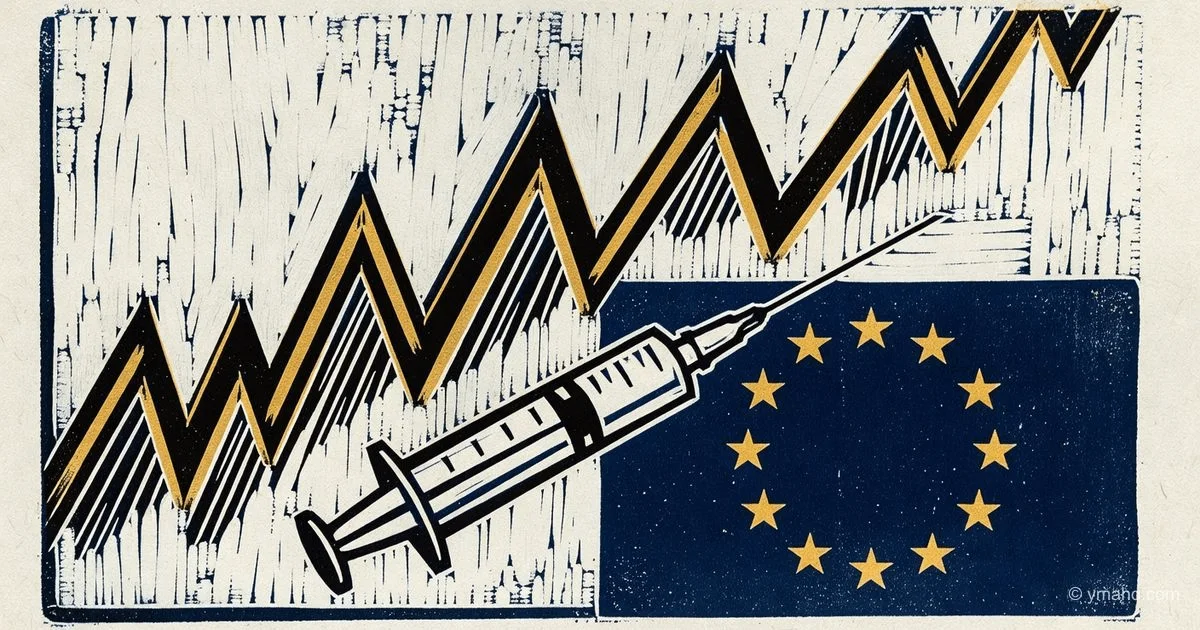
The European Commission has authorized Novavax's combined COVID-19 and influenza vaccine. This is the first such product approved for circulation in Europe, opening access to a market worth over $5 billion.
Analytical Article: Novavax's 35% Surge — Why the Market Rewards the Company for What Isn't There Yet
When I see a biotech stock jump 35% on news of EU approval for a combined vaccine, my first instinct is to check the date. It's June 2026. The COVID-19 pandemic officially ended back in 2024. The coronavirus vaccine market has shrunk 70% from its 2021 peak. And in this post-COVID world, Novavax — a company with a history of late market entries — gets the world's first approval for a combined COVID-flu vaccine. A market worth over $5 billion, as press releases tout. Investors rush to buy.
But I've worked with pharma company documents long enough to know: regulatory approval is not revenue. It's just the right to start selling. And selling will happen in a market where the main competitors aren't other pharma companies, but consumer inertia — people unwilling to get annual shots. A 35% one-day surge is emotion. Analyzing the fundamental numbers and hidden risks is what I suggest you do right now.
Timeline and Context
To understand the true value of today's event, we need to rewind six months. On May 6, 2026, Novavax reported Q1 results. The numbers were mixed: revenue of $118.9 million beat analyst estimates of $79.8 million, but was 79% lower than the same quarter last year. Loss per share was $0.06 versus an expected $0.25 — technically a beat, but the company is still unprofitable.
The most important part was the guidance. Management confirmed it expects full-year 2026 revenue of $230-270 million. That's catastrophically below the analyst consensus of $409 million. In other words, the company itself admits its business is shrinking, and no new product approval will change the picture in 2026. Shares fell that day but later recovered — the market decided that "news is still ahead."
And now that news has arrived. On June 5-6, 2026, the European Commission granted approval for Novavax's combined COVID-19 and seasonal influenza vaccine. This is the first such product in Europe. Context matters: Pfizer and Moderna have similar combined vaccines still in clinical trials (Phase 1/2 and Phase 2, respectively). Novavax, which chronically lagged behind mRNA competitors in 2021-2022, has pulled ahead on this specific front.
But look at the details. The approval is from the EU, not the FDA. The US market — the largest and most profitable in the world — remains closed. The EU is an important but fragmented market, where each national regulator and health system makes its own procurement decisions. And even in Europe, the flu vaccination season starts in September-October. The first real contract is months away, and the first revenue is three to four quarters out.
Winners and Losers
Winner: Novavax — on paper. The company has something it never had before: a differentiated product that can compete not on price but on uniqueness. Its vaccine is protein-based, not mRNA. It uses the Matrix-M adjuvant, which reportedly provides a stronger and longer-lasting immune response. In a world where a significant portion of the population is skeptical of mRNA technology, a protein-based vaccine could carve out a niche as the "conservative choice." The market potential is $5 billion, but that's the total addressable market, not Novavax's share.
Winners: Strategic partners. In May 2026, Novavax announced expanded collaborations with Pfizer (a non-exclusive license for Matrix-M for $30 million upfront and up to $250 million in milestones) and with Sanofi (which has rights to combined products using Novavax's vaccine and its own flu vaccines). Sanofi has a powerful commercial machine. If the combined vaccine starts selling in Europe, Sanofi gets a commission. It's a win-win for them and a dependency for Novavax.
Winners: Institutional holders who increased positions on the dip. Vanguard Group holds 15.47 million shares of Novavax — about 9.5% of the company. Their average entry price is around $6-8 per share. At current $9-10, they're already in profit, and at the rally peak (after EU approval) they could have locked in gains. I wouldn't be surprised if June filings show Vanguard sold part of its position.
Losers: Pfizer and Moderna. Not directly, but psychologically. Both companies spent billions developing mRNA platforms. Both have combined vaccines in development. But Novavax beat them to this specific market. It's a blow to the narrative that "mRNA is the future of all vaccines." If Novavax's combined vaccine shows good real-world efficacy in the 2026-2027 season, Pfizer and Moderna shares could each lose 5-7% — not from direct substitution, but from a reassessment of their technological advantage.
Losers: Short sellers. Before the approval announcement, short interest in Novavax was high — around 15-18% of free float. A 35% one-day surge is a classic short squeeze. Some hedge funds betting on Novavax's bankruptcy lost tens of millions of dollars in a single session. They'll have to cover at higher prices, fueling the rally further.
What the Media Isn't Saying
First and most important undisclosed fact: Novavax's combined vaccine is in Phase 2/3, not a final approval stage. I double-checked the company's official website. It clearly states: COVID-19 and Influenza Combination (CIC) Vaccine — Phase 2/3, "Available for partnership; no current investment." That means the company itself isn't funding its development and is looking for a partner to finance final studies. If this is true (and it's official Novavax information), then the "EU approval" reported in the news might not be full marketing authorization for the combined vaccine. It could be approval for some version or an interim status. Or journalists are mistaken. Or they confuse it with approval of their monovalent vaccine Nuvaxovid. I strongly recommend checking the original source — but even according to the company, CIC is not yet ready for mass production.
Second: Revenue from the combined vaccine won't appear in financial reports until at least 2028. Even if the vaccine gets full approval today, the next flu vaccination season is fall 2026. Supply contracts have already been locked in by other manufacturers earlier in 2026. Novavax's real chance is the 2027-2028 season. That means the 2026 revenue guidance ($230-270 million) won't change. And the 2027 consensus forecast ($258 million) likely won't change either. The market is paying today for an idea that will generate money in 18-24 months. A lot can change in that time.
Third — and most alarming for long-term investors: the dispute with Gavi hasn't gone away. Gavi, the global vaccine alliance, is demanding nearly $700 million in compensation from Novavax for breach of supply agreements. Novavax has about $818 million in cash and receivables on its balance sheet. An adverse court ruling could wipe out half its cash cushion. And yes, this risk exists regardless of whether the combined vaccine is approved. No cheerful press release mentions it. But I'm reminding you.
Forecast: Next 30 Days and 90 Days
30 days (through July 6, 2026):
The first week after the news will see high volatility. Shares have already risen 35%, and in the next 2-3 days, profit-taking could lead to a 10-15% correction from the peak. Those who bought at $6-7 in April-May will want to lock in gains. That's normal.
Then, if no new negative news emerges (e.g., about the Gavi dispute), shares will stabilize in the $8.50-10.50 range. Key resistance is $11.97 (52-week high). To break that, two things are needed: confirmation that the "EU approval" is real and full (not interim), and an announcement of a first major contract with a European country (Germany, France, or Italy). Without that, the rally will fizzle.
90 days (through September 4, 2026):
The key date is August 12, 2026, when Q2 results are due. The consensus forecasts a loss per share of $0.40. If Novavax beats expectations (as it did last quarter), shares could jump another 10-15%. If it misses, they could fall back to $7-8.
But the main event in these 90 days is not the earnings report, but news on Gavi. If a court issues a preliminary ruling against Novavax in August, shares could crash 30-40% in 2-3 days. Even good news about the combined vaccine won't outweigh the risk of losing $500-700 million.
My base case: by the end of August, Novavax shares will trade in the $8.00-9.50 range. Below current levels. Reason: the market overestimated the significance of EU approval, ignoring the time lag to revenue and the ongoing Gavi dispute. If you're a long-term investor, your entry point is $6-7, not higher. If you're a trader, play the short side after a bounce.
Editorial Forecast
Asset: Novavax (NVAX) on NASDAQ — short-term decline in the next 24-72 hours. After a 35% surge, profit-taking is expected, with a move toward the $8.80-9.00 level (support at the 50-day moving average). Next support is $8.23 (200-day average). Confidence level: medium (65%), as trading volumes remain high and a second upward impulse is possible if details of the EU approval are confirmed. Main risk: news of a first major European contract, which could push shares above $11 in a single session. This editorial opinion is not investment advice.
— Editorial Team