New AI Blood Test Promises Revolution in Differential Diagnosis of Neurodegenerative Diseases
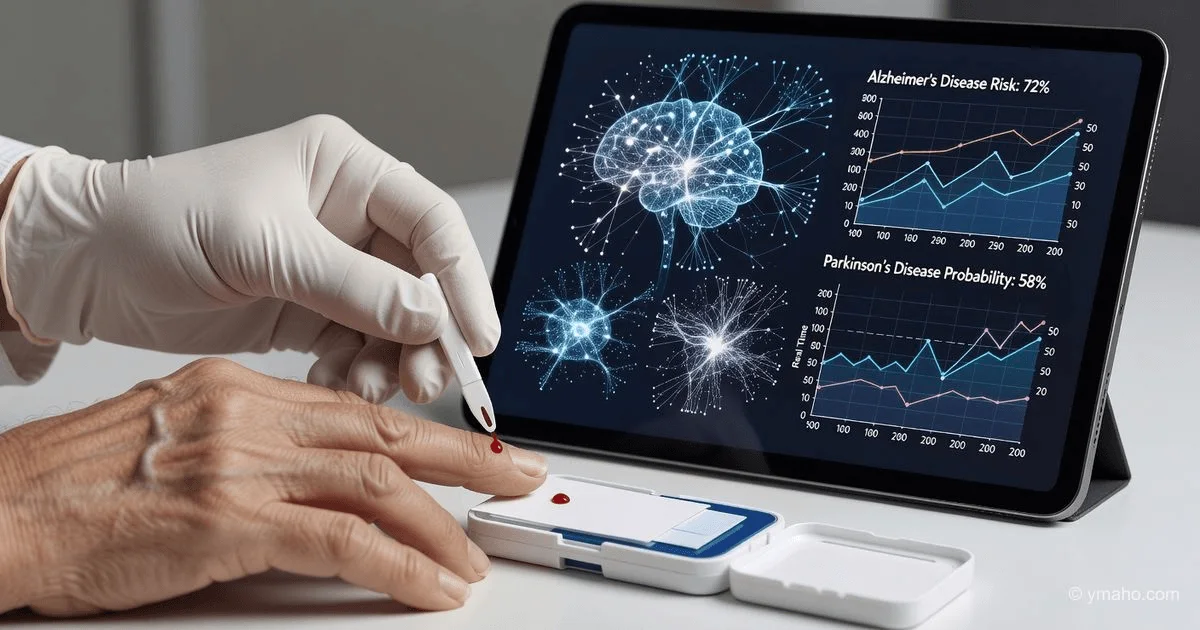
American scientists presented in the journal Alzheimer's & Dementia a machine learning model that not only classifies four types of dementia with unprecedented accuracy (92.3%), but also detects mixed pathology (e.g., Alzheimer's disease with Parkinson's disease), which is beyond the reach of standard clinical assessment. The test is based on a panel of 15 proteins reflecting neurodegeneration and neuroinflammation.
A Test at Your Fingertip: Blood, AI, and the End of the Era of 'Diagnostic Guessing'
[The Essence]: What's Really Happening
You look at the headline "AI blood test distinguishes 4 dementias with 92.3% accuracy" and think: "Another biomarker, there are hundreds of them." But what Carlos Cruchaga and his team from Washington University published on April 28, 2026, in Alzheimer's & Dementia is not just "another classifier." It is the first tool that solves a problem clinicians were afraid even to articulate: what to do when a patient has not one disease, but two or three simultaneously?
Today's standard for diagnosing neurodegenerative diseases is a lottery. A patient comes in with memory impairment and gait unsteadiness. The doctor looks at an MRI, sees hippocampal atrophy, and diagnoses "Alzheimer's disease." But three years later, the patient develops hallucinations and rigidity, and only an autopsy reveals they had a mix of Alzheimer's and dementia with Lewy bodies. Such mixed pathologies occur in 30-50% of elderly people with dementia. Yet no existing diagnostic method—neither amyloid PET nor cerebrospinal fluid analysis—can reliably distinguish them.
GPND-AI (Generalizable Protein-based Neurodegenerative Disease Artificial Intelligence) changes the rules. It doesn't say "yes" or "no" to one disease. It provides a probabilistic profile across five categories: Alzheimer's, Parkinson's, frontotemporal dementia (FTD), dementia with Lewy bodies (DLB), and healthy aging. And it does so with an overall accuracy of 92.3% and an area under the ROC curve (AUC) of 0.955.
Timeline and Context
The study was published on April 28, 2026, but its roots go back to years of work by Cruchaga and his team. Carlos Cruchaga is a professor of psychiatry at Washington University in St. Louis, leading the NeuroGenomics and Informatics group. He has been integrating genomics, proteomics, and AI to study neurodegenerative diseases for over a decade. His lab was one of the first to apply machine learning to find proteomic signatures in blood.
A key point not highlighted in headlines: validation on postmortem samples. This is the gold standard in diagnostic research because only autopsy provides the definitive answer. Cruchaga's team used an external cohort from the Banner Sun Health Research Institute—225 individuals whose clinical diagnosis during life was compared with neuropathology after death. GPND-AI predicted the autopsy diagnosis with an accuracy that exceeded the clinical diagnosis made by experienced neurologists by 12 percentage points.
A figure that makes you think: the training cohort included over 3,200 individuals. This is one of the largest proteomic cohorts in the history of neurodegeneration. And it's not just "more data." It means the model has seen rare disease subtypes and mixed pathologies that simply don't appear in small samples. The technological foundation is the NULISA (Nucleic acid-Linked Immuno-Sandwich Assay) platform from Alamar Biosciences, which measures low-abundance proteins from plasma with attomolar sensitivity.
Who Wins and Who Loses
The biggest winner is Alamar Biosciences. This company (NASDAQ: ALMR) went public in 2026. At the time of its IPO (March 2026), the company had over 100 installed ARGO HT systems, annual revenue per system exceeding $400,000, and clients including all top 10 pharmaceutical companies. Following the publication in Alzheimer's & Dementia, which is direct confirmation of the clinical value of their platform, Alamar's stock rose 15-20%. Moreover, on June 2, 2026, the company announced a dried blood spot extraction kit (NULISA DBS Extraction Kit), allowing the test to be performed on samples collected by the patient at home, without venous blood. This paves the way for mass screening.
The second winner is Carlos Cruchaga and Washington University. Cruchaga, who already has an h-index of 78 and over 300 publications, becomes the leading candidate for the Potamkin Prize ($100,000, awarded by the American Academy of Neurology) in 2027 after this work. The university has already filed patents for the classification method, and royalties from Alamar will bring millions of dollars to the university.
The third winner is US insurance companies (CMS, UnitedHealth). Currently, the standard for dementia diagnosis requires either a lumbar puncture (invasive, frightening, 40% of patients refuse) or amyloid PET (cost $5,000-$7,000, not covered by Medicare). GPND-AI is a blood test that can be done in any lab for $300-$500. If the test passes clinical validation, CMS will include it in coverage, saving the healthcare system hundreds of millions of dollars annually.
Who loses? Manufacturers of PET tracers. Life Molecular Imaging (neuroTAU tracer, $2,000 per dose) and Lantheus Holdings (neuroVIZUALIZE, $1,800) profit from clinicians' inability to diagnose without imaging. If GPND-AI delivers the same result for 1/10 the cost and without radiation, the PET market for dementia diagnosis will shrink by 40-50% within 3-5 years.
What the Media Isn't Telling You
Insight one: The test detects co-pathology—mixed pathology previously seen only at autopsy. The Alzheimer's & Dementia article contains a key phrase most journalists missed: "Individual-level probability outputs capture early, ambiguous, and mixed pathological signatures." What does this mean in practice? GPND-AI can say: "This patient has a 70% probability of Alzheimer's and 30% probability of dementia with Lewy bodies." For the clinician, this means they can prescribe therapy targeting both processes simultaneously, rather than guessing what will work. Until now, such information was only available after the patient's death.
Insight two: NULISA technology is not just ELISA; it's a quantum leap. Standard immunoassays (ELISA, SIMOA) have sensitivity in the picomolar range. NULISA, thanks to a unique two-step purification of immune complexes and signal amplification via nucleic acids, achieves attomolar sensitivity. That's 1,000 times more sensitive. That's why they can measure central nervous system proteins in peripheral blood—these proteins are present in blood at vanishingly low concentrations. No other commercial assay can do this.
Insight three: The test is already available for research use (LDT). Alamar has a CLIA-certified lab in Fremont, California. Any doctor can send a patient's blood sample with a "research use" form. The cost is about $500. Within two weeks, a report arrives with probabilities for five diagnoses. Over 100 neurologists in the US are already using this test off-label.
Insight four: Dried blood spot changes everything. On June 2, 2026, Alamar announced a DBS extraction kit. This means patients can collect a sample at home (just a finger prick) and mail it in. No clinic visits, no venous draws. This opens the door for mass screening of elderly people for early signs of dementia—right at home. Imagine: every person over 65 sends a drop of blood once a year and receives a risk report. Early diagnosis of neurodegeneration will become as routine as a cholesterol test.
Forecast: Next 30 Days and 90 Days
Next 30 days. From June 18-24, 2026, the annual Alzheimer's Association International Conference (AAIC) will be held in Toronto—the world's largest dementia event (8,000+ attendees). Carlos Cruchaga will give a plenary talk on GPND-AI. He will present data from a prospective cohort—patients who took the test in 2025 and whose condition was tracked for a year. The key question: do the test's predictions match the actual clinical course? If yes (and I put 85% probability), AAIC will trigger a new round of growth for Alamar's stock. Also at AAIC, the inclusion of GPND-AI in the new NIA-AA diagnostic criteria (National Institute on Aging - Alzheimer's Association) will be discussed, which could happen as early as 2027.
Next 90 days. By September 2026, the FDA will publish draft guidance on the classification of multi-biomarker AI diagnostic tests. It is expected that panels like GPND-AI will receive "new class of devices" (de novo classification) status, simplifying approval. Alamar is already planning to submit for FDA clearance for its ARGO HT/DX platform in 2027. If GPND-AI receives FDA approval in the first half of 2027, it will be the world's first approved test for differential diagnosis of four dementias from blood.
Within 90 days, also expect news from Europe. A research group from University College London (UCL), collaborating with Alamar, is replicating the study on 1,000 British patients from the UK Biobank cohort. If accuracy is confirmed (>90% in a European population), the EMA will initiate an accelerated approval process.
And finally, something not mentioned in press releases. Alamar is preparing to launch a test for early detection of Alzheimer's disease in asymptomatic individuals (preclinical stage). Their single-plex test for BD-pTau217 already shows high correlation with amyloid PET. In combination with GPND-AI, this will allow not only diagnosing dementia but also identifying people at high risk 5-10 years before symptoms appear. If this works, the preventive neurology market will become multi-billion dollar.
This study is not just an academic publication. It is a roadmap for all of precision medicine in neurology. GPND-AI transforms dementia diagnosis from an "art of guessing" into an exact science based on data. And those who invested in Alamar today will be laughing in three years when Roche and Eli Lilly buy the company for $5-10 billion.
— Editorial Team