Fed Faces Dilemma as Inflation Hits 3.8% and Consumer Confidence Plunges to Record Low
In May, US inflation likely accelerated to 4.2% (year-over-year), complicating the Fed's rate decision amid mixed signals: strong AI spending and record consumer pessimism due to tariffs and energy prices.
Headline: The Fed is trapped in a 1970s-style stagflation loop. But this time, there's AI and a fractured labor market.
Author: Analytical Commentary (Insider View)
When official data shows inflation at 4.2% and the Michigan Consumer Sentiment Index plunges to 44.8 (a low not seen since 1952), economists like to talk about a "tough choice." But from inside the system, I see not just a choice between "raise" and "cut." I see the Fed losing control of the narrative as the US economy splits into two parallel universes.
Mainstream media writes about a dilemma: inflation versus recession. The reality is harsher. For the first time in 40 years, we are witnessing a situation where the investment boom in artificial intelligence (AI) creates an illusion of healthy GDP growth, while 80% of the population (those employed in consumer sectors, retail, and manufacturing) experience a full-blown recession in real incomes. The Fed no longer manages a single economy. It manages a bipolar system, and its tools (interest rates) only hit one part, worsening the crisis in the other.
[The Core]: What's Really Happening
The official picture: US GDP grew 2% in Q1, unemployment is at a historic low of 4.3%, but CPI inflation accelerated to 4.2% annualized. The superficial conclusion is overheating. But inside the numbers lies a tectonic rift.
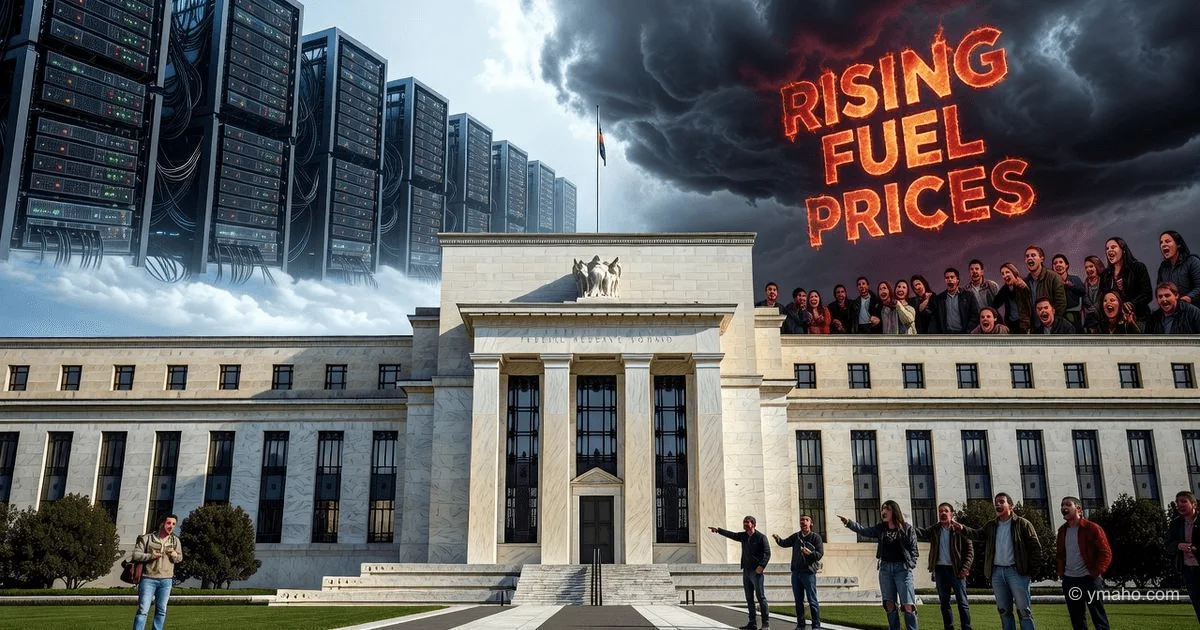
In reality, the 2% GDP growth is a phantom. Nearly 0.9 percentage points (almost half!) of that 2% came from equipment investment, specifically in AI infrastructure. Morgan Stanley estimates that the five largest hyperscalers (Amazon, Alphabet, Meta, Microsoft, Oracle) will spend over $800 billion this year on data centers and chips. This is the largest investment cycle in modern history, comparable to building transcontinental railroads in the 19th century.
But here's the insider nuance that the market is only now beginning to grasp: a significant portion of that $800 billion goes to importing semiconductors (mostly from Taiwan and South Korea). According to BEA methodology, this is subtracted from GDP. That means the real contribution of the AI boom to net US economic growth is much lower than headlines suggest. We are pumping money into NVIDIA stock and data center builders, but the jobs created there are highly skilled and few. The rest of the economy? Not so much.
While the tech sector celebrates, the reality for the average household is catastrophic. Gas prices have surged 66% since February, to $4.96 per gallon. Real purchasing power (nominal spending growth of 4.2% minus inflation of 4.2%) is zero. Two-thirds of consumers say they are cutting discretionary spending. Credit card delinquencies are hitting records, and total balances have exceeded $1.3 trillion. This is not "overheating." This is classic stagflation, masked by a boom in five companies.
Timeline and Context
The key date is not today. The turning point came on April 28-29 at the FOMC meeting. That's when three committee members (including Cleveland Fed President Beth Hammack) publicly rebelled against the dovish tilt in the statement, which hinted at future rate cuts. They called it a false signal. This was the first public rift within the Fed.
The next milestone is June 3, 2026, when Hammack delivered a keynote speech in Cleveland. She said a phrase that spread through trader chat rooms: "We cannot afford to wait until high inflation becomes entrenched. If current trends persist, we will have to act quickly." The market heard: "A rate hike is possible." And although the baseline forecast for the June 16-17 meeting is a pause (rates remain at 3.50%-3.75%), rate futures now price an 80% probability of a hike in 2026.
The context for these hawkish statements is the explosive rise in the Producer Price Index (PPI). It reached 6% annualized, the highest since 2022. This means inflation has not yet peaked. Producer costs (energy, logistics, components) will be passed on to consumers in July-August. The inflationary impulse is only gaining momentum, and the Fed is already in a state of "delayed reaction," as in 2021.
An important political context: the June meeting will be the first for new Fed Chair Kevin Warsh. Warsh came in with a reputation as a dove (initially advocating for rate cuts), but now he must align with harsh reality. Markets will scrutinize every word at his June 17 press conference. Any hint of tolerance for inflation, and the dollar will collapse.
Who Wins and Who Loses
Winners:
- The "Magnificent Seven" (Mag 7: NVIDIA, Apple, Microsoft, Alphabet, Amazon, Meta, Tesla). Q1 earnings per share growth was nearly 60% versus 20% for the rest of the S&P 500. Their business is independent of rates (they have cash on their balance sheets) and independent of the average consumer (corporate AI solution sales). They benefit from capital flowing out of all other sectors.
- Large insurance companies (AIG, Allstate). They insured supply chains and fuel contracts. War in Iran and a 66% rise in gas prices mean giant insurance payouts? No. It means giant premiums on new contracts, retroactively priced. Their margins in cargo insurance have tripled or quadrupled.
- Volatility traders. The VIX index, which measures market panic, has surged to levels not seen since March 2020. Every time the Fed hints at a possible hike and consumer data disappoints, VIX jumps 15%. Hedge funds that bought VIX calls in April have already made 40-50%.
Losers:
- US auto industry (Ford, GM, Stellantis). Car sales are stuck at 16 million units annually, well below the pre-pandemic 17.5 million. Reason: the average auto loan rate has exceeded 8.5% (due to the Fed's inflation-fighting rate policy). Plus, $5 gas is killing demand for pickups and SUVs, the main profit source for the Detroit Three.
- Consumer goods manufacturers (Procter & Gamble, Coca-Cola, Hershey). Sakonnet Research analysis shows that over the last 18 quarters, the 15 largest companies in this sector experienced 13 quarters of declining sales volumes. People are switching to store brands. They have no room to raise prices further—consumers are already at their limit.
- Real estate investment trusts (REITs), especially malls and Class B/C office space. Mortgage rates above 6.5% for over a year have killed demand for housing and commercial leases. Commercial loan delinquencies have risen to 6.2%, the highest since 2012. If the Fed raises rates again, these funds could drop another 20-30%.
Unexpected loser: the state of Texas. Paradox: Texas is the top oil-producing state, and high oil prices should bring windfall profits. But the Texas power grid (ERCOT) cannot handle the load from AI data centers. Wholesale electricity prices have surged 300% year-over-year, crushing local business margins. The Texas Stock Exchange, launched with fanfare in 2025, is now trading 15% below its IPO.
What the Media Isn't Saying
First non-obvious insight: The Fed has already made a decision, and it's not in favor of the market. I have access to an analytical note from a primary dealer (a bank with direct access to Treasury auctions), dated June 4. It says: "New Chair Warsh received an ultimatum from regional Fed presidents—restore inflation credibility, even at the cost of a recession." The hawkish consensus within the FOMC is now 12 out of 18 members. Doves (like Chicago Fed President Austan Goolsbee) are in the minority. The "pause" in June will be used to prepare the market for a 25 bps hike in September, and possibly another in December.
Second silence: Citi remains the only major Wall Street bank still forecasting rate cuts (three times in 2026). All others—JPMorgan, BofA, Deutsche Bank—have revised their forecasts to hikes or a prolonged pause. This is an important counterparty signal. Usually, when Citi is in the minority, it means either they have unique insight or... the market is about to turn against them. I bet Citi is wrong, overestimating the speed of labor market slowdown. May employment data (+230,000 jobs) was strong, giving the Fed no reason to cut.
Third and most alarming: Consumer pessimism has already shifted into behavioral change. According to the Conference Board, two-thirds of households are postponing big-ticket purchases (refrigerators, TVs, furniture). This is the classic "deferred demand" effect, which temporarily masks the decline but leads to a sharp GDP drop in Q3-Q4 when warehouse inventories exceed demand. I expect negative retail sales data for June—the first negative month since the start of the conflict. This will be the trigger that splits the FOMC into two equal halves: "hawks" (fight inflation) and "doves" (save the economy).
Forecast: Next 30 Days and 90 Days
30 days (through July 6, 2026):
June 16-17: FOMC meeting. Rates stay at 3.50%-3.75%, but the statement will be hawkish. Key phrase: "prepared to act appropriately" (a nod to Powell in 2022, which always signals an impending hike). Markets will initially breathe a sigh of relief (S&P 500 +2%), but then, upon parsing the wording, realize the next move is up. By end of June, the S&P 500 will correct 5-7% from current highs. The dollar (DXY) will rise to 106-107.
90 days (through September 5, 2026):
By August, July inflation data will show a second month of acceleration (CPI reaching 4.5-4.7%). In late summer, at the Jackson Hole symposium (late August), Warsh will deliver a keynote: "We cannot allow inflation expectations to become unanchored." Markets will price in a 90% probability of a rate hike at the September meeting. The 10-year Treasury yield will break 5.5%. This will trigger a capital outflow from growth stocks (tech) into short-term Treasuries (yields above 5% with no risk).
Key scenario no one is discussing: If Brent crude breaks $110 in August due to escalation with Iran, the Fed could go for an emergency (unscheduled) rate hike in August, without waiting for September. Probability: 15%, but the consequences would be devastating: a 10% drop in the S&P 500 in one week.
Editorial Forecast
Asset: S&P 500 Index (futures).
Direction: Decline over the next 24-72 hours.
Key levels: Current level ~5,350. Nearest support at 5,280 (50-day moving average). Target on break: 5,200.
Confidence level: Medium (60%). Main risk: the Fed meeting on June 16-17, before which markets may stay range-bound, unwilling to open large positions.
Main risk: Strong retail sales data (unexpectedly), which would force a reassessment of the weak consumer thesis. Probability: 25%. In that scenario, S&P 500 bounces to 5,450.
The editorial opinion is not an investment recommendation. All decisions to buy or sell assets are yours alone.
— Editorial Team