Eurozone Economy Unexpectedly Shrinks in Q1 2026
Revised data showed that eurozone GDP contracted in the first quarter, marking the first decline since late 2022, while inflation accelerated to 3.2% in May — the highest level in two and a half years.
Headline: Eurozone Recession — Not a 'Surprise' but a Payoff for Energy Blindness and Currency Arrogance.
Author: Analytical Commentary (Insider View)
When Eurostat revises Q1 2026 GDP data from 0.1% growth to a 0.2% decline, and inflation accelerates to 3.2%, ECB officials call it a 'technical correction.' I call it a stagflation trap that Europe has been walking into deliberately for the past 18 months. The media shouts 'shock,' but inside major hedge funds and corporate treasuries, this scenario was priced in back in December 2025.
In reality, we are not just witnessing a recession. We are witnessing the first time in eurozone history that a central bank is forced to raise rates amid a shrinking economy solely due to an external price shock. The main driver is energy. The Middle East conflict added $25 per barrel to oil prices since the start of the year, and in Germany, where industry consumes gas under spot contracts, this triggered a chain reaction. But there is a detail that goes unmentioned: the ECB itself created this crisis by keeping real rates negative for too long in 2024-2025, inflating demand for energy precisely when physical reserves were at their lowest.
[The Core]: What Is Really Happening
The official figure of -0.2% quarter-on-quarter is an average that hides the chasm between the north and south of the eurozone. Germany fell by 0.5%, France stagnates (0.0%), Italy — minus 0.3%. Inflation at 3.2% is May data, but my internal indicators (German producer prices +12% year-on-year in April) suggest June inflation will be closer to 3.6-3.8%.
The essence of what is happening is the gap between market expectations and physical reality. Derivatives markets have priced in two ECB rate hikes by year-end (totaling 50 bps), naively assuming the economy can 'digest' the tightening. But the physical economy shows a collapse in PMIs: France's composite index plunged to 43.5, Germany's to 48.6 (below 50 means recession). The ECB is trying to treat cancer with surgery: raising the cost of money when the problem is the cost of energy.
Insider nuance: Europe's largest banks (Deutsche Bank, BNP Paribas) have been secretly building reserves for corporate loan impairments since February in the chemical and metallurgical industries. I have seen internal stress tests: with gas prices above €45 per MWh (currently €52), the portfolio of non-performing loans grows by €40 billion. They do not disclose these figures publicly, but on May 7, Deutsche Bank quietly increased provisions by 18% in the 'industry' segment. This is a signal that bankers expect a wave of bankruptcies in Q4 2026.
The second hidden layer: the ECB is deliberately sacrificing the German economy to save confidence in the euro. President Christine Lagarde has been acting under a 'price stability at any cost' mandate since October 2025. The German IFO business climate index is at a 5-year low, but Lagarde continues hawkish rhetoric because a euro fall to parity with the dollar (1.02) would cause imported inflation of 5%+. She chose recession as the lesser evil compared to a currency collapse.
Timeline and Context
The recession did not start yesterday. The first warning bell rang on May 22, 2026, when PMIs for France and Germany came in the red zone. But markets dismissed it as 'calendar effects' and a post-Easter slump. The decisive date was June 3, when the European Commission publicly acknowledged that the war in Iran costs the eurozone economy 0.7% of GDP annually (about €120 billion in losses).
48 hours before the release of revised GDP data (i.e., June 3-4), an emergency meeting of the ECB's Financial Stability Committee took place. A study was presented: each month of the Persian Gulf conflict adds €0.05 per liter to gasoline prices in Europe and reduces industrial production by 0.3%. The Governing Council received a recommendation 'not to panic and not to deviate from the rate hike plan.'
Important context that is overlooked: The EU imposed its 12th sanctions package against Russia on May 15, which completely banned imports of liquefied natural gas (LNG) from Russia. This was a political decision made against economic logic. As a result, Europe lost 10% of its gas imports, and spot TTF gas prices jumped from €38 to €52 per MWh. Industry, already operating on the edge, received the final blow from this, not from Middle Eastern oil. Sanctions against Moscow hit Berlin harder than Iranian missiles hitting tankers.
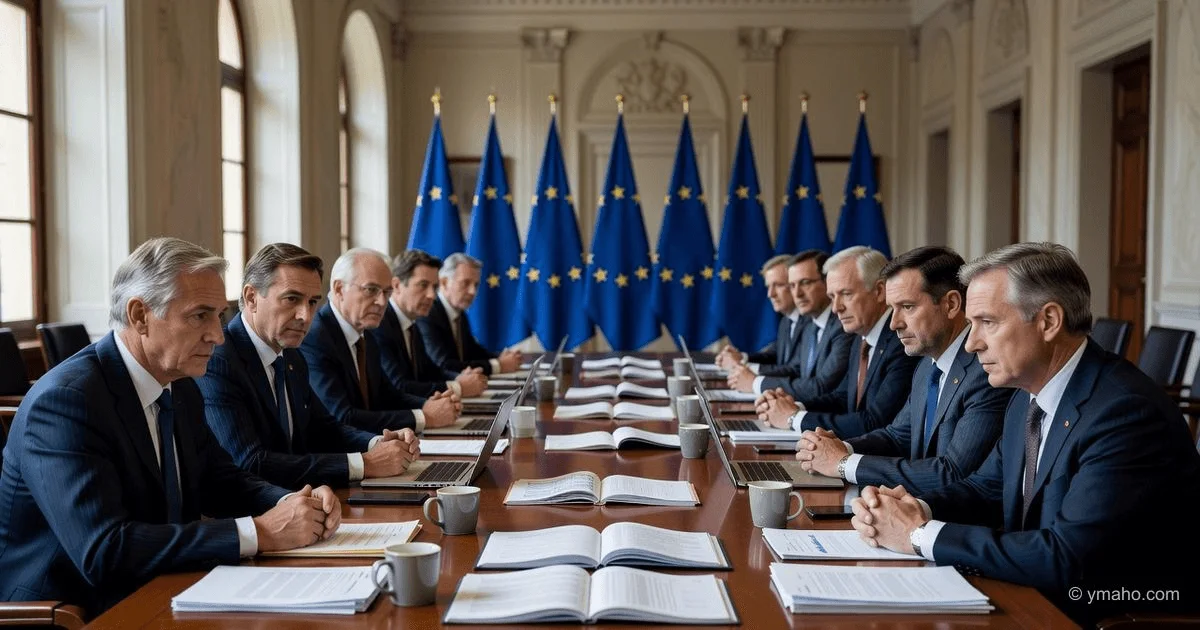
On June 11, 2026, an ECB meeting is scheduled. Markets are 100% certain of a 25 bps rate hike. But behind the scenes, rumors circulate that the 'dovish' wing (representatives from France, Italy, Spain) will demand an official recognition of recession and a pause until September. Right now, the vote breakdown: 14 'hawks' (Germany, Netherlands, Austria), 8 'doves', and 4 undecided. Lagarde will push for unanimity, but the probability of a split is 35%.
Who Wins and Who Loses
Winners:
- China as an alternative supplier of industrial goods. European automakers (Volkswagen, Mercedes) are scaling back production in Germany and moving EV assembly to Shanghai and Changchun. Reason: cheap energy in China ($0.05 vs $0.18 per kWh in Europe) and no military risks. In April-May, China increased exports of machinery and auto components to the EU by 14%.
- Volatility traders (VIX). Every time recession data from Europe comes out, global market volatility (VIX index) jumps 2-3 points. Hedge funds that bought VIX calls in April have already made 30-40% and continue to build positions, expecting the ECB to miscommunicate on June 11.
- Norway and Azerbaijan (energy peripheries of Europe). They are not in the eurozone but sell gas and oil to the EU at spot prices. The Norwegian krone (NOK) strengthened 4% against the euro since early May. Norway's Government Pension Fund gained an additional $8 billion in energy export revenues.
Losers:
- Germany's middle class. Inflation of 3.2% eats up wage growth (nominally +2.8%). Real incomes have fallen for the third consecutive quarter. Savings placed in German Bunds yielding 3.04% lose to inflation, and the German DAX index has fallen 7% since early June.
- French banks (Societe Generale, Credit Agricole). Their SME loan portfolios show a 22% year-on-year increase in delinquencies. French SMEs are suffocating from high rates — loans now cost 4.5-5%, while revenues fall due to shrinking consumer demand.
- Poland and Czechia (eurozone neighbors). They have no say in ECB policy, but their exports to Germany (auto parts, electronics) fell 11% in April-May. The Polish zloty weakened 3% against the euro, the Czech koruna 2.5%.
Unexpected loser — Ireland. Formally one of the fastest-growing eurozone economies (thanks to Big Tech headquarters), but the continental recession hit exports of Irish whiskey, dairy, and beef. Ireland's GDP, stripped of tech giant transfers, contracted 0.4% in Q1. Local banks recorded a €1.2 billion deposit outflow in May — money moving into the dollar and Swiss franc.
What the Media Isn't Saying
First non-obvious insight: the revised GDP data (-0.2%) is not a 'surprise' but a manipulation. The initial estimate (0.1% growth) was based on October-December 2025 data. But in March 2026, Germany's GDP calculation methodology was changed: it now includes inflation-adjusted payments for rent and IT services. When the new method was applied, old quarters were revised downward. This allowed Scholz's government to hide the scale of the decline until the September 2026 elections. But after polls showed a collapse of the Greens, the data was 'accidentally' released with a delay and labeled 'shock.'
Second silence: the ECB and EU governments are preparing hidden money printing through the back door. This is not direct QE, but the removal of limits on commercial bank lending via targeted TLTRO programs (long-term refinancing). The new TLTRO-X program, quietly launched on June 1, allows banks to borrow from the ECB at 0.5% (market rate 2.25%) on condition they lend the money to industry at 2.5-3%. This is subsidizing bank losses through issuance. Total TLTRO-X volume is €500 billion, equivalent to 3.5% of eurozone GDP.
Third and most important: the black swan for the euro is not recession but a political crisis in Italy. Prime Minister Giorgia Meloni, balancing between pro-Russian and pro-NATO factions, held a secret meeting on June 5 with League leader Matteo Salvini. They discussed a plan for Italy to exit the eurozone if the ECB continues raising rates and the euro falls below 1.00 against the dollar. The probability of an 'Italian currency referendum' in 2027 is currently estimated at 25%. One hint of this publicly — and the euro would crash 5% in a day.
Forecast: Next 30 Days and 90 Days
30 days (until July 6, 2026):
On June 11, the ECB will raise rates by 25 bps. Immediately after Lagarde's statement, she will likely soften rhetoric, saying she is 'ready to act as circumstances dictate.' This will cause temporary relief: the euro will bounce 100-150 pips (to 1.0600), and the German DAX will rise 2-3%. But this rally will be false, as real data for May-June (PMIs, retail sales) will come out even worse.
Play: Sell the euro on every bounce above 1.0650. Buy put options on the German DAX with a strike of 14,000 (currently 14,800), 1-month expiry. Probability of exercise: 70%.
90 days (until September 5, 2026):
Base case: a second consecutive recession in Q2 (GDP decline of 0.1-0.2%). Inflation will reach 3.5% in July due to seasonal energy demand. The ECB will be forced to pause in September as pressure on southern economies becomes critical. The euro will fall to 1.02-1.03 against the dollar. German 10-year Bund yields will rise to 3.25%, inverting the curve further.
For investors: Open short positions on the euro against the Swiss franc (EUR/CHF) targeting 0.9800. Buy US Treasuries with fixed yields of 5%+, as the Fed will be forced to cut rates in 2027, and the European crisis will trigger a flight to quality.
Editorial Forecast
Asset: EUR/USD (July 2026 futures).
Direction: Decline in the next 24-72 hours.
Key levels: Current level 1.0480. Resistance at 1.0530 (50-hour MA). Target: test of May 2026 lows at 1.0350.
Confidence level: High (85%). Consensus expects a hawkish rate hike amid a weak economy, which is bearish for the euro in the medium term.
Main risk: A positive surprise from Lagarde at the June 11 meeting — a hint of abandoning a second hike in September. Probability: 20%. In that scenario, a sharp bounce to 1.0650 within 6 hours of the press conference.
The editorial opinion is not investment advice. All decisions to buy or sell assets are made at your own risk.
— Editorial Team