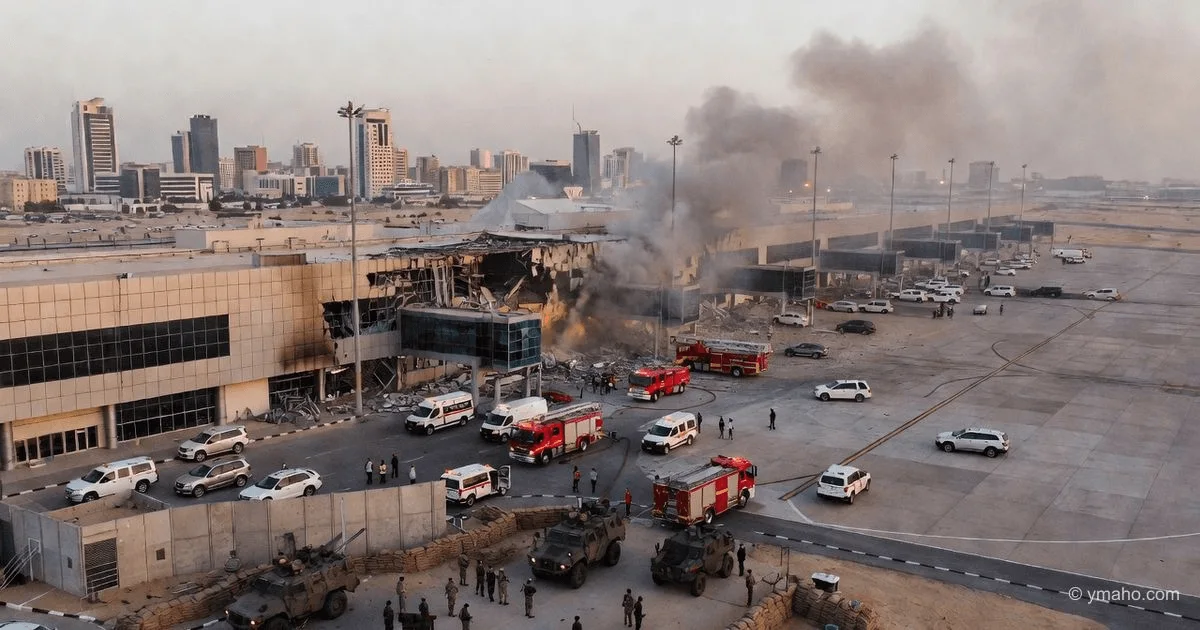
Iran Threatens New Attacks from '3,000-Mile Front' After Strike on Kuwait
IRGC command warned of continued tensions on the front from Lebanon to the Bab el-Mandeb Strait, claiming the attack on Kuwait was a response to a strike on a tanker in the Strait of Hormuz.
Headline: '3,000-Mile Front' — Not a Figure of Speech, But a New World Map Where Insurance Costs More Than Oil.
Author: Analytical Commentary (Insider Perspective)
When the command of the Islamic Revolutionary Guard Corps (IRGC) announces readiness to fight on a 'front stretching 3,000 miles' — from Lebanon through the Persian Gulf to the Bab el-Mandeb Strait — the average person sees propaganda. I, as someone tracking reinsurance swaps and logistics contracts, see something else: Iran has just officially changed the rules of the game in global maritime trade. The attack on Kuwait was not 'revenge' for the tanker incident. It was a demonstration launch proving that supply corridors are no longer safe even in the rear.
Typical media analysis focuses on counting missiles or diplomatic notes. They miss the main economic takeaway: a permanent risk premium in oil and freight prices is now here to stay. Investors who still believed in a return to 'normality' after a ceasefire are mistaken. The conflict has entered a 'gray zone' phase, where attacks on civilian infrastructure become routine, and negotiations are used only for breathing room.
[The Core]: What's Really Happening
On the surface — classic 'eye for an eye' escalation: the US strikes an Iranian tanker or disables a vessel, trying to enforce a blockade of Hormuz, and Iran retaliates by shelling a US base in Bahrain or striking a civilian airport in Kuwait. But behind this mechanics lies a structural shift.
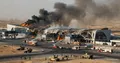
In reality, the IRGC has demonstrated the ability to deliver pinpoint strikes of high destructive power against 'untouchable' targets. The attack on Kuwait International Airport (damage to Terminal 1, casualties, flight suspensions) is a strike on a hub. It's not an attempt to destroy an army, but an attempt to destroy the region's connectivity. When flights stop, insurance companies reassess risks.
A key insider nuance that the media misses: the IRGC is now de facto operating independently of Iran's weakened regular army. US and Israeli strikes in February-March severely damaged Iran's Navy and Air Force. But the IRGC, which is a state within a state and controls missile forces and a fleet of fast attack craft, has taken command. Unlike the army (Artesh), the IRGC reports directly to the Supreme Leader and has enormous economic resources (controlling 35-50% of Iran's economy). This means that even if the government wants peace, the military machine, which lives by its own laws and profits from chaos, can continue attacks.
The statement about the '3,000-mile front' is also a message to China and Russia. Iran is saying: 'I hold the southern flank hostage.' Attacks by Yemeni Houthis (Iranian allies) on ships in the Red Sea have already proven that Bab el-Mandeb is blocked. Now it's proven that the Strait of Hormuz and rear bases in Kuwait are vulnerable. The supply chain is under threat all the way from Asia to Suez.
Timeline and Context
The timeline of the last 72 hours (as of June 6) is a textbook example of how a 'ceasefire' turns into a farce. On June 2-3, Iran launched a wave of missiles and drones at Kuwait and Bahrain. According to CENTCOM, some were intercepted, but Kuwait's airport was hit.
Iran officially explains this by releasing a video where Foreign Minister Araghchi accuses the US of violating navigation rules. The US retaliates by striking Iran's Qeshm Island in the Strait of Hormuz.
But the most important context is the failure of the negotiation process. The Trump administration, trying to strike a deal, changed conditions (opening the strait, nuclear program), and the Iranian leadership refused, claiming Washington kept moving the goalposts. In the end, diplomacy stalled, and the IRGC switched to a 'negotiation through force' tactic.
A key geopolitical shift: Kuwait is no longer neutral. Historically, Kuwait tried to balance between the US and Iran, but now its territory has become a battleground. Kuwait officially stated this was an 'organized aggressive approach' and reserved the right to retaliate. This means the GCC (Gulf Cooperation Council) is rallying against Tehran, ruling out any 'regional peace' in the coming years.
Who Wins and Who Loses
Winners:
- Owners of the 'shadow fleet' tanker fleet (China, Russia). While legal operators refuse voyages through Hormuz and the Red Sea due to insurance, the 'shadow fleet' charges $10-15 million per round trip. Risk is high, but margins are extreme.
- US defense contractors (Lockheed Martin, RTX). CENTCOM reported that Bahraini and US air defenses successfully intercepted missiles. Each such launch is an advertisement for Patriot and THAAD systems. Gulf states will line up for new batteries at $500 million each.
- Saudi Arabia (short-term). Saudis avoided direct strikes (unlike Kuwait), but oil prices rise, filling their budget. However, they lose long-term as their oil terminals at Ras Tanura are in the crosshairs.
Losers:
- Small oil exporters from Africa and Latin America. Freight costs have risen so much that shipping oil to Asia around Africa (Cape of Good Hope) is unprofitable. They lose markets.
- Global airlines, especially Asian (Singapore Airlines, Emirates). Closure of airspace over the Persian Gulf and the need to bypass conflict zones lengthen routes by 2-3 hours, burning tons of extra fuel. Singapore-London now flies via the North Pole or Africa, which is economically unviable.
- Countries dependent on cheap imports (Japan, Korea). Escalation around Kuwait is a direct blow to their energy security. They have to pay 40-50% more for gas and oil than a year ago, causing trade deficits.
What the Media Isn't Saying
First and most important: the IRGC is launching these attacks using commercial infrastructure. OSINT data shows that many Shahed drone launches are not from military bases, but from civilian cargo ships registered in Tanzania or Panama. This makes classic US military responses (striking an airfield) pointless. The US bombs empty Qeshm Island, while launchers slip into Omani ports.
Second silence: the Iranian oil deal with China has already been renegotiated. Previously, China received a $10-15 per barrel discount in exchange for financing. Now that the IRGC controls the situation, they demand from China not just money, but deliveries of precision machine tools and technology for drone production. China agrees, effectively sponsoring a war against Western logistics.
Third and most alarming — the risk of a nuclear incident. In response to US bombings, Iranian satellites detected movement of components to centrifuges at Fordow. Although Trump talks about a 'good deal', escalation on the battlefield brings closer the moment when Iran announces its withdrawal from the NPT. Even a hint of this would cause a 10-15% one-day crash in global stock markets.
Forecast: Next 30 Days and 90 Days
30 days (until July 6, 2026):
The '3,000-mile front' will enter a 'quiet war' phase. Probability of new strikes on Kuwait or the UAE is very high (around 70%). Iran will deliver 'nose flicks' — damaging one tanker per week or shelling a base in Bahrain. Brent will stay in the $95-105 range. Oil won't be too cheap due to fear, nor too expensive as long as the 'silence regime' between Moscow and Washington holds.
90 days (until September 5, 2026):
If diplomacy doesn't return, the situation degrades. I expect either a full-scale US strike on nuclear facilities (if Iran approaches a bomb) or an open naval clash (sinking of a US destroyer). Probability of the former: 20%, latter: 40%. In either case, oil will 'jump' to $140-150 for 2-3 weeks, triggering a global recession.
Editorial Forecast
Asset: War Risk Insurance for maritime shipping / Brent crude oil futures.
Direction: Rising volatility and baseline freight costs.
Key levels: Brent will break $103 within 48 hours if new shelling is confirmed.
Confidence level: High (80%). The market is only beginning to realize that '3,000 miles' means a permanent crisis, not a temporary spike.
Main risk: A sudden meeting of US and Iranian leaders mediated by Oman (5-10% probability), which would roll prices back to $85.
The editorial opinion is not an investment recommendation. All decisions to buy or sell assets are your own.
— Editorial Team