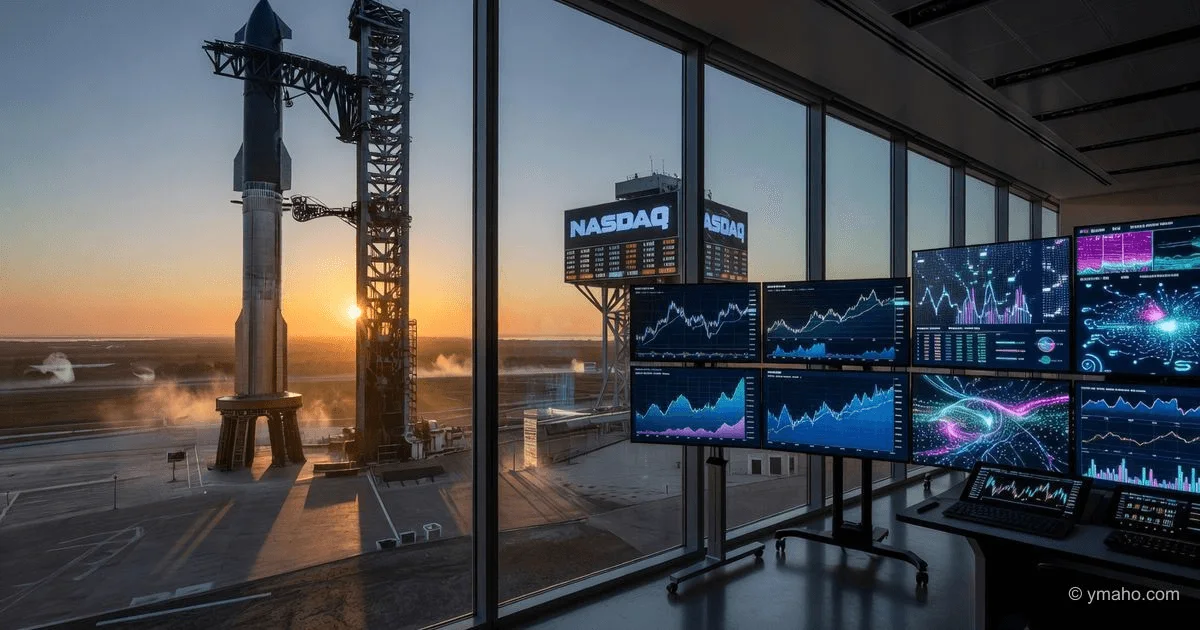
SpaceX Prepares for the Largest IPO in History Amid AI Company Valuation Boom
SpaceX is expected to conduct an initial public offering that could be record-breaking in size, as the company's valuation approaches $1.8 trillion amid the ongoing boom in AI investments and capital construction.
Headline: SpaceX's $1.8 Trillion Valuation Is Not a Bet on Space, but the Most Expensive Lottery in Wall Street History.
Author: Analytical Commentary (Insider View)
When traditional media write that SpaceX is preparing for an IPO that could be the largest in history, they usually focus on the numbers: $75 billion raised, a valuation of about $1.8 trillion, $135 per share, and a launch date of June 12, 2026. This sounds like another triumph for Elon Musk.
But as someone tracking the flow of smart money and real multiples, I see something different. In fact, the upcoming SpaceX IPO is not a confirmation of business genius, but the biggest stress test for the artificial intelligence (AI) bubble. The company no longer wants to be valued as a "rocket" or "telecommunications" company. In its prospectus, $26.5 trillion of the $28.5 trillion addressable market is attributed to AI. This turns SpaceX into a financial instrument for betting on the future, not on current profits.
[The Essence]: What Is Really Happening
The public narrative says: SpaceX is a company that revolutionized the space industry, created the profitable satellite internet Starlink, and is now conquering AI.
But the reality hidden in the S-1 prospectus is shocking. In 2025, SpaceX's revenue was $18.7 billion. However, its net operating loss reached $2.6 billion. The year before, the company was profitable. What happened? SpaceX acquired xAI for $250 billion. This acquisition brought losses of $6.4 billion in 2025 alone and another $2.5 billion in the first quarter of 2026.
An insider nuance that doesn't make the front pages: SpaceX currently has only one profitable segment—Starlink. It generated $11.4 billion in revenue and $4.4 billion in operating profit. The rocket segment (the company's historic pride) is unprofitable (a loss of $657 million), and the AI segment is a black hole, burning $12 billion in capital expenditures per year.
Thus, an investor buying SpaceX shares gets the following "package": you get a mature telecom business with satellites (which by itself would never be worth $1.8 trillion), to which is attached a loss-making rocket business and a giant pig in a poke—an AI lab that has yet to prove its viability. Essentially, $1.8 trillion is a bet that SpaceX's AI division (Grok, etc.) will become the next Google, and its "orbital data centers" will become a reality.
Timeline and Context
The machine promoting this IPO was set in motion several months ago, but key events are unfolding right now.
Key Date #1: Mid-May 2026. SpaceX files a preliminary prospectus (S-1), revealing its "alchemy" to the world for the first time. The market's initial reaction is shock at the numbers. A valuation of $1.8 trillion (initially targeting $2 trillion) with a P/S ratio (market cap to revenue) of about 96—this is a cosmic multiple that only Palantir has.
Key Date #2: June 3-4, 2026. SpaceX holds a roadshow, convincing investors that they are not just buying shares of an aerospace company. They are buying exclusive access to the "largest addressable market in human history" worth $28.5 trillion, where the lion's share is AI.
Key Date #3: June 6, 2026 (today). It becomes known that the IPO is oversubscribed by two times. Demand is about $150 billion. This means all available shares are already booked by large institutional players (pension funds, hedge funds, sovereign wealth funds) who are afraid of missing out.
Final Date: June 12, 2026. On this day, SpaceX shares will begin trading on NASDAQ under the ticker SPCX. And just 15 trading days later (!!!—unprecedentedly fast), they will be included in the Nasdaq 100, forcing ETF funds to buy another 10-15% of shares, regardless of their actual value.
Who Wins and Who Loses
Winners:
- Elon Musk. He will retain 82% of voting shares. The IPO will allow him to raise $75 billion in capital for the company without selling his control. Moreover, part of this money will likely go to finance his other projects through intra-company loans (as was the case with Tesla and xAI, which already bought $2.69 billion worth of batteries from Tesla).
- Early investors and employees. They will be able to monetize their options. For many ordinary SpaceX engineers who received shares at $10-20, the price of $135 is a fantastic exit.
- Speculative traders. The huge hype around the IPO, oversubscription, and guaranteed index inclusion ensure high volatility in the first days. For those who buy on dips and sell on hype, it's a goldmine. Especially considering that 5% of shares are reserved for employees, who may want to sell them immediately after listing, creating a local drop.
Losers:
- Retail investors who enter the deal at $135. Morningstar analysts and New York University professor Aswath Damodaran estimate SpaceX's fair value at $780 billion and $1.3 trillion, respectively. Buying at $135 means overpaying by 30% to 100%. This is a classic "listing trap."
- Space competitors (Rocket Lab, AST SpaceMobile). SpaceX's success will attract even more capital to the sector, but also strengthen Musk's dominance. Moreover, anticipation of the SpaceX IPO has already driven up competitors' stocks, and disappointment may follow after the event ("buy the rumor, sell the fact").
- Shareholders of blue chips (Apple, Microsoft). A giant $75 billion IPO is a "vacuum cleaner" that sucks liquidity out of the market. To pay for SpaceX shares, institutional investors will be forced to sell other, more liquid assets (e.g., Big Tech stocks), creating short-term pressure on the S&P 500 and Nasdaq indices.
What the Media Isn't Saying
The first non-obvious insight: this IPO could trigger the bursting of the AI bubble. SpaceX is a "real company" that doesn't generate billions in AI profits like Nvidia, but burns them. If after a public quarterly report investors see that xAI's losses are growing, and competitors (OpenAI, Anthropic) remain private and unaccountable to the market, a sell-off across the sector will follow. SpaceX will become the "canary in the coal mine" for the entire AI market.
Second silence: harsh criticism of the "orbital data center" model. SpaceX promises to build computing power in space to solve Earth's energy shortage. However, experts call this "marketing detached from reality." The cost of launching 1 kg of cargo into orbit, despite Starship, is still enormous. Cooling servers in a vacuum, signal delays, and radiation protection make this idea economically absurd. This is not a business plan, but a story for venture investors to justify the multiple.
Third and most important: SpaceX is a "one-man company," and that is a colossal risk. Unlike Apple or Microsoft, where management is distributed, SpaceX is Elon Musk. Any event related to his reputation (scandal, health issues, involvement in another project) could crash the stock by 30-40% in a single day. Institutional investors understand this, but retail investors do not. Musk's 82% voting power is not efficient management dictatorship; it's a "key man" whose removal would collapse the entire structure.
Forecast: Next 30 Days and 90 Days
30 days (until July 6, 2026):
"First days of euphoria." The IPO will take place on June 12. The opening trade will likely be above $135 (possibly $150-160) due to huge demand. Then a correction of 10-15% will occur within the first week (profit-taking by early investors). By July 6, shares will stabilize in the range of $130-145 as ETFs start buying for inclusion in the Nasdaq 100.
90 days (until September 5, 2026):
The first quarterly report as a public company will be the "moment of truth." If SpaceX shows reduced xAI losses and higher-than-expected Starlink revenue growth, shares could soar to $200. But the base case (losses continue to grow, cash flow negative) will lead to a drop below $100, i.e., 25-30% below the IPO price. This will create a classic "IPO failure" pattern, benefiting only those who entered at the bottom.
Editorial Forecast
Asset: SpaceX shares (SPCX) on the secondary market in the first 72 hours after listing.
Direction: Short-term growth followed by volatility.
Key levels: Opening price—$135. Expected first-day peak—$155-165. Support level in the first week—$125.
Confidence level: Medium (60%). Fundamentally, the asset is overvalued, but technically, the FOMO factor and forced ETF buying could drive the price above any reasonable limits.
Main risk: A broad market crash due to a recession in Europe. If the S&P 500 falls 3-5% on stagflation news, the festive mood around SpaceX will fade, and the IPO could fail, opening below $135.
The editorial opinion is not an investment recommendation. All decisions to buy or sell assets are made at your own risk.
— Editorial Team