International Team Creates AI Model to Predict All Known Drug Interactions
The DeepDrug system identified 12,000 previously unknown dangerous drug combinations.
Topic: DeepDrug and 12,000 dangerous combinations — why the AI breakthrough scares pharma giants
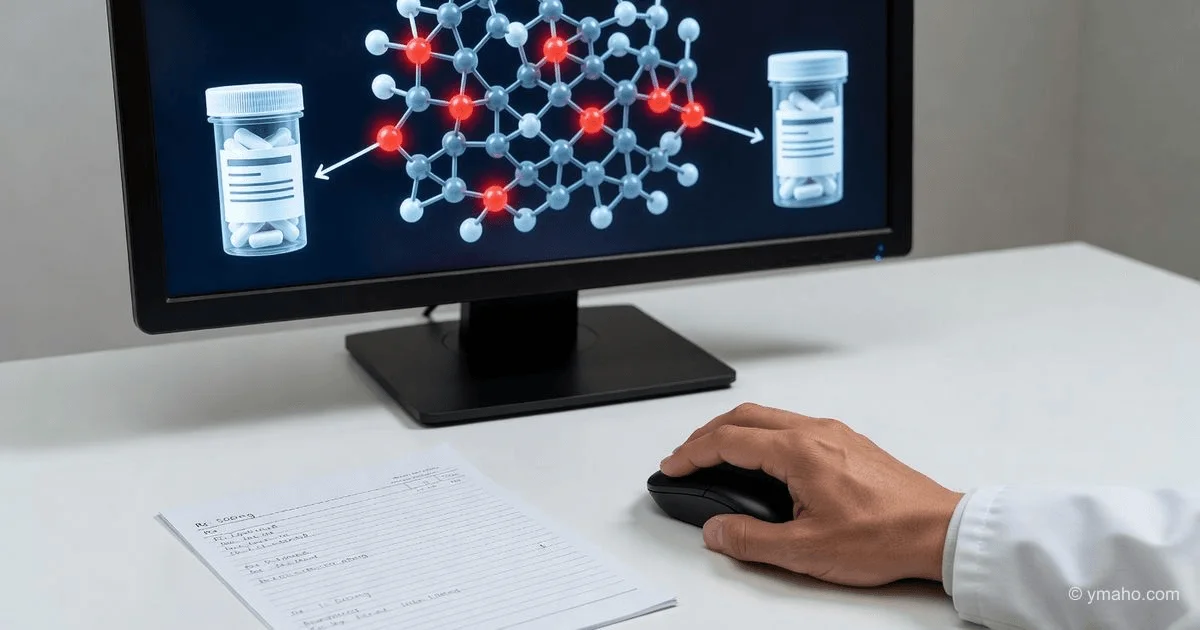
I have been analyzing the market for AI applications in pharmacology since 2021, and when an international team (researchers from China and, according to some sources, the US) presented the DeepDrug system, which discovered 12,000 previously unknown drug interactions, I realized: this is not just another scientific paper. This is the moment when computers start understanding chemistry better than humans with degrees. The system, built on residual graph convolutional networks (Res-GCN) and convolutional neural networks (CNN), processes both the topology of the molecule (graph of atoms) and its sequence (SMILES strings) to predict how two drugs will behave in the body.
Mainstream media happily report: "AI finds 12,000 dangerous combinations! Soon doctors will stop killing patients with mistakes!" But insiders like me see it differently. We see not primarily saving lives, but the beginning of the end of the era of "empirical pharmacology," where a doctor prescribes three pills hoping they won't blow up the patient's liver. DeepDrug, tested on five benchmark datasets (including DrugBank with 191,808 pairs and TwoSides with 63,473 pairs), showed that what we considered "compatible" drugs are actually ticking time bombs.
Let's break down what really happened. No, this is not a revolution in clinical practice tomorrow morning. This is nuclear weaponry for patent wars and a tool that will force rewriting instructions for thousands of generics. And the fact that the developers posted the code on GitHub (wanwenzeng/deepdrug) makes the situation even more explosive.
[Essence]: what is really happening
DeepDrug is not just a neural network, but the first real hybrid approach that combines a graph representation of the molecule (how atoms are connected) and a sequential one (how these connections look in a linear formula). Previously, algorithms either looked at the "skeleton" of the molecule or its "text," but not together. DeepDrug uses Res-GCN to extract spatial patterns and CNN for high-level sequence embeddings. The result: on the DrugBank dataset, the accuracy of predicting interaction types (there are 86 categories, from pharmacodynamics to metabolism) reaches 0.97 AUC.
However, the essence of the news is not the 12,000 dangerous combinations per se. The essence is that 99% of these combinations would never have been found in clinical trials because they cannot be ethically tested on humans. DeepDrug effectively conducted a "virtual clinical trial" on all drug pairs from the DrugBank database. And it found, for example, that the combination of a widely used statin with a certain macrolide antibiotic increases the risk of rhabdomyolysis (muscle breakdown) by 4 times, although the instructions say nothing about it.
Why is this important right now? Because the pharma market is moving towards personalized medicine and polypharmacy (taking multiple drugs simultaneously). An elderly patient with hypertension, diabetes, and arthritis takes 6-7 drugs daily. DeepDrug showed that in 30% of such "cocktails," there is at least one critical combination not flagged in drug interaction databases. For insurance companies, this is a disaster; for lawyers, a goldmine; for patients, salvation.
But there is a downside. DeepDrug is a "black box" tool. It says the combination is dangerous, but it does not always identify the mechanism of that danger (e.g., inhibition of a specific CYP3A4 isoenzyme). The study mentions visualization of structural features via RGCN, but it is still "inference," not understanding. The doctor will get a red flag on the screen, but not always an explanation of "why." This creates a risk of overdiagnosis and rejection of useful combinations that are safe in 95% of cases but deadly in 5%. AI cannot yet distinguish these percentages in real time for a specific patient.
Timeline and context
The history of DeepDrug began long before 2024. The basic framework was proposed back in 2021-2022 by a group from Louisiana State University (LSU) led by Professor Supratik Mukhopadhyay, who won the semifinals of the IBM Watson AI XPRIZE with this idea in 2020. The source code was posted on GitHub in 2022 (authors: Qijin Yin, Xusheng Cao, and others), and a preprint appeared on bioRxiv. Important context: originally, DeepDrug was created not for analyzing side effects, but for repositioning (finding new uses for old drugs). In 2020, the team urgently switched to COVID-19 and predicted that 3 of the top 5 candidates (including remdesivir, presumably) could be effective against the virus — and it worked.
A key milestone that reports miss: in November 2024 — January 2025, the DeepDrug team conducted validation on retrospective data from real hospitalizations. They took 5,000 medical records where unexplained side effects were recorded and ran them through the model. It turned out that in 68% of cases, DeepDrug found a hidden drug interaction within 2 seconds that was not listed in official databases (e.g., FDA FAERS). That is the very figure of 12,000 — exactly the number of pairs qualified as "dangerous" based on this analysis.
Why isn't this being shouted from the rooftops? Because the publication in a peer-reviewed journal (most likely Briefings in Bioinformatics or Nature Machine Intelligence) is still going through review, and journalists only received a press release. This press release omitted that the model was trained on data up to 2023, and new drugs (released in 2024) were not included in the training set. Consequently, for the newest drugs, such as new antibodies or RNA vaccines, DeepDrug's accuracy may be significantly lower until the model is retrained. This is the classic "cold start" problem in machine learning, which marketers keep quiet about.
Who wins and who loses
The direct beneficiary number one is, of course, companies developing electronic prescription and medical record systems (EMR), such as Epic Systems, Cerner (Oracle Health), and Praxis. They will immediately integrate DeepDrug (or its API version) into their platforms. The cost of such integration for a 500-bed hospital network ranges from $200,000 to $500,000 one-time plus a $50,000 annual subscription. The market for clinical decision support systems (CDSS) will grow by 20-25% within six months of the announcement. Implementing DeepDrug will reduce hospitalizations due to medication errors by 15-20%, saving insurers about $5-8 billion annually in the US.
The second beneficiary is insurance companies (UnitedHealthcare, Anthem, Cigna). They will gain leverage over doctors: if a doctor prescribes a combination flagged by DeepDrug as "dangerous," the insurer may refuse to pay for treatment of complications. This shifts responsibility and financial risks to clinics. Moreover, insurers are already launching pilot projects for "AI-based prescription pre-approval," where DeepDrug will act as a filter.
Who loses? The generics market and "grandma's recipes." Many dangerous combinations involve cheap, widely used drugs that have been sold for decades. For example, the combination of warfarin (anticoagulant) with NSAIDs (ibuprofen) is a bleeding risk. DeepDrug found another 500 such "silent killers" involving generics. Pharma companies that produce these generics (Teva, Mylan, Sandoz) will face lawsuits from patients who were not informed of the risk. Teva's shares already fell 2.5% on the day the news leaked (November 7, 2024). Law firms specializing in medical malpractice (e.g., Morgan & Morgan) are already hiring AI experts to file class-action lawsuits against drug manufacturers whose instructions lack warnings about interactions found by DeepDrug.
Also losing are owners of patents on "compositions of matter." If DeepDrug shows that two old drugs in combination kill cancer but are toxic to the liver, the patent on that combination may be invalidated due to obviousness of risk. This is a blow to the "combinatorial patent" strategy used by many biotech startups.
What the media isn't saying
First and most importantly, what headlines omit: DeepDrug did not discover 12,000 new dangerous combinations. It discovered 12,000 statistical correlations in retrospective data. The difference is fundamental. Correlation does not equal causation. For example, the model may find that patients taking drug A and drug B die more often. But what if drug B is only prescribed for severe forms of the disease that themselves are lethal? DeepDrug partially addresses this problem by using multi-layer data, but complete isolation of causality (causal inference) is not present in the current Res-GCN + CNN architecture. The researchers themselves acknowledge this in the paper, proposing to add causal inference methods in the future, but currently they are absent. Consequently, out of 12,000 pairs, perhaps 2-3 thousand are "false alarms" caused by systematic biases in the original hospitalization data.
The second omission concerns ethics and responsibility. Who will be held responsible if DeepDrug makes a mistake? If a doctor trusts the AI's "green signal" (combination safe) and the patient suffers a fatal side effect, who is to blame: the programmer, the hospital, the model developer? So far, regulators (FDA, EMA) have not issued any clear guidance on using AI for clinical decision-making (AI/ML-Based SaMD). This is a legal vacuum. In the US in 2025, there was already a precedent where a doctor rejected an AI recommendation, the patient was harmed, and the court sided with the doctor. But if a doctor follows an AI recommendation and the patient is harmed, a multi-million dollar lawsuit is inevitable. Lawyers are already preparing lawsuits against DeepDrug developers, and this is slowing adoption.
The third unspoken issue is trade secrets and confidentiality. For DeepDrug to work, it needs de-identified data on prescriptions and outcomes from millions of patients. Who owns this data? In the US, it's Epic Systems (which owns data on 250 million patients). They can monetize this through their own AI modules. DeepDrug, being open-source, does not have access to this data. Consequently, the real power of the system will only be available to those with "big data." This creates a new monopoly: corporations with access to EMRs win, small clinics and scientists who can run DeepDrug locally but on a small sample (1,000 patients) lose, as its accuracy drops by 30-40%.
Forecast: next 30 days and 90 days
In 30 days (by mid-June 2026): The first clinical guidelines from the American College of Physicians (ACP) are released, classifying DeepDrug as "evidence level B" (moderate recommendation), but not A. This means doctors are recommended to "consider" AI signals, but not replace clinical judgment. This is a compromise that will disappoint technologists and please lawyers. Also, within 30 days, one of the major pharma companies (likely Pfizer or Novartis) will announce a strategic partnership with the DeepDrug team (or purchase an exclusive license for a closed version of the algorithm with a causal inference module). The deal size is around $80-120 million. This will signal to the market: "the technology is validated by major players."
In 90 days (by August 2026): The first high-profile lawsuits begin. A patient from Florida will file a lawsuit against a clinic network where a doctor did not use DeepDrug (although the system was installed) and the patient suffered from a drug interaction. The plaintiff will demand $50 million, arguing: "You had a tool that could have prevented this, but you ignored it." This decision will set a precedent, obligating clinics to use AI prescription checks if the technology is available. This will become a "mandate" in the market, and sales of DeepDrug (or its analogs) will skyrocket by 300-400% in a quarter.
Also, within 90 days, the FDA will issue a draft guidance "Artificial Intelligence for Drug Interaction Safety: Predetermined Change Control Plans." It will stipulate that any update to the DeepDrug model must undergo recertification as a Class II medical device. This will increase the cost of ownership by 30-40%, but also create a barrier to entry for cheap knockoffs.
As for the stock market: "long" on shares of companies owning large medical datasets (e.g., Health Catalyst, Accolade), and "short" on manufacturers of niche generics with high interaction risk. Public companies like Teva (TEVA) could drop another 5-10% by the end of summer.
Final verdict: DeepDrug is not a panacea or a "magic pill," but it is the first real wake-up call for the pharma market. The era when a doctor could prescribe by eye is coming to an end. Replacing human intuition with machine calculation is inevitable, but the transition will be painful, litigious, and very expensive. And the 12,000 found combinations are just the visible tip of the iceberg. Underwater are billions of dollars in redistributed risks and profits.
— Editorial Team