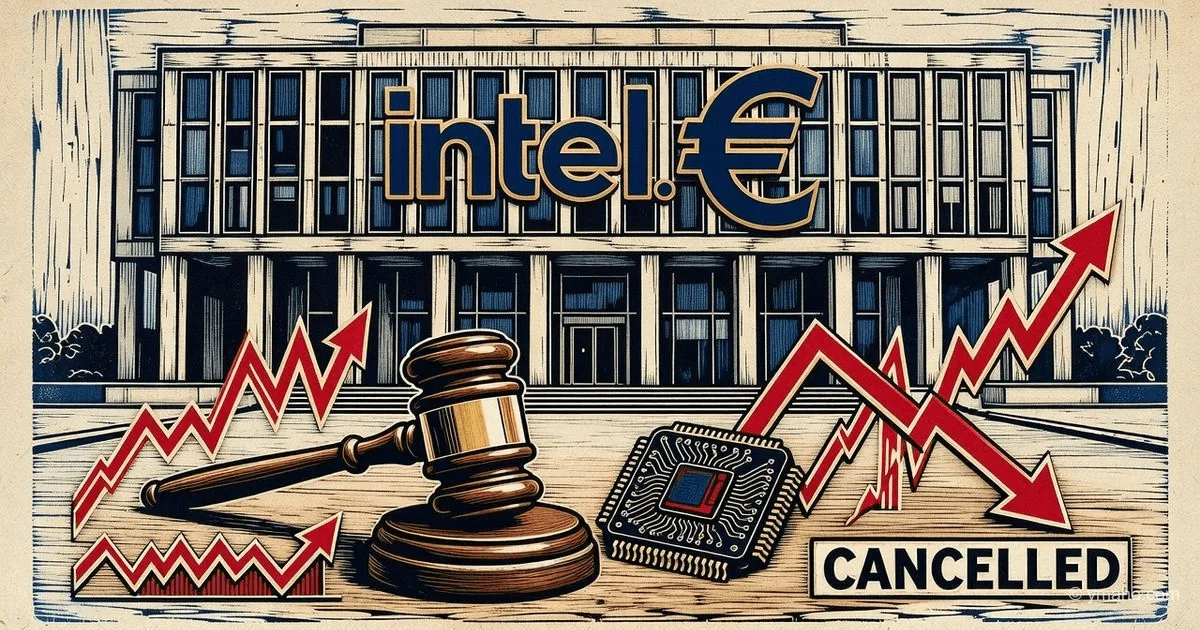
EU Court Annuls €1.06 Billion Fine Against Intel in 2009 Antitrust Case
The European Court ruled to annul the record fine against Intel, deciding that the regulator failed to prove the economic substance of the chipmaker's rebates.
Intel Fine Overturned: How Europe Lost the Battle but Won the War
I have been following antitrust proceedings in the tech sector for over fifteen years. And the Intel case is perhaps the most telling example of how European bureaucracy can chase its own tail for years. The news that the EU Court has finally annulled the €1.06 billion fine against Intel looks like a sensation. But in reality, it is the expected finale of a saga that lasted nearly two decades.
Officially: the court ruled that the regulator failed to prove the economic substance of the rebates to the chipmaker. It sounds like a defeat for the European Commission. But the real story is much more complex. And there is one insight that most readers don't know, which I will reveal in this analysis.
[The Core]: What Is Really Happening
In fact, not the entire fine was annulled, but only the part concerning "conditional rebates." This is a crucial legal nuance that gets lost in news headlines. The second part of the charges—so-called "naked restrictions"—was confirmed by the court back in 2022 and has not been contested since.
What are "naked restrictions"? These were direct payments by Intel to computer manufacturers—HP, Acer, and Lenovo—to delay or completely cancel the launch of products based on competitor AMD's processors. For example, HP received money to sell AMD-based desktops only to small and medium businesses, not through retail chains. Acer delayed the launch of an AMD laptop by four months. Lenovo by six months. These were not "volume discounts"—they were direct, deliberate elimination of a competitor from the market. And the court confirmed this.
Thus, Intel did not get off scot-free. The company has already paid a revised fine of €237 million (reduced from €376 million on appeal) specifically for these "naked restrictions." And the €1.06 billion was a fine that should never have been that large. The European Court simply aligned the penalty with the actual scope of violations.
The second non-obvious point. The court effectively rewrote the rules of antitrust assessment for all of Europe. In 2017, the European Court of Justice ruled that the Commission can no longer automatically consider conditional rebates by a dominant company as inherently evil. Now the regulator must prove at an economic level that these rebates are indeed capable of restricting competition. This decision fundamentally changes the rules of the game for all tech giants—not just Intel, but also Google, Apple, Microsoft, Amazon. And this is far more important than the fate of a single fine.
Timeline and Context
The story began in 2000 with a complaint from AMD. The investigation lasted nine years. In 2009, the European Commission imposed a fine of €1.06 billion—at the time a record for a single violator. Intel appealed. In 2014, the General Court dismissed the appeal and upheld the fine. Then came another twist: in 2017, the European Court of Justice overturned the 2014 decision and sent the case back for review, simultaneously changing the legal standard for evaluating rebates.
In 2022, the General Court partially annulled the Commission's decision—overturning the part on "conditional rebates" but confirming guilt on "naked restrictions." And it annulled the entire fine because it was impossible to determine which part of the fine corresponded to the proven violations. In 2023, the Commission imposed a new fine—only for the "naked restrictions"—amounting to €376 million. Intel appealed again. In December 2025, the General Court reduced the fine to €237 million, finding that the Commission had exaggerated the timeframe and severity of the violation.
And now the finale. June 2026. The EU Court finally confirms the annulment of the original €1.06 billion fine. Seventeen years have passed since the investigation began. Twenty-six years since AMD's complaint. This is the longest antitrust proceeding in the history of the European Union.
Who Wins and Who Loses
Intel wins—financially, but not reputationally. The company avoided paying €1.06 billion, but €237 million has already been paid (or reserved). However, Intel's main gain is not money, but the change in legal standard. Now any tech giant can appeal to the Intel ruling, demanding economically substantiated evidence from the Commission. This sets a precedent that will complicate future antitrust investigations against large tech companies in Europe.
AMD wins—morally, but not legally. AMD initiated the complaint, and their key argument—"naked restrictions"—was fully confirmed. Moreover, the entire process took so long that by the time of the finale, AMD had already won market competition on its own. In 2025-2026, AMD's share of the server processor market exceeded 35%, and in gaming PCs, around 40%. Intel paid for its behavior not so much in money as in lost market position. And AMD knows this.
Antitrust lawyers across Europe win—that's obvious. The Intel case created a mountain of case law that will be used for decades. Every point of the court decisions—from 2014 to 2026—will be cited in every major tech antitrust case. Demand for specialists in European competition law will increase by 30-40% in the next two years.
The European Commission loses—but not as badly as it seems. Yes, the fine was annulled. Yes, it is a blow to its authority. But the Commission achieved the main thing: Intel's "naked restrictions" were declared illegal and will remain in judicial history as an example of abuse of dominant position. Moreover, in 2023, the Commission already imposed a new fine of €376 million (reduced to €237 million), so Intel did face punishment.
The principle of "swift justice" in the EU loses. The Intel case is a disgrace for the European judicial system. Twenty-six years from complaint to final decision. The processor market has completely changed in that time. Tech giants have learned: even if the European Commission fines you, you can appeal for years and delay payments. This reduces the deterrent effect of antitrust fines. A 2025 study showed that the average duration of antitrust proceedings in the EU is 45 months for prohibition decisions. That is too long for markets that change in 12-18 months.
What the Media Leaves Out
First, what all news outlets are silent about: the annulment of the €1.06 billion fine is a technical decision, not an exoneration of Intel. The court did not say that Intel did not violate the law. The court said that the European Commission failed to calculate the fine correctly. This is a fundamental difference. Intel's guilt in "naked restrictions" remains in force and was never contested.
Second, this case created a dangerous precedent for future investigations. In 2009, the Commission assumed that conditional rebates by a dominant company were inherently evil. After 2017, they must prove the economic effect of each rebate. This significantly complicates and increases the cost of investigations. According to expert estimates, proving "ability to restrict competition" instead of "automatic recognition" increases investigation duration by 12-18 months.
Third, and most importantly, this entire story unfolded against the backdrop of a global reassessment of Intel's role. In 2026, Intel shares trade around $99, with a market capitalization of about $498 billion. But that is far from historical highs. Nvidia, the main competitor in the AI chip market, is worth over $2.5 trillion. Intel is trying to pivot toward contract chip manufacturing (foundry business) but is incurring losses. For 2025, Intel's net margin was negative—minus 5.9%. The annulment of the fine gives Intel an additional €1.06 billion in freedom, but against the backdrop of investment needs for new factories (a $20 billion fab is being built in Ohio alone), it is a drop in the ocean.
Fourth, the Commission has not given up on holding Intel accountable for conditional rebates. Their appeal against the 2022 decision is still pending before the European Court of Justice (Case C-240/22 P). So theoretically, the saga could continue. But the practical chances of success for the appeal after the June 2026 ruling are considered low—less than 20%.
Forecast: Next 30 Days and 90 Days
30 days:
- Intel shares (INTC)—I expect moderately positive dynamics. The news of the fine annulment is already partly priced in, but could provide a 3-5% boost within a week. However, fundamental indicators are much more important for the market—in Q2 2026, Intel forecasts EPS of $0.20. If the result is better, shares could rise to $105-110. But if competition from Nvidia and AMD continues to pressure, a correction to $90 is not ruled out.
- European tech sector—positive. The court ruling reduces regulatory risks for all major tech companies operating in the EU. Google, Apple, Meta, Amazon—all are under antitrust investigations, and now their lawyers will actively cite the Intel precedent. This could lead to revised fines or softened requirements. The European tech index may see a short-term boost of 2-3%.
90 days:
- I expect the European Commission to revise its antitrust investigation strategy. Overly lengthy procedures make fines ineffective. The Commission is likely to start using "interim measures" more actively—a mechanism that allows forced cessation of behavior before the full investigation is completed. This tool has been used only once since 2003 (against Broadcom in 2019). In the next 90 days, we may see at least one new case applying interim measures.
- AMD shares—long-term positive. Although AMD did not receive compensation formally, the moral victory and historical confirmation of their correctness have strengthened confidence in the company. AMD continues to gain market share from Intel. I expect that in 90 days, AMD may announce a new record quarter with a server processor share of around 38%. AMD shares could outperform Intel by 10-15% over the quarter.
Editorial Forecast
The main asset to monitor in the next 24-72 hours is Intel shares (INTC). A sideways trend with a short-term growth impulse in the range of $98.50-$102.00 is expected on the news of the fine annulment, which removes uncertainty. Confidence level is medium, as fundamental risks (competition, losses in the foundry business) remain dominant for long-term valuation. The main risk is the publication of an analyst report that shifts market focus back to Intel's weak financial performance, which could nullify any positive effect from the legal victory. The editorial opinion is not an investment recommendation.
— Editorial Team