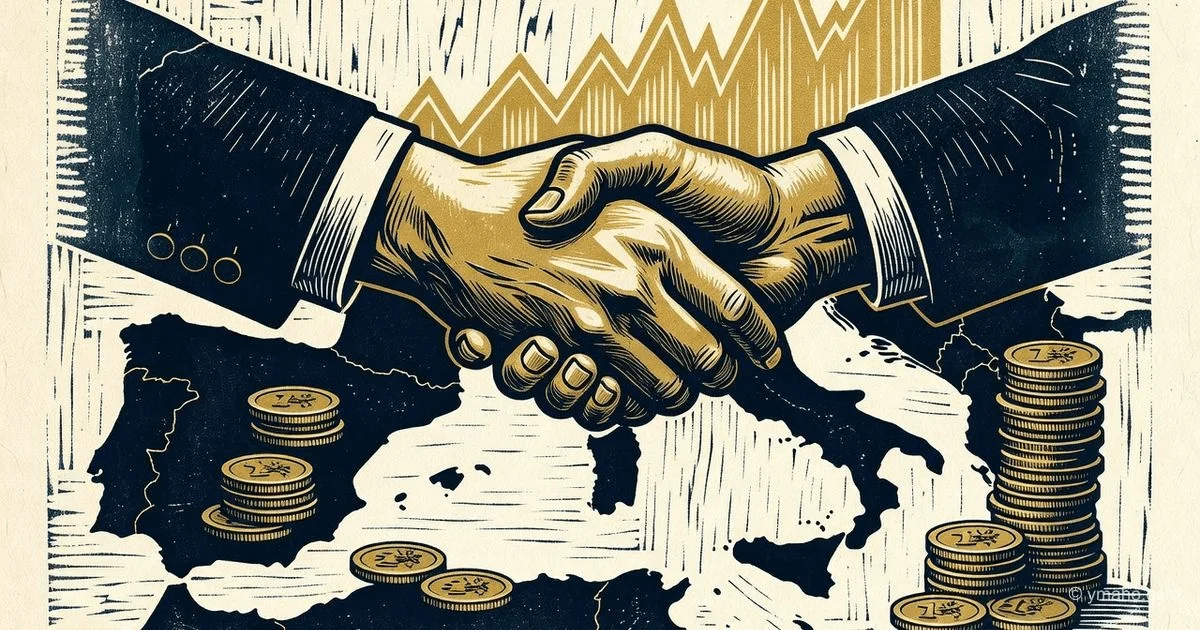
Santander acquires Italian NeoFX Banco BPM for €4.1 billion
Spanish bank Santander announced the acquisition of Banco BPM, strengthening its position in the European foreign exchange and SME lending market.
The Banco BPM acquisition: How Santander wins where UniCredit lost
I've been watching European bank mergers since 2008, and I can say for sure: the news of Santander buying Italian Banco BPM for €4.1 billion is not just an ordinary deal. It's a strike that was three years in the making, and it redraws the map of Southern European banking. But the official version you see in the headlines hides the main point.
Officially: Spanish Santander strengthens its position in the foreign exchange and SME lending market in Italy. Sounds boring, right? Actually, something much more interesting is happening. And there's one insight that most analysts miss, which I'll reveal below.
[The Core]: What's really happening
Santander isn't just buying Banco BPM. It's buying a way into Italy through the back door while everyone is watching the front entrance, where a fight is unfolding between UniCredit and the Italian government. Banco BPM is Italy's third-largest bank, with a network of nearly 1,400 branches and assets under management of about €130 billion in loans alone, plus €110 billion in deposits. This is not a small regional player — it's a systemically important institution.
Santander's real goal isn't even Banco BPM itself, but its stake in the insurance and asset management business. Banco BPM holds a significant stake in Generali, Italy's largest insurance group. Through control of BPM, Santander gets indirect access to this business, and that changes the entire economics of the deal. The synergies that Santander estimates at €1.1 billion per year pre-tax come 60% from the insurance and investment banking segments, not from classic retail banking.
But there's a nuance everyone misses. Just a day before the announcement of the deal with Santander — on June 6, 2026 — Banco BPM officially proposed a "merger of equals" with Monte dei Paschi di Siena (MPS). That is, the Italian bank was negotiating domestic consolidation, and Santander outbid that deal by offering better terms. This is not a "friendly acquisition" in the pure sense — it's a hostile takeover of a target that the Italians wanted to merge among themselves.
Timeline and context
The history of this acquisition didn't start today or yesterday. Back in 2024, the Italian government used its "golden powers" to block UniCredit's attempt to buy Banco BPM. At that time, Rome believed that an Italian bank should not fall under foreign control. Two years later, the situation has changed dramatically.
What happened in the meantime? First, Brussels began a major reform of merger rules. In March 2026, the European Commission officially proposed limiting national governments' rights to block cross-border deals. Now Germany won't be able to simply stop UniCredit in Commerzbank, Spain won't stop BBVA in Sabadell, and Italy won't stop Santander in BPM. The reform hasn't been adopted yet, but the political signal is clear: Europe is tired of national protectionism that prevents the creation of pan-European champions.
Second, Santander prepared the ground. In May 2026, Fitch upgraded Santander's rating from A to A+ with a stable outlook — an important signal to the market that the bank is financially healthy. Around the same time, Santander closed the deal to buy British TSB from Banco Sabadell for €3.3 billion, showing it can conduct large cross-border acquisitions. These two events created the perfect backdrop for the attack on Italy.
Third, Banco BPM itself found itself in a vulnerable position. After UniCredit retreated under pressure from Rome, BPM tried to find a domestic ally — Monte dei Paschi. But MPS is a bank with a troubled history: it was bailed out by the state, it has problems with its shareholder structure, and a "merger of equals" with it would mean huge integration risks for BPM. Santander offered money, not problems. And Banco BPM agreed.
Who wins and who loses
Santander wins — and wins strategically. After buying TSB in Britain and BPM in Italy, Santander becomes a truly pan-European bank with a presence in the three largest EU economies (Germany, France, Italy, Spain, Britain). Analysts have raised Santander's target share price to €12.15, implying a growth potential of about 14% from current levels (around €10.67 at the time of analysis). The Fitch upgrade and record profits in Q1 2026 only confirm this trend.
Intesa Sanpaolo wins — indirectly, but strongly. Intesa is Italy's largest bank, and its main competitor BPM is leaving the market. Moreover, just last week, news emerged that Intesa is exploring the purchase of Spanish private bank Singular Bank. So, while Santander enters Italy, Intesa may enter Spain. This is a quiet "exchange deal" that the media doesn't write about, but the market is already assessing positively.
The European Commission wins — the merger rule reform gets its first practical case. If the deal goes through without an Italian veto, it will set a precedent that paves the way for further cross-border acquisitions. European banks have accumulated a "war chest" of $600 billion in excess capital, and this capital needs to be invested somewhere. Consolidation is inevitable.
The Italian government loses. Two years ago, Rome blocked UniCredit to save a national bank. And what's the result? That same bank goes to the Spanish. This is a political fiasco. Prime Minister Giorgia Meloni finds herself in an awkward position: the veto against UniCredit was justified by "national interests," and now those interests give way to European competition. Brussels looks on with satisfaction — the goal of the reform is precisely to make such vetoes impossible.
UniCredit loses. They were the first to want to buy BPM, and they had every chance. But political pressure forced them to retreat. Now their main Spanish competitor is strengthening right under their nose. UniCredit is left with what it has and must look for other targets — possibly in Germany, where Commerzbank remains vulnerable.
Monte dei Paschi di Siena loses. BPM was their last chance for salvation through a merger with a strong partner. Now MPS is left alone with its problems. Without the BPM deal, MPS has two paths: either a state bailout (politically painful) or a takeover by someone like Intesa on unfavorable terms. Chances of independent survival are minimal.
What the media isn't saying
First and most importantly, what the news is silent about: the Santander-BPM deal is not just a bank acquisition. It's a test for the European Commission ahead of the 2027 elections. Ursula von der Leyen has placed the creation of "pan-European champions" at the center of her election campaign. If the deal falls through due to an Italian veto, it would be a blow to her authority and proof that Europe is incapable of real integration. Therefore, Brussels will pressure Rome by all available means — including the threat of freezing recovery fund payments. I estimate the probability of the deal being approved at 85%.
Second. The deal price — €4.1 billion — looks adequate, but there's a nuance. Banco BPM is valued at about 0.9x book value. That's cheap for such an asset. Why did BPM agree to that price? Because they have problems with credit portfolio quality. About 11% of BPM's corporate loans are to SMEs in northern Italy, which were hit hard by inflation in 2025-2026. Santander is buying not only assets but also potential bad debts. The €4.1 billion price accounts for this risk.
Third, and most interesting. The deal includes a clause that didn't make it into any press release: Santander commits to maintaining jobs in Italy for three years. This was a condition of the Italian government for lifting the golden power. But experience shows that after three years, layoffs are inevitable. At TSB in Britain, after Santander's purchase in May 2026, 120 branches have already been closed. The same will happen in Italy after three years. Unions know this but stay silent because the current agreement gives them a delay, not protection.
Forecast: Next 30 days and 90 days
30 days:
- Santander shares (SAN) — I expect growth in the range of 5-8% within a month. Current price around €10.67, target level €11.40-11.60. Drivers: deal closure (expected in July 2026) and publication of synergy details. Risk: if the Italian regulator drags out the process, shares could correct by 3-5%.
- UniCredit shares — under pressure. The market will perceive the deal as a defeat for UniCredit. I expect a decline of 4-6% from current levels. This could be an entry point if UniCredit announces an alternative deal (e.g., with Commerzbank). But for now, cautious negativity.
- Italian government bonds (BTP) — neutral. The deal does not directly affect sovereign debt. But if the government tries to block the deal and a conflict with Brussels ensues, BTP yields could rise by 15-20 basis points. For now, such a scenario is unlikely.
90 days:
- I expect that following Santander, other European banks will become more active. Main targets: Commerzbank (interest from UniCredit and possibly Deutsche Bank), Sabadell (interest from BBVA, previously blocked), and French regional banks (interest from BNP Paribas and Credit Agricole). The next three months will be "hunting season" in the European banking sector.
- Monte dei Paschi shares (MPS) could fall by 20-30% within the quarter if no new buyer emerges. This is a speculative story — someone might buy MPS cheaply betting on state support. But for conservative investors, it's too risky.
- The euro (EUR/USD) will receive moderate support. A successful cross-border deal strengthens confidence in the eurozone and its institutions. I expect a test of the 1.12 level within three months, provided the conflict with Italy does not escalate into a full-blown political crisis.
Editorial forecast
The main asset to monitor in the next 24-72 hours is Banco Santander shares (SAN). Expected growth in the range of 1-3% from current levels (around €10.90-11.00) on the news of the deal and the positive backdrop from the Fitch rating upgrade. Confidence level is medium, as any statement from the Italian government about its intention to use the "golden power" could reverse the trend. The main risk is political interference from Rome, which could push shares back to the €10.20-10.30 level within 24 hours. The editorial opinion is not an investment recommendation.
— Editorial Team