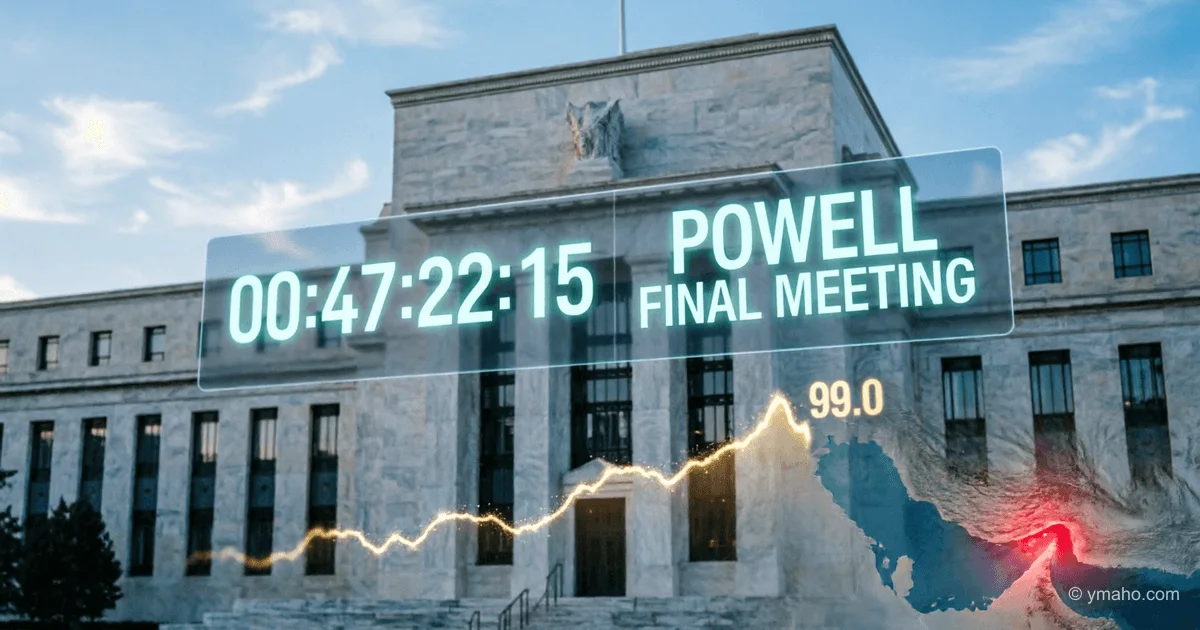
Dollar Edges Higher on Fed Meeting Expectations
Traders continue to monitor geopolitics and await the regulator's rate decision, which will be Jerome Powell's last as chair. The dollar is supported by its safe-haven status amid escalating tensions in the Middle East.
Introduction
On April 29, 2026, the currency market is in a state of tense anticipation. The US Dollar Index (DXY) is showing a slight but steady rise, stabilizing around 99.00 — near two-week highs. Morning trading shows the euro down 0.09% to $1.1701, the British pound losing 0.10% to $1.3503, and the dollar strengthening against the yen to 159.71.
This movement occurs under unique historical circumstances. Today's Federal Reserve meeting will be Jerome Powell's last as chair — his term expires on May 15. He is widely expected to be succeeded by Kevin Warsh, whose candidacy has already passed key procedural stages in the Senate. Simultaneously, tensions in the Middle East remain at their highest: the blockade of the Strait of Hormuz is approaching the two-month mark, and oil prices remain nearly 50% above pre-war levels.
In this situation, the dollar traditionally acts as a "safe haven" — a defensive asset that attracts capital during periods of uncertainty.
Event Details and Timeline
Current Currency Market Situation
As of the morning of April 29, the dollar is showing moderate gains against a basket of major currencies for the second consecutive session. The DXY index is up 0.08%, and the broader WSJ Dollar Index is up 0.13%. However, the movement remains subdued — investors are hesitant to open large positions until they receive concrete signals from the Fed.
Specific rates as of 10:10 Moscow time:
- EUR/USD: $1.1701 (-0.09%)
- GBP/USD: $1.3503 (-0.10%)
- USD/JPY: 159.71 yen (+0.06%)
- USD/CNH (offshore): 6.8391 yuan
Fed Decision: What to Expect
The Federal Open Market Committee (FOMC) will announce its rate decision at 21:00 Moscow time. Markets are almost fully (99.7%) convinced that the rate will remain unchanged in the range of 3.5%–3.75% — this would be the third consecutive meeting with no change.
However, the main intrigue lies not in the decision itself, but in three accompanying aspects:
- Powell's rhetoric. The outgoing chair's final press conference (starting at 21:30 Moscow time) could set the tone for the coming months.
- Future rate projections. The March Summary of Economic Projections (SEP) indicated only one 25 bps cut by the end of 2026. But since then, the inflation situation has worsened.
- Assessment of the Middle East conflict. Markets will listen closely to how the Fed evaluates the economic consequences of the war and the blockade of the strait.
Geopolitical Background
As the Fed prepares for its meeting, the situation in the Persian Gulf continues to escalate. Talks between the US and Iran have reached a deadlock — the US side deemed Tehran's latest peace proposal unacceptable as it does not address the nuclear issue. Moreover, according to The Wall Street Journal, President Trump has instructed his aides to prepare for a prolonged blockade of Iranian ports.
The blockade of the Strait of Hormuz, which began after US and Israeli strikes on Iran on February 28, has now lasted nearly two months. This directly pressures global energy prices and, consequently, inflation expectations worldwide.
Impact and Significance (for the World / Industry / Society)
For Global Finance and Currency Markets
The US dollar is becoming the main beneficiary of global instability in the current configuration. Analysts at ING note that the dollar's recovery over the past 24 hours was driven less by geopolitics and more by nervousness in the US stock market related to the AI sector. Nevertheless, the "Middle East factor" remains a key driver.
As Ipek Ozkardeskaya, senior analyst at Swissquote, notes, "the main winner of the Middle East conflict is the US dollar." The US economy has proven more resilient to energy shocks than European or Asian economies — the country is a net energy exporter and imports only 17% of its needed resources, a 40-year low.
For Monetary Policy
The situation creates an unprecedented challenge for central banks worldwide. Before the conflict began, markets priced in a probable Fed rate cut in June with about 50% probability. Now that probability has shrunk to around 25%. Analysts at TD Securities expect the Committee to once again emphasize the need for patience.
An even more telling situation is unfolding in Europe. Traders are now pricing in the possibility of rate hikes by the European Central Bank this year, rather than cuts as previously expected. The Bank of England and the Bank of Canada are also revising their plans amid inflationary pressure from energy prices.
For Investors and Savings
For retail investors, the current situation sends mixed signals. As Anna Bodrova, analyst at Alpari, notes, the dollar will retain its safe-haven status this year, but the optimal strategy remains diversification — allocating funds between the dollar, euro, and national currency in roughly a 30/30/30 proportion.
The Middle East war has already forced investors to rethink some of the most popular strategies of 2026. Short positions on the dollar (bets on its weakening), which were the largest since 2021, have come under pressure, and many have been forcibly closed. At the same time, emerging market stocks and currencies have suffered significant losses — the emerging markets stock index lost 7% last week.
Reaction of Key Players
Fed and Jerome Powell
For Powell, today's meeting may be his farewell. His four-year term as chair expires on May 15. However, legally he can remain on the Board of Governors as a regular member until 2028. Powell has previously stated he would only stay if he believed the Fed's independence was under threat.
Most analysts agree that Powell will take a rather hawkish stance at the press conference. "Given the lack of progress in the Persian Gulf, Powell may lean toward hawkish rhetoric," write ING analysts. The minutes of the March FOMC meeting already noted that "many" participants would support rate hikes to reduce inflation in the event of a prolonged war.
Analysts and Investment Banks
Professional market participants' forecasts are divided into two camps:
Hawkish scenario (analysts at BBH): "We expect Chair Powell to confirm that the current stance of Fed policy is appropriate, implying a high bar for resuming easing. Watch for whether Powell confirms discussion of the next step being a rate hike."
Neutral scenario (TD Securities): "With uncertainty remaining high, the Committee will likely once again emphasize the need for patience. Powell will probably maintain a neutral policy stance and refrain from new comments on the succession issue."
International Markets
The Bank of Japan has already signaled: the rate was kept at 0.75%, but three of the nine board members voted for a hike to 1%. The regulator also raised its consumer price growth forecast for 2026, strengthening expectations of future policy tightening.
On Thursday, the European Central Bank and the Bank of England will announce their decisions. Both are expected to hold rates, but their rhetoric will be closely analyzed for reactions to the energy shock.
Stock Market
Corporate earnings reports deserve special attention. Today, tech giants Alphabet, Microsoft, Amazon, and Meta are publishing their quarterly results. As ING notes, "in many currency pairs, global equities currently have the highest beta in our short-term models." This means the dollar's reaction to Big Tech earnings could be comparable to, or even stronger than, its reaction to the Fed decision.
Forecast and Conclusions
Near-Term Outlook (End of Week)
The outcome of today's meeting will depend on two main factors: Powell's rhetoric and simultaneous movements in the stock market. Three scenarios are possible:
- Hawkish tilt (most likely): Powell points to risks of persistently high inflation due to the energy shock. The dollar gets a short-term boost, DXY tests the 100 level. In this scenario, EUR/USD could fall below 1.1680 — the area where the 100-day and 200-day moving averages converge.
- Neutral scenario: Powell maintains a "wait and see" stance. Markets are disappointed by the lack of clear signals, the dollar stays in the 98.5–99.5 range.
- Dovish scenario (least likely): Powell expresses optimism about a rapid decline in inflation after oil prices correct. The dollar comes under selling pressure, EUR/USD attempts to break resistance at 1.1800.
Medium-Term Outlook (1–3 Months)
As Alpari analyst notes, market focus will be on the situation in the Middle East. What matters is not so much the conflict itself, but its impact on inflation. Rising oil prices and potential supply disruptions directly affect energy costs and, consequently, global inflation.
Based on the current situation, analysts expect only one Fed rate cut closer to autumn. Until then, the regulator will likely maintain tight conditions. This strategy makes the dollar more attractive as investors earn higher yields on dollar-denominated instruments.
Long-Term Perspective
The question of whether the dollar could lose its status as the world's reserve currency is raised regularly, especially during crises. However, as experts emphasize, neither the yuan, nor the euro, nor the pound offers comparable market depth and trust. No currency today matches the dollar in terms of use in international settlements and financial infrastructure.
Conclusions for Investors
The current situation requires a balanced approach. As analysts note, "this year, investors were betting on economic growth. A stagflationary shock was not part of those plans." The optimal strategy remains diversification of the currency basket.
For those seeking to preserve the purchasing power of their savings, experts recommend an allocation of roughly 30% in dollars, 30% in euros, and 30% in the national currency. Such distribution allows one asset's decline to be offset by another's rise — for example, a weakening dollar is usually accompanied by a rise in most other currencies.
Key takeaway: Today's Fed meeting will be not only a technical event (rate hold) but also an important indicator of how the world's largest central bank intends to balance fighting inflation with supporting economic growth amid a prolonged geopolitical crisis. Powell's rhetoric will set the tone for the dollar in the coming weeks, and possibly months — until Kevin Warsh takes the chair. Investors should prepare for increased volatility in both currency and equity markets.
— Editorial Team









