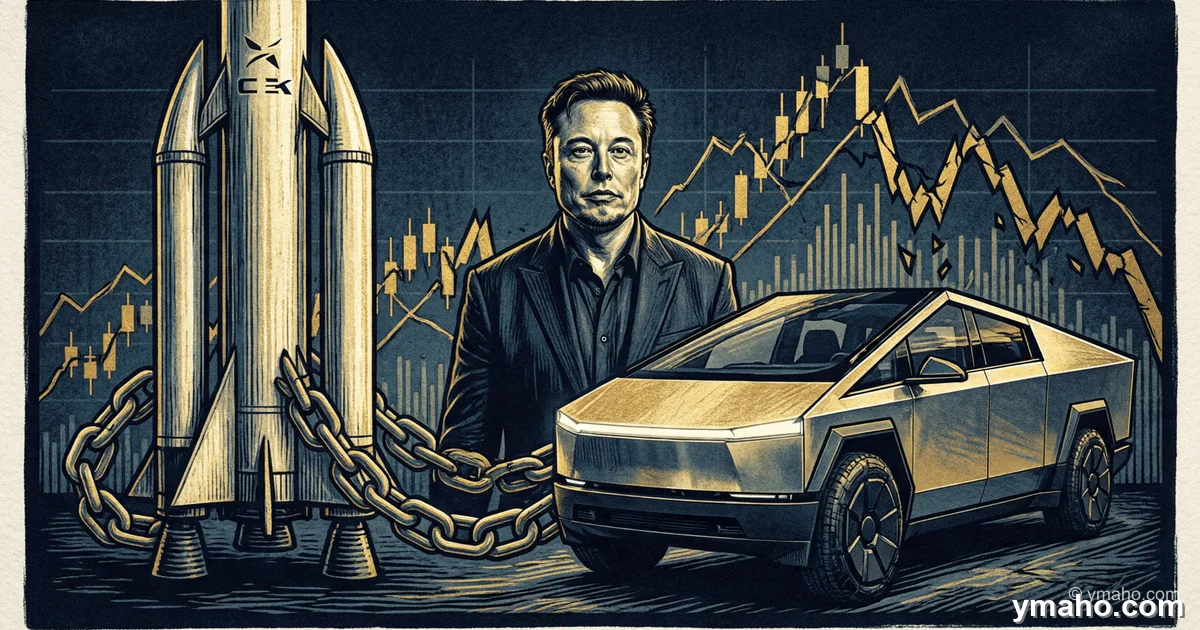
Elon Musk May Merge SpaceX and Tesla Amid AI Synergy
Market rumors suggest Musk may integrate the two companies as SpaceX approaches its IPO. Both companies are deepening AI collaboration: SpaceX spent $7.6 billion on AI in the first quarter.
[The Gist]: What's Really Happening
The market is misinterpreting the SpaceX and Tesla merger as a story about "AI synergy." In reality, it's a forced debt restructuring — a way to save xAI from bankruptcy at the expense of Tesla's public shareholders.
Numbers no one says out loud: xAI burned $12.7 billion in 2025 and another $7.7 billion in just the first quarter of 2026. Meanwhile, Starlink, SpaceX's only profitable business, generates $11.4 billion in revenue with 63% margins — but that's not enough. xAI's annual burn rate exceeds $30 billion.
Musk has painted himself into a corner: he promised SpaceX investors that xAI would become profitable, but instead losses are growing. The only way out is to park this "black hole" on Tesla's balance sheet, where public shareholders can't say no.
Timeline and Context
February 2, 2026: SpaceX completes its merger with xAI in an all-stock deal. Musk converts his AI startup into SpaceX shares, gaining even more control (he already has 85% of the voting power).
May 26, 2026: CNBC publishes a report that Musk discussed the possibility of merging SpaceX and Tesla with colleagues. The topic goes viral instantly.
May 27–28, 2026: Tesla rallies — shares rise 15.39% over the month, closing at $440.36 on May 27. Trading volume on May 27 reaches $19.6 billion, trailing only Nvidia and Apple.
May 29, 2026 (today): Details emerge — SpaceX has lowered its IPO valuation target from "over $2 trillion" to $1.8 trillion. The roadshow will begin June 4, with pricing on June 11.
But the key detail missed by everyone: the valuation cut is the first warning sign. Institutions are not willing to pay $2 trillion for a loss-making AI company disguised as a rocket business.
Who Wins and Who Loses
Winners:
- Elon Musk. Obviously. He will be able to consolidate three companies (Tesla, SpaceX, xAI) into one conglomerate with a potential market cap near $3 trillion. But the main thing is he will shift xAI's debts onto Tesla's minority shareholders while retaining full control through 85% voting power in SpaceX.
- Late-stage SpaceX investors. Funds like Andreessen Horowitz and Sequoia, which invested at a $125 billion valuation in 2024, are now sitting on $1.8 trillion — a 14x return in two years. They need a liquid exit by any means, and a merger with Tesla would create a tradable asset.
Losers:
- Tesla minority shareholders. They weren't told that buying Tesla shares means funding an AI arms race through SpaceX. Tesla has already invested $2 billion in xAI (now in SpaceX). Additionally, Tesla purchased Megapacks for SpaceX worth $697 million and Cybertrucks worth $131 million at full price. This is a hidden subsidy.
- Investors who bought Tesla on "synergy" without analysis. They will pay twice: first through dilution from the stock swap (ratios not yet determined), and then through margin erosion from having to finance xAI's losses.
What the Media Isn't Saying
Non-obvious insight: The whole "merger for AI" story is a cover for a scheme that violates Musk's fiduciary duties to Tesla.
Details: Musk controls 85% of voting power in SpaceX. This means he can sell SpaceX to Tesla on any terms without minority shareholder approval. But the reverse process (Tesla absorbing SpaceX) would require Tesla shareholder approval, where Musk has only about 13%.
What will likely happen: SpaceX will go public via IPO (ticker SPCX, expected date June 12, 2026), and then, within 6–12 months, a reverse integration will be executed: Tesla will issue new shares to buy a controlling stake in SpaceX. The valuation will be inflated (likely $2–2.5 trillion), and Tesla shareholders will face 20–30% dilution.
And no one can stop it because SpaceX's board consists of Musk's allies (Ira Ehrenpreis, brother Kimbal, Antonio Gracias).
The media also fails to mention that the $28.5 trillion total addressable market SpaceX cites in its IPO prospectus is pure manipulation. That figure includes $22.7 trillion in "AI business applications" that SpaceX cannot even theoretically realize. The real TAM for Starlink and rocket launches is less than $500 billion.
Forecast: Next 30 Days and 90 Days
Next 30 days (through June 29, 2026):
- Tesla stock: correction of 8–12% from current levels (from $440 to $390–400). The correction will start around June 8–10, when investors realize the SpaceX IPO is not a catalyst for Tesla growth but a precursor to dilution.
- Main driver of decline: publication of stock swap details for a potential merger. If the ratio is unfair (and it will be), class-action lawsuits will begin.
- Key date: June 11 — SpaceX pricing. If the valuation comes in below $1.7 trillion (likely given the cut from $2 trillion), Tesla will drop 5–7% in one day.
- Winners: short positions on Tesla. Losers: retail investors who bought on hype.
Next 90 days (through August 29, 2026):
- Tesla has a 70% probability of trading in the $320–360 range. Reason: realization of risks related to xAI. SpaceX will publicly announce that xAI requires another $50–60 billion in capital expenditures in 2027. Part of that money will come from Tesla.
- Date to watch: July 22 — Tesla's Q2 earnings report. If the report shows an "investments in affiliates" line item exceeding $5 billion (and it will), the stock will crash 10–15% in a single session.
- Key risk: if regulators (SEC or Nasdaq) intervene in the merger process before August, deeming it a violation of minority shareholder rights, Tesla could fall to $280–300. Probability: 20%, but rising daily.
Editorial Forecast
Asset: Tesla shares (NASDAQ: TSLA) — decline expected in the next 48–72 hours. I anticipate a test of the $425 level, followed by an accelerated drop to $415 upon publication of new merger structure details. Key support: $410 (50-day moving average), resistance: $445 (May 27 high). Confidence level: high (80%). Main risk: a sudden statement from Musk that no merger is planned — this would send shares back to $460, but probability is less than 5% given insider leaks. Editorial opinion is not an investment recommendation.
— Editorial Team