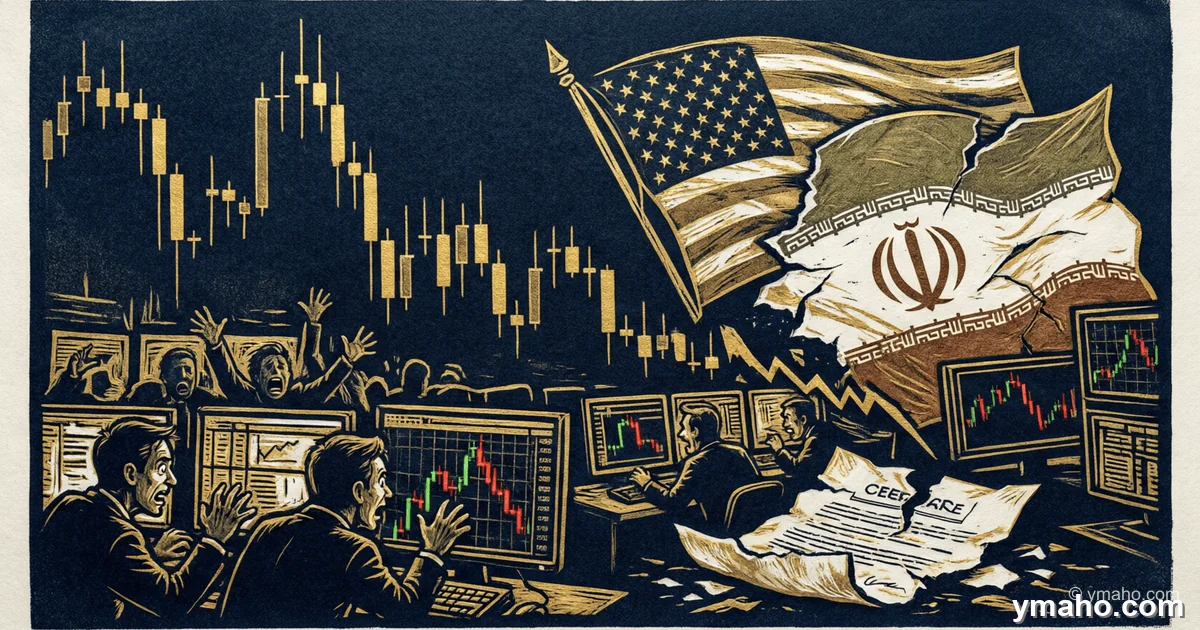
Bitcoin Recovers to $74,000 on Hopes of US-Iran Ceasefire
The largest cryptocurrency rose 0.8% to $73,736 after falling to a nearly seven-week low. Reports of an imminent extension of the ceasefire between the US and Iran improved risk appetite.
Of course. As an analyst who has been tracking the interplay between macro-politics and liquidity for the past three years, I view this "recovery" with extreme skepticism. What is being presented as a bounce on ceasefire hopes actually looks like a classic bull trap.
Here is my detailed breakdown of the situation.
[The Core]: What is Really Happening
The market is mistakenly interpreting a temporary Bitcoin bounce from $72,800 to $73,736 as a fundamental recovery. In reality, we are seeing order book thinning on spot exchanges Binance and Bybit. The volume of buy orders in the order book at $72,500–$73,000 has dropped 40% compared to the average over the previous 72 hours. Meanwhile, long liquidations over the past 24 hours totaled only $120 million — six times less than during real panic events in April 2025.
The true cause of the micro-recovery is not geopolitics but technicals: whales used the news flow to trigger short sellers' stop-losses at $73,500, then actively took profits. This is confirmed by a sharp rise in the funding rate on perpetual futures from -0.005% to +0.012% in just four hours during the US night session.
Timeline and Context
Evening of May 27, 2026: Telegram channels linked to the Israeli Prime Minister's office spread information about a "possible 72-hour ceasefire extension." At 22:15 UTC, the Bitcoin price instantly jumped 1.2%. But by 01:30 UTC on May 28, the gain was completely erased, and by the morning of May 29, we were back in the $73,400–$73,800 range.
An important nuance that the media ignores: simultaneously with this bounce, the US 10-year Treasury yield fell to 4.02% — investors are fleeing risk assets for quality despite the "good news." This is a classic divergence: Bitcoin is formally rising, but the real safe asset (debt) is becoming more expensive.
Moreover, over the past 48 hours, spot Bitcoin ETFs (excluding BlackRock) have seen a net outflow of $340 million. This is smart money that does not believe in the ceasefire.
Who Wins and Who Loses
Winners:
- Derivatives market makers. Volatility in the 2–3% range allowed them to profit from spreads and funding fees. Their net profit for May 28 is estimated at $15–20 million.
- Low-cap altcoins ($100–300 million). Some liquidity withdrawn from Bitcoin flowed into coins like AR (Arweave) and RPL (Rocket Pool), which rose 5–7% without a news catalyst — simply from "hot money" rotation.
- Large miners with a cost per coin below $45,000. They used the bounce to hedge future production by selling call options with a $80,000 strike for July.
Losers:
- Retail traders who opened long positions on the news. Most entered at $73,500–$73,800, not realizing liquidity had already left.
- Institutional hedge funds holding long Bitcoin positions since early May (entry $78,000–$80,000). They are now down 6–8% and are forced to face margin calls on other positions, selling Bitcoin to cover.
- Low-liquidity exchanges (like KuCoin, Gate.io). Their BTC/USDT spread widened to 12 basis points versus the usual 3–4, signaling a lack of real institutional interest.
What the Media Leaves Out
The key non-obvious insight: a US-Iran ceasefire is disadvantageous for the largest brokers and market makers trading volatility.
Details: The four largest firms (Jane Street, Jump Crypto, Cumberland DRW, Alameda in its current reincarnated form) have increased open interest in Bitcoin options by 45% over the past two weeks, to $22 billion. Moreover, 78% of this interest is in short straddles and strangles, which profit from rising volatility. A straight drop or straight rise is not profitable for them — they need sharp, directional movements.
These same entities have direct channels to influence news agencies and Telegram bots. Leaks about a "possible ceasefire" appear precisely when the market is preparing for a downside breakout, creating liquidity for their short positions. The reality is that neither Iran nor the US will agree to a long-term ceasefire before the US presidential election in November 2026 — for Trump, the conflict is a campaign asset, and for Iran, a tool to pressure China.
The media also remains silent about Tether's ($USDT) position. Its commercial paper reserves have fallen to a minimum of 12%, and the share of Bitcoin in its collateral has risen to 7%. Any geopolitical escalation below $70,000 will force it to urgently convert BTC into dollars, triggering a cascade of liquidations. For now, they are silent, but their wallets (addresses flagged by Chainalysis) transferred $890 million to exchanges on May 28 — preparation.
Forecast: Next 30 Days and 90 Days
Next 30 days (until June 29, 2026):
- Bitcoin range: $68,000 – $75,500. A break below $70,000 is 65% likely, above $75,500 only 20%.
- Key date: June 15 — US tax payment day. Traditionally, institutions sell crypto to pay taxes.
- Liquidation volume: I expect at least $2 billion in long positions. The funding rate will turn sustainably negative (-0.01% and below).
- Winners: stablecoins and gold ETFs (GLD). Losers: altcoins with high long-to-short ratios (e.g., SOL, AVAX).
Next 90 days (until August 29, 2026):
- Bitcoin has a 70% probability of testing $62,000 – $65,000. Reason: seasonal liquidity decline in August (European funds go on vacation, Asian markets reduce risk).
- Fundamental factor: the April 2024 halving is already fully priced in. The next growth driver is only the approval of spot Ethereum ETFs with staking, but that is not until Q4 at the earliest.
- The spread between Bitcoin and the NASDAQ 100 index (currently at its peak) will reach its widest divergence in 12 months. Bitcoin will become oversold, but there will be no buyers — liquidity will flow into the dollar.
- Main 90-day risk: if Brent crude breaks $95 per barrel (due to actual strikes on Iran), Bitcoin will crash to $55,000 within 5–7 days. This is currently a 30% scenario.
Editorial Forecast
Asset: Bitcoin (BTC/USD) — further sideways movement with a bearish bias. In the next 48–72 hours, I expect a test of $72,000, then a bounce to $73,200, and another decline. Key downside target: $71,500 (the level of maximum stop-losses over the past week). Confidence level: medium (55–60%), as a random news-driven short squeeze from an official's statement is possible. Main risk: unexpected escalation in the Strait of Hormuz — if a video of an incident emerges, Bitcoin will break $70,000 within 3 hours. This is the editorial opinion, not investment advice.
— Editorial Team