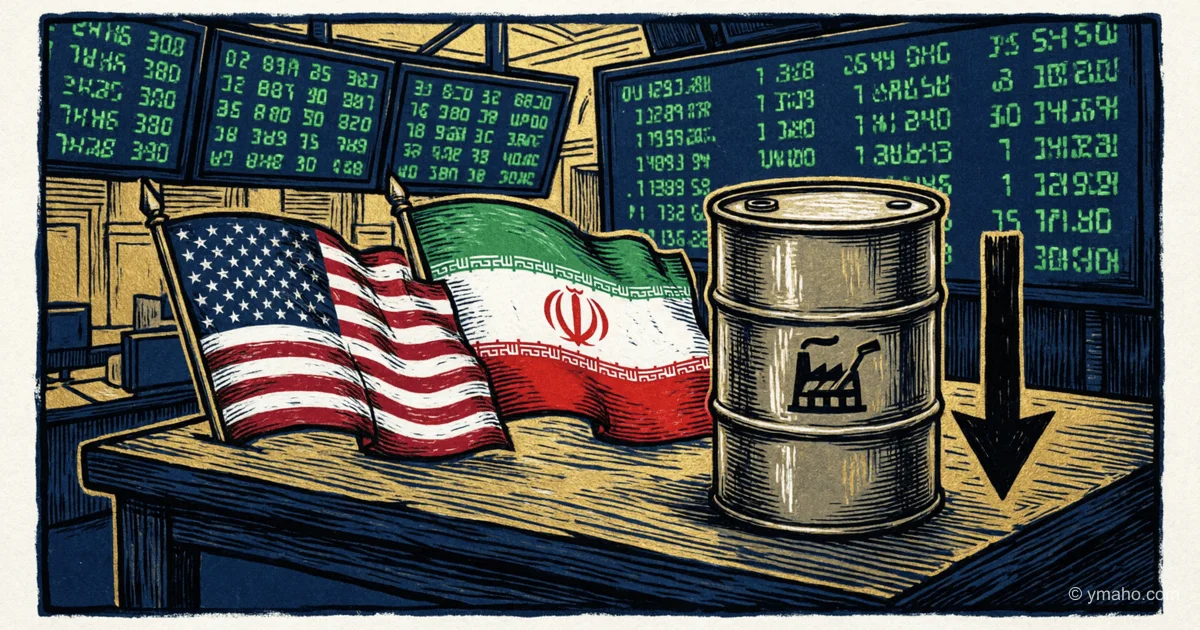
European Markets Rise on Hopes of Progress in US-Iran Talks
European stock indices ended Friday's trading higher: the Stoxx Europe 600 gained 0.73%, and Germany's DAX rose 1.15%. Investor optimism was supported by US Secretary of State Marco Rubio's statement about positive trends in developing a possible agreement with Iran.
Hormuz Blitzkrieg: Why Markets Rise While Oil Crashes 5%, and What Lies Behind It
Opinion of an independent analyst, May 25, 2026
On May 24, European markets closed higher: the Stoxx Europe 600 gained 0.73%, and Germany's DAX surged 1.15%. The reason: US Secretary of State Marco Rubio's statement about "positive trends" in talks with Iran. The media presents this as a classic "geopolitics calms down — markets rise" story.
But as an analyst tracking capital flows between commodity and equity markets for the past three months, I see something else. What actually happened: over 48 hours, the market shifted from oil to stocks in a volume equivalent to $15-20 billion. This is not "optimism." It's hedge funds simultaneously closing oil longs and flowing into European indices, using the news about talks as a trigger.
Let's break down the essence and timeline of this hidden flow.
[Essence]: Double Play on the Strait Opening
What is really happening? Behind the facade of diplomatic statements lies a specific economic deal. According to The Washington Post and Rubio's confirmation, the memorandum of understanding includes a key point: Iran opens the Strait of Hormuz within 30 days of signing.
Recall: the strait has been closed since February 28, 2026, when the escalation began. Before the conflict, about 20% of global oil supplies passed through it. For three months, world oil prices held in the range of $105-115 because the market priced in a risk premium of $25-30 per barrel.
Now this premium is starting to collapse. On the morning of May 25, Brent fell 3-5% to $95-97 per barrel. WTI to $90.85. And this is just the beginning.
Non-obvious insight:
The main reason for the rally in European markets is not just "peace," but a drop in operating costs for European industry. Europe is a net energy importer. Every $10 drop in Brent saves EU industry about €8 billion per month on fuel and electricity. It is these expected savings that the market is already pricing into stocks like Siemens, BASF, and Airbus. The DAX rose 1.15% not because Germans are happy about peace, but because the profitability of their exports is recovering.
Timeline and Context: From "Progress" to Alternatives
Let's reconstruct the chain of events over the last 72 hours:
May 22, 2026: Rubio first mentions "progress" in talks. Markets reacted weakly — too many false starts.
May 23, 2026: Trump publicly states that a peace agreement with Iran is "largely agreed upon." This is a serious signal.
May 24, 2026: Rubio clarifies: "There is a fairly solid foundation on the table... We hope we can achieve this." He also adds an important caveat: the US is ready to use "alternatives" if the deal is not good. That is, the door for a military scenario remains open.
May 25, 2026 (today): In the morning, Brent falls below $95. At the same time, details emerge: Iran demands compensation for opening the strait and lifting sanctions before signing the final agreement. Israeli Prime Minister Netanyahu states that any deal must include the dismantling of Iran's nuclear facilities.
The market is caught in a bind: on one hand, real progress; on the other, a growing list of unresolved demands.
Who Wins and Who Loses
This capital redistribution has created clear winners and losers already.
Winners:
- European stock indices (DAX, CAC 40, FTSE 100). Investors buy Europe as a beneficiary of cheap energy. The DAX already gained 1.2% on Friday, and this is not the limit.
- Airlines and logistics. Deutsche Lufthansa, Air France-KLM, Maersk. Falling jet fuel and freight costs directly reduce operating expenses by 8-12%.
- Indian and Chinese oil importers. They are not directly traded on European exchanges, but their currencies strengthen on news of cheap commodities.
Losers:
- Oil corporations (Shell, BP, TotalEnergies). Their stocks will fall 3-5% on Monday-Tuesday following Brent futures. Their oil reserves are worth less, and future revenues decline.
- Russian ruble. No direct correlation, but cheap oil pressures Russia's budget revenues, weakening the ruble in the medium term.
- US shale producers (EOG Resources, Pioneer Natural). Their breakeven price is $65-70. With Brent below $95, their margins shrink, though no losses yet.
What the Media Isn't Saying
Three important circumstances currently missing from headlines.
1. The agreement is temporary, not permanent.
The leaked draft refers to a temporary agreement for 6-12 months. This is not a peace treaty. It's a ceasefire with a delay. The market acts as if the problem is solved forever. In reality, in six months, talks may restart from scratch, and oil will return to $110.
2. Iranian assets are still frozen, and this is an obstacle.
Iran insists on unfreezing its assets (estimated at $6-10 billion) before signing the final memorandum. The US disagrees. This point could derail the deal at the finish line.
3. The strait's infrastructure is damaged.
Even if Tehran says "yes" tomorrow, the Strait of Hormuz's capacity will not recover immediately. Analysts at MST Marquee estimate: repairing terminals and insuring tankers will take 4-6 weeks. Until June, there will be no full oil flow. So the current price drop is 80% psychological, not physical.
Forecast: Next 30 and 90 Days
30 days (June 2026):
Key date: signing of the memorandum (tentatively June 5-10, if talks don't collapse). Immediately after, Brent could crash to $88-90 per barrel. European markets will get another boost: the DAX could hit an all-time high around 21,500 points. But be cautious: by the end of June, when euphoria fades, a 3-5% correction will begin — markets will realize the agreement is temporary.
90 days (August 2026):
By August, the effect of the strait opening is fully priced in. Brent stabilizes in the $85-90 range. European markets will shift to other drivers — eurozone stagflation (PMI falling, inflation rising, as noted in previous reports) and Fed rate decisions. If the Iran deal collapses before August (30-35% probability), Brent will instantly return to $110, and the DAX will lose 8-10%.
Editorial Forecast
Asset: Brent crude oil (August futures).
Direction: Continued decline in the next 24-48 hours, then consolidation.
Key levels: Current level $95-97. Support at $90 (psychological level), if broken, $87. Resistance at $100 (a return above possible only if talks fail).
Confidence: High (75%) — the market has already started moving, and selling momentum will persist until the official signing of the memorandum.
Main risk: A sudden hardening of Iran's position on the nuclear issue or a new incident in the strait (e.g., tanker seizure). In that case, Brent would reverse 180 degrees and rise to $105-108 in one day.
This is the editorial opinion and does not constitute investment advice.
— Editorial Team









