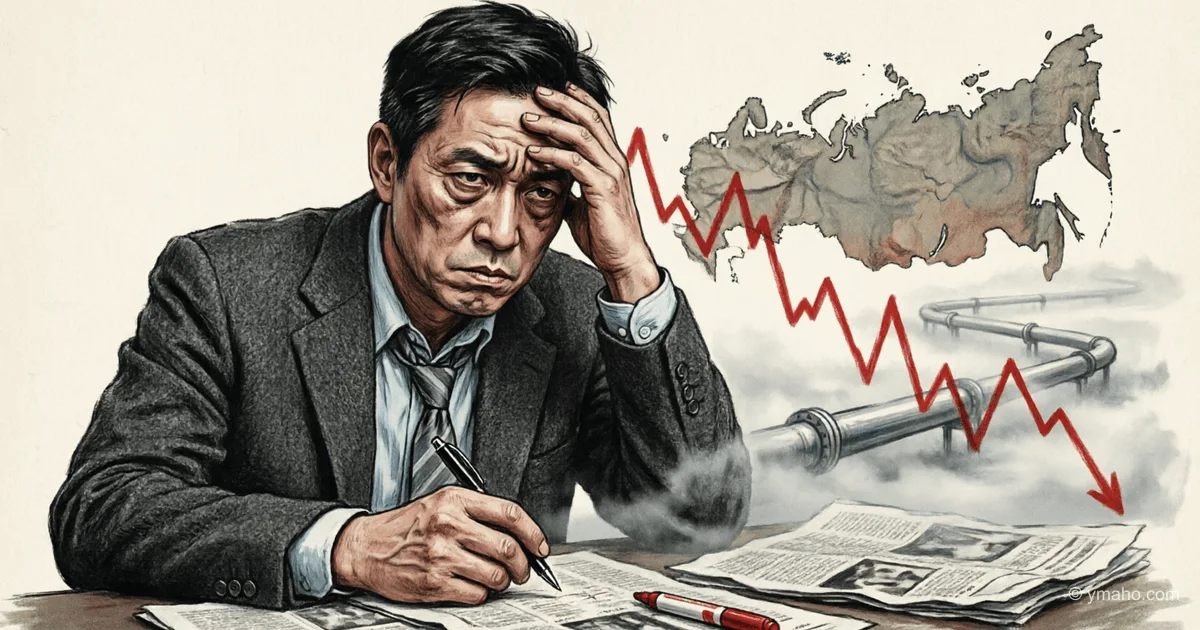
Gazprom shares fall 3.5% amid uncertainty over Power of Siberia 2
Quotes declined after statements about reaching an understanding on the project's key parameters but lacking clear implementation timelines. The MOEX Index lost 1% against this backdrop.
There is nothing surprising about the 3.5% drop in Gazprom shares. What is surprising is that the market held onto illusions at all until the visit to Beijing, which was doomed from the start. When Dmitry Peskov states that "understanding of key parameters has been reached, only details remain," in translation from diplomatic to plain English, it means: "No one will give us money, and there is no contract." The market has finally learned to read these signals, and we are now witnessing a belated but sobering removal of the geopolitical premium from the shares of a company that has refused dividends for the fourth consecutive year and is losing its last lever of influence in the eastern direction.
The Essence: What Is Really Happening
The results of the visit to Beijing, which the media are trying to portray as a "lack of progress," are actually a veiled catastrophe for Gazprom's negotiating position. It is reported that out of about 40 signed bilateral documents, none concerned oil and gas cooperation or a new pipeline. This is not just "uncertainty over timelines" — it is a harsh signal from Xi Jinping. China, using the window of opportunity due to the effective closure of the Strait of Hormuz, is twisting Moscow's arm, demanding a gas price close to the domestic Russian price (about $60–$70 per thousand cubic meters in dollar equivalent). For comparison, the remaining consumers in Europe pay several times more. Accepting such terms for Gazprom means forever transforming from a global energy giant into a subsidiary of China. Not accepting means being left with a pipe leading nowhere and a multi-billion dollar debt.
Timeline and Context
The tragedy has been unfolding not since May 2026, but over the past five years. However, the critical turning point came on May 19, when Gazprom's board of directors officially recommended not paying dividends for 2025. For the savvy investor, this was no surprise: with total debt of about $80 billion and negative free cash flow, there is simply nothing to pay shareholders with. But the combination of two news items on the same day — the failure in Beijing and the dividend refusal — created a "perfect storm" effect. If earlier shareholders could console themselves with the thought that investments would go toward the great construction of Power of Siberia 2, now there is neither construction nor dividends. All that remains is a lumbering monopolist with falling revenue and zero M&A potential in the current reality.
Who Wins and Who Loses
At first glance, the winner is China. Beijing has received a blank check. In conditions where maritime LNG supplies from Iran and Qatar are delayed, China could have panicked, but instead it is methodically squeezing Gazprom on price. The obvious loser is Gazprom's minority shareholders. Four years without payouts amid rising inflation and a strengthening dollar turns their investments into a classic "value trap." Separately, the Russian budget loses out: the state as the controlling shareholder is missing out on tens of billions of rubles that could have covered the budget deficit.
However, there is also a non-obvious beneficiary — Novatek and independent gas producers. The absence of a monopoly on an export pipeline contract with China makes their LNG projects the only window to Asia for Russian gas, increasing their bargaining power and strategic valuation.
What the Media Are Not Saying
While everyone discusses "uncertainty," the most acute insider insight lies in the area of currency control and the corporation's financial flows. Analysts overlook that Gazprom, under sanctions, has become hostage to cross-subsidization schemes and hidden financing of other state projects. A huge investment program (including endless social construction and gasification) eats up operating cash flow before it even reaches debt service or profit distribution items. The dividend refusal is not a management decision but a symptom that the company has been turned into a "wallet" for solving socio-political tasks. It is this conflict between the company's public status and its functions as a state agency that is killing capitalization. Moreover, China understands this perfectly and therefore is in no hurry to sign a contract: why pay a high price if the counterparty is burdened with non-core expenses and is forced to sell at any price?
Forecast: Next 30 Days and 90 Days
30 days (by June 21, 2026). I expect continued pressure on Gazprom shares. The MOEX Index will fluctuate in the range of 2600-2650 points, as Gazprom pulls it down while oil stocks try to hold the platform amid relatively high oil prices (Brent above $100). No specific progress on construction should be expected — the parties will take a pause until autumn. The price target for negotiations has been set for September, meaning the market will live in an information vacuum until August.
90 days (by the end of August 2026). This is the moment of truth. If by the appointed time (September) the Kremlin does not extract price concessions from Beijing, Gazprom will face a reality where without a strategically acceptable solution, it will have to either start cutting the investment program or ask for direct assistance from the National Welfare Fund. This would send quotes down another 10-15%. However, there is an alternative scenario: by autumn, China will agree to a contract on its own terms. For the market, this would mean that shares get a short-term growth driver ("deal signed"), but the long-term profitability of the business would be undermined by low supply prices. In either case, Gazprom will no longer become the former growth giant.
Editorial Forecast
Asset: Shares of PJSC Gazprom (GAZP). Direction: short-term sideways with a risk of slipping 1-2% in the next 48 hours.
Key levels: support around 150-155 rubles (per share). Confidence level: high regarding the sideways trend.
The market has already priced in the shock from the lack of a contract and dividends, but buyers are still absent due to fundamental uncertainty over the gas price for China. Risk to the forecast: a sudden announcement by Beijing and Moscow of a framework agreement, which could trigger a short-term spike of 3-5%, but without an approved pricing formula, the rise will be quickly sold off. This is the editorial opinion, not an investment recommendation.
— Editorial Team









