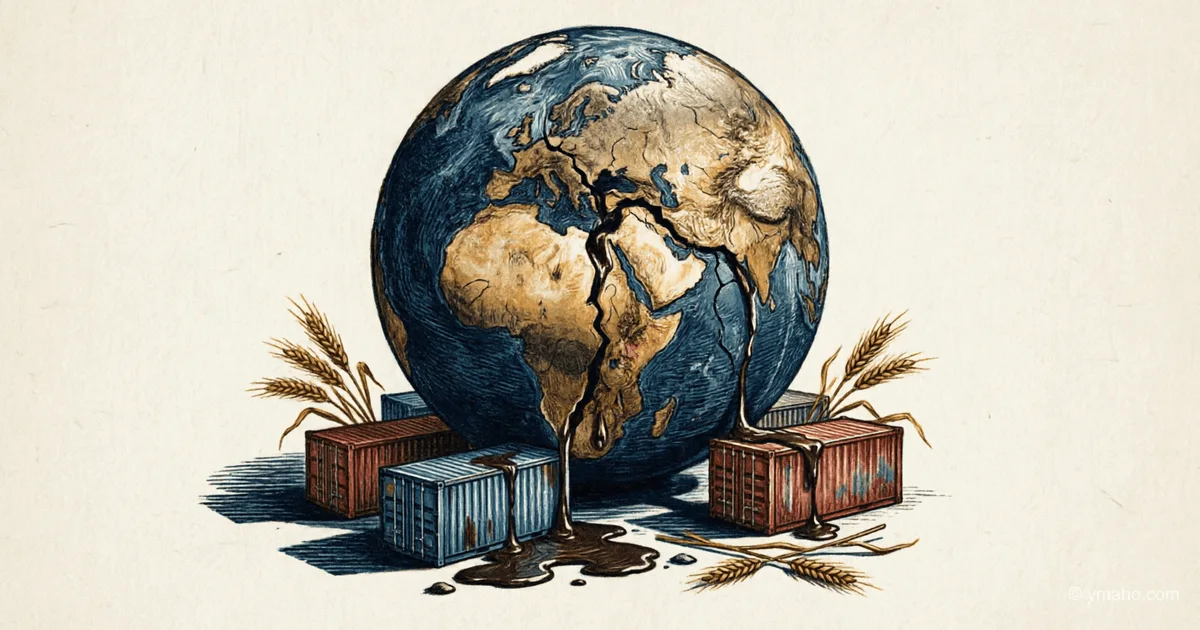
UN Downgrades Global GDP Growth Forecast to 2.5% Due to Middle East Crisis
The UN has downgraded its global economic growth forecast for 2026 to 2.5%, warning that in a worst-case scenario, the figure could fall to 2.1% due to rising energy prices and supply chain disruptions.
While business media headlines are fixated on the "2.5%" figure, the real story unfolding on May 19 at UN headquarters is not the forecast revision, but the ominous silence surrounding the section on global food security. The document I read is not just an economic report. It is a veiled warning about a structural breakdown in global logistics that cannot be fixed with old monetary tools.
The Essence: What Is Really Happening
The global GDP growth forecast of 2.5% is the "baseline scenario," already outdated at the time of publication. It does not account for the secondary effects described in footnote 14 on page 12 of the UNCTAD report published the same day. The point is that global trade is slowing not linearly, but cascadingly. Global trade growth in 2026 is expected at 1.5–2.5%, down from 4.7% in 2025. That is a drop of more than half in one year—an event that only occurs during global recessions or pandemics.
But the real bomb is in the inflation forecast. The UN raised its global inflation forecast to 3.9%—up 0.8 percentage points in just a few months. Such a sharp revision has not been seen since 2008. For developing countries, the figure jumps to 5.2%. This is not just "rising prices"; it is the death of domestic demand in countries that have served as engines of global growth for decades.
Timeline and Context
The assault on forecasts began not on May 19, but on February 28, when the US and Israel launched airstrikes on Iran, to which Tehran responded by blockading the Strait of Hormuz. Since then, the global economy has lost an artery through which one-fifth of the world's oil and gas supplies flow.
In the 80 days since the blockade began, three critical shifts have occurred:
Oil trap for Europe. Unlike the US, which is relatively self-sufficient, Europe is caught in a trap. The eurozone depends on energy imports, and its growth forecast has fallen from 1.5% in 2025 to 1.1% in 2026. For the UK, the situation is even worse: a drop from 1.4% to 0.7%. This is not a cyclical slowdown, but a brutal reassessment of an entire economic model built on cheap imports.
Invisible wheat and fertilizers. While everyone watches the Brent price, the UN report raises a topic the market is ignoring: disruptions in the fertilizer supply chain. Hormuz is a channel not only for crude oil, but also for natural gas and chemicals. Fertilizer supply disruptions are already pressuring global food prices. The UN estimates that the number of people facing acute food insecurity could rise by 45 million to 363 million. Hunger always leads to political instability.
Asian pivot. The forecast for the US remains "relatively stable" at 2%, but for West Asia—the Persian Gulf region—the UN predicts a collapse from 3.6% to 1.4%. This is a regional catastrophe driven by infrastructure destruction and the collapse of tourism and trade. Meanwhile, China and India show "relatively strong growth momentum," but it is only a matter of time: their dependence on energy imports from the Persian Gulf is an Achilles' heel.
Who Wins and Who Loses
The losers are obvious: any country with an energy deficit. This includes all of South and Southeast Asia, which depend on remittances from Persian Gulf countries. As soon as construction in Dubai and oil fields in Saudi Arabia begin to experience disruptions, remittance flows to Bangladesh, Nepal, and the Philippines will dry up. This will pull the bottom brick from the foundation of consumer demand in these countries.
A hidden loser is US Treasury debt. At first glance, the US is safe. But Morgan Stanley, in its semi-annual forecast of May 15, indicated that a resolution scenario is expected only by mid-June, and even then in the baseline case. If the blockade drags on and oil prices rise above $150 per barrel, the "recession switch" will be triggered. This will crush demand for risk assets, and foreign holders will start dumping UST, driving yields to levels unthinkable for an economy with $35 trillion in debt.
The winners are only a narrow layer of energy traders and a few exporting countries like Algeria and Angola, which are reaping short-term windfall profits from soaring prices. But even for them, this is a Pyrrhic victory: rising food import costs will quickly eat away that margin.
What the Media Is Not Saying
A key point from the report is being suppressed: the UN cannot give an accurate forecast because "policy changes faster than the forecasting cycle can capture." In other words, official data is a photograph of the day before yesterday.
A second suppressed fact: the development financing gap has reached $4 trillion. This means developing countries cannot service debts, maintain healthcare, or fund education. This is not a macroeconomic abstraction, but a direct path to defaults and social explosions in Africa and Asia, the consequences of which will instantly spill over onto the balance sheets of European banks that lent to these regions.
Forecast: Next 30 Days and 90 Days
30 days. Morgan Stanley's baseline scenario of a conflict resolution by mid-June looks optimistic. Markets will start pricing in a "protracted war premium." Brent oil will test $105-110. Business activity indices in Europe will fall into contraction territory below 48 points. We will see the first major debt defaults in Egypt and Pakistan.
90 days. If the crisis resolution scenario does not materialize, the world will shift to a "war economy" model. Oil prices above $120 will become the new normal, global inflation will exceed 4.5%, and central banks will face an impossible choice: crush inflation with rate hikes, triggering a recession, or tolerate rising prices that destroy the middle class. The 2.1% GDP growth forecast that the UN calls the "worst-case scenario" will become the new baseline.
Editorial Forecast
Asset: Natural Gas Futures (Dutch TTF)
Direction: Up in the next 24-72 hours. The market is only beginning to grasp the scale of fertilizer and gas-chemical disruptions described in the UN report, which is pressuring LNG supply to Europe amid competition with Asia.
Key Levels: A break above €48 per megawatt-hour opens the path to €52. Support is at €44.
Confidence Level: Medium. Technically, gas is oversold after last week's correction, but the geopolitical premium could be realized at any moment.
Main Risk: Emergency EU intervention with a price cap or mandatory reduction in industrial gas consumption—in that case, quotes could collapse below €40 per MWh.
Editorial opinion, not investment advice.
— Editorial Team









