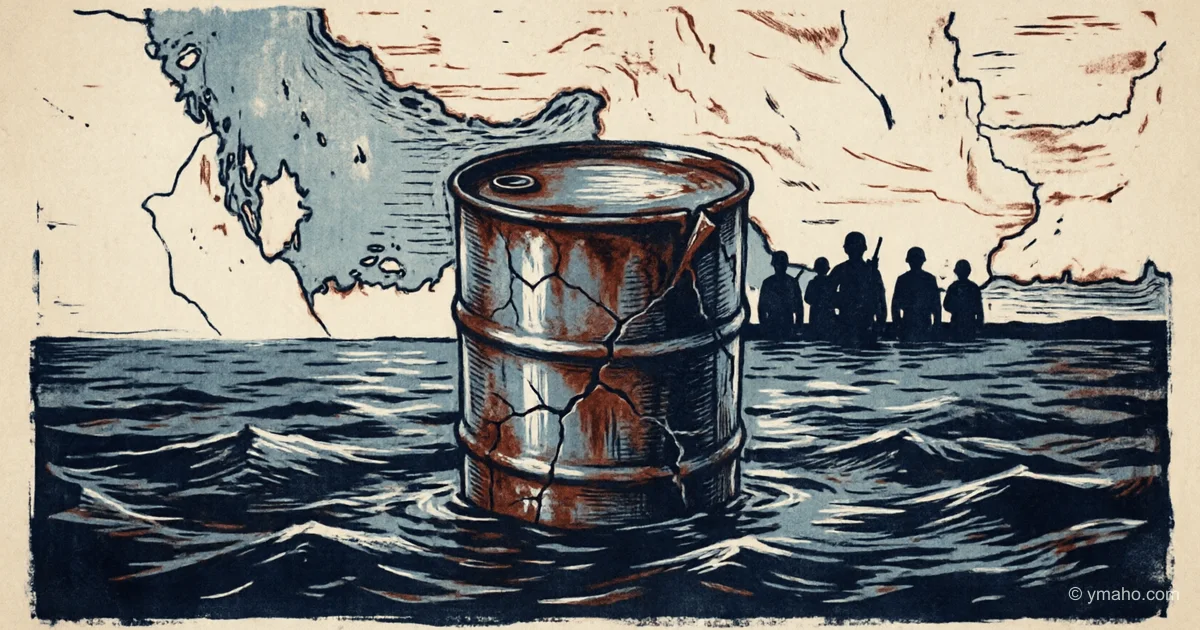
Global Oil Inventories Hit Lowest Level in Nearly a Decade
According to UBS estimates, global crude oil inventories could fall to 7.6 billion barrels by the end of May — the lowest since 2016 — as the conflict in the Persian Gulf severely disrupts shipments through the Strait of Hormuz.
The figure of 7.6 billion barrels cited by UBS sounds alarming, but it is only the tip of the iceberg. The market, hypnotized by absolute numbers, overlooks the qualitative transformation of the inventories themselves. We are entering a zone where oil ceases to be just a traded commodity and becomes a geopolitical weapon of the apocalypse.
The Core: What Is Really Happening
The UBS report everyone is referencing records a drop in global inventories to 7.6 billion barrels by the end of May. But the key insight is not the number itself, but the speed at which the market's "liquidity cushion" is shrinking. This is not about government strategic reserves, which are released with great fanfare, but about commercial oil inventories "in transit" and at regional hubs, which usually serve as a quick buffer against demand spikes.
Due to the effective blockade of the Strait of Hormuz, this "fast" oil is disappearing from the map. According to vessel tracking data, traffic through the strait has fallen to 10 transits per day, compared to the usual 125–140. The world is losing not just barrels, but operational flexibility. When a refinery in Rotterdam or Ulsan runs out of crude, it cannot simply take it from the "global pool" — a tanker needs clearance from the IRGC to exit the Persian Gulf. This turns market logistics into military-diplomatic negotiations.
Timeline and Context
The inventory collapse did not start on May 20, but on February 28, when the conflict between the US and Iran escalated into a hot phase and the Strait of Hormuz was effectively closed to free navigation. Over three months, we have gone through three stages.
The first stage was a supply shock. In April, global inventories shrank by an average of 6.6 million barrels per day. The cumulative market losses over this period reached one billion barrels.
The second stage was buffering, which began in late March. Governments, primarily the US, started aggressively selling off strategic reserves. Since the start of the crisis, the US SPR has fallen to 374 million barrels — the lowest since July 2024. In just one week, a record 9.9 million barrels were withdrawn from the SPR. This allowed the US to boost exports to an all-time high of 5.6 million barrels per day and temporarily plug the hole in the market.
The third stage is now upon us. According to UBS, "buffers are largely exhausted." Demand has, of course, been somewhat destroyed by prices soaring to $110 per barrel, but this does not compensate for the physical shortage of crude. Inventories at the key Cushing hub are approaching critical "working bottom."
Who Wins and Who Loses
Is Iran winning? Definitely. UBS directly states that the current dynamics "align with Tehran's interests": the longer it keeps the strait closed, the greater the economic pressure on the US to strike a deal. Iran is effectively blackmailing the entire world, turning every day of delay for the vessel Universal Winner carrying 2 million barrels of Kuwaiti oil into a bargaining chip.
Asian economies without strategic reserves are the clear losers. Indonesia, Vietnam, Pakistan, and the Philippines will face "operational stress" in the coming months. But the most unexpected loser is the Saudi and Kuwaiti oil industry. Having physical oil, they cannot sell it due to the logistical collapse in the Gulf, losing market share to US exporters who are ramping up shipments via the SPR.
What the Media Is Not Saying
There is silence about the physical damage to US SPR infrastructure. The accelerated drawdown of strategic reserves — over 1.4 million barrels per day — will inevitably damage the salt caverns where this oil is stored. This involves the risk of roof collapse and cavity deformation. This means that even when the crisis ends, the US will not be able to simply "pump it all back" — a significant portion of storage capacity may be lost forever.
The second hushed-up fact is the "Panama hole" in statistics. The inventories that are now rapidly declining are mainly concentrated in non-OECD countries. Data from there arrives with a delay and is often fabricated. The real situation in oil storage facilities in India or China could be much worse. When this information leaks to the market, it could trigger the very "panic buying" that UBS warns about.
Forecast: Next 30 Days and 90 Days
30 days. The market will continue to hang by a thread on Trump's statements. As shown on May 20, a single phrase about the "final stage of negotiations" can crash prices by 7% intraday. However, the physical deficit will not go away, and Brent will hold in the $103–115 range. If negotiations stall and the SPR continues to shrink, fuel rationing will begin in Asia.
90 days. By August, the world will enter a mode of severe oil austerity. If Iran continues to hold the strait, further use of the SPR will become physically dangerous for the storage facilities, while commercial inventories in the US will continue to fall (just last week, minus 7.9 million barrels), and the market will face a real shortage. In this case, Brent could rise above $130. However, there is a high probability that the parties will still reach a deal, and then, after the blockade is lifted, pent-up oil will flood the market, causing prices to collapse to $85 and, paradoxically, a new crisis — this time for US shale producers.
Editorial Forecast
Asset: Brent crude oil (next month futures)
Direction: Upward in the next 24–72 hours. A technical bounce after the crash on Trump's words and fundamental pressure from the record inventory drop and SPR issues will push prices higher.
Key levels: The nearest target is a return to the consolidation zone of $107.50–$110.00 per barrel. A break above $110 likely tests $115. Support is at $103 (May 20 low).
Confidence level: Medium. The market is highly politicized, and any leaks about progress in US-Iran negotiations instantly remove the risk premium, as we saw yesterday.
Main risk: An official announcement of a truce or deal to reopen the Strait of Hormuz. In this scenario, the oil sell-off would be instant and brutal, with Brent falling 10–15% in a single trading session.
Editorial opinion, not investment advice.
— Editorial Team









