The Ultimate Guide To Storing Crypto Safely
The Ultimate Guide To Storing Crypto Safely
Cryptocurrency offers unprecedented financial independence, but this freedom comes with a critical responsibility: you become your own bank. Unlike traditional assets held with a brokerage, crypto ownership is determined by who controls the private keys, making it essential to understand how to store cryptocurrency safely to protect your digital wealth from hacks, scams, and irreversible loss . This guide distills expert advice from financial regulators and security professionals into a clear, actionable strategy for safeguarding your assets, whether you are a beginner or a seasoned investor.
What You'll Learn
By the end of this guide, you'll understand the fundamental difference between hot and cold wallets and the critical importance of private key control. You'll be able to choose a storage method that balances security and convenience for your needs. Most importantly, you'll walk away with a clear, step-by-step plan to implement a hybrid storage strategy, protecting your long-term holdings while keeping some funds accessible for trading.
Understanding the Fundamentals: Private Keys and Custody
The first principle of crypto security is that your coins are not "stored" in a wallet like cash in a physical one. Instead, a cryptocurrency wallet stores the "private keys"—cryptographic passcodes that prove your ownership of assets on the blockchain . A private key is like a master password. Anyone who possesses it can authorize transactions and move your funds . Conversely, your "public key" is like your email address, which you can share to receive funds .
This leads to the golden rule of crypto: "Not your keys, not your crypto." Your assets are only truly secure if you control the private keys.
Custodial vs. Non-Custodial Storage
Your first major decision is about who controls these keys:
- Custodial Storage: A third party, like a crypto exchange (e.g., Coinbase, Kraken), holds your private keys for you . This is convenient, as you don't have to manage complex security protocols, and customer support can help with password recovery . However, it introduces third-party risk. If the exchange is hacked, goes bankrupt, or freezes withdrawals (as seen in the FTX collapse), you could lose access to your funds . Custodial accounts are also not insured by the FDIC or SIPC .
- Non-Custodial (Self-Custody): You take full responsibility for securing your private keys . This gives you complete control and eliminates third-party risk but also means there is no "forgot password" option. Losing your keys or seed phrase means losing your crypto forever .
Hot vs. Cold Wallets: The Security Spectrum
For self-custody, your storage options fall into two main categories that balance convenience against security.
Hot Wallets: Convenience for Active Use
A hot wallet is any wallet connected to the internet, such as a mobile app, desktop software, or a web-based interface . They are ideal for storing small amounts of crypto you use for daily transactions, trading, or interacting with decentralized finance (DeFi) applications .
The primary advantage is convenience: they allow for quick and easy access to your funds . The major drawback is increased vulnerability. Because they are always online, hot wallets are susceptible to hacking attempts, malware, and phishing scams . High-profile exchange attacks, such as the one on Binance in October 2022 where hackers stole $570 million, underscore these risks .
⚠️ Critical Warning: Consider hot wallets analogous to a physical wallet. You would carry a small amount of cash for daily expenses but would not store your life savings there.
Cold Wallets: The Secure Vault for Long-Term Holdings
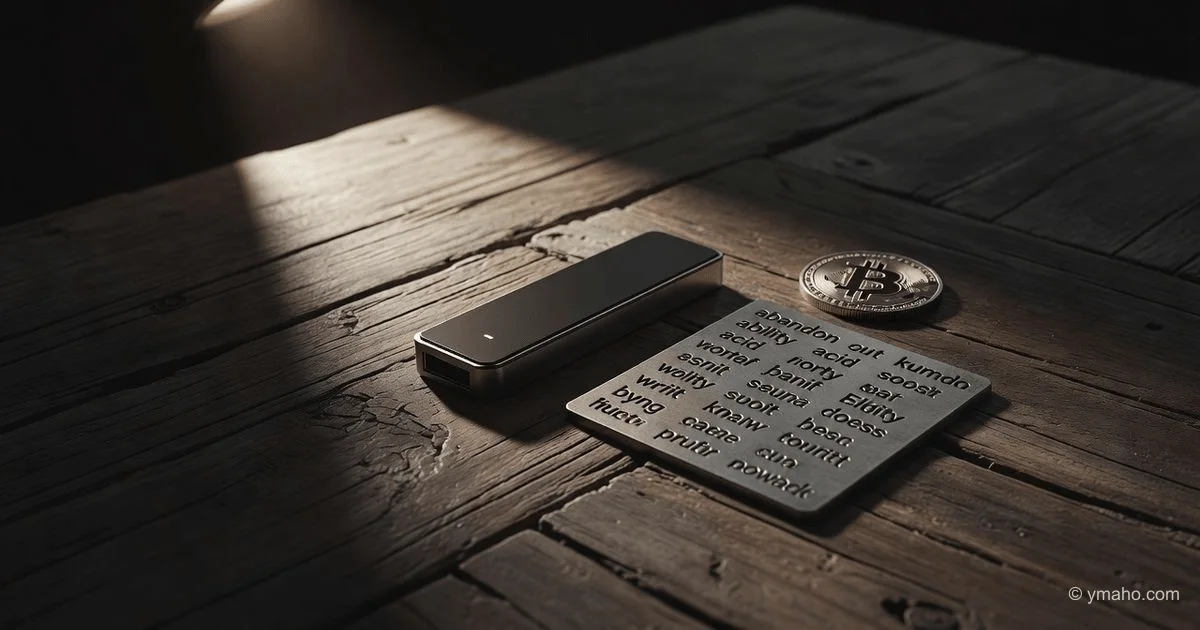
A cold wallet is a storage method that keeps your private keys completely offline, making them immune to remote cyberattacks . The most common and recommended type of cold wallet is a hardware wallet, a physical device (resembling a USB stick) that generates and stores your private keys in a secure element chip .
Hardware wallets, such as Ledger or Trezor, are considered one of the safest ways to store significant amounts of cryptocurrency . When you need to make a transaction, you physically connect the device to a computer or phone and authorize the transaction on the device itself, ensuring your private key never touches the internet . Other forms of cold storage include paper wallets (a physical printout of your keys or seed phrase), though these are more fragile and less convenient .
The trade-off is lower convenience. Accessing your funds requires a physical device and a deliberate, multi-step process, which makes frequent trading cumbersome . There is also a risk of physical loss or damage, which is why a proper backup is essential .
| Feature | Hot Wallet (e.g., Exchange/Mobile App) | Cold Wallet (e.g., Hardware Device) |
|---|---|---|
| Connection | Always connected to the internet | Completely offline |
| Security | Vulnerable to hacks and phishing | Highly secure; immune to remote attacks |
| Convenience | High; easy and fast for transactions | Low; requires physical device and setup |
| Best For | Small amounts, active trading | Long-term savings, large holdings |
| Cost | Typically free | $50 to $200 for a hardware device |
The Expert Hybrid Strategy: Best of Both Worlds
Financial experts and security professionals overwhelmingly recommend a hybrid strategy as the most practical and secure approach for most investors . This involves using both hot and cold wallets to balance security with accessibility.
- The Vault: Store the bulk of your long-term cryptocurrency holdings (e.g., Bitcoin, Ethereum) in a hardware wallet . This is your "savings account" that you rarely touch.
- The Checking Account: Keep a smaller amount of crypto in a hot wallet (or on a trusted exchange) for active trading, staking, or daily spending .
A common and safe practice is to buy crypto on a regulated exchange and then immediately transfer the assets you plan to hold long-term to your cold wallet .
A Step-by-Step Guide to Moving Crypto to Cold Storage
- Select a Reputable Hardware Wallet: Purchase a hardware wallet directly from the manufacturer (e.g., Ledger, Trezor, Tangem) to avoid tampered devices .
- Set Up Your Wallet: Follow the manufacturer's instructions to initialize the device. This process will generate your private key and a seed phrase.
- Secure Your Seed Phrase: This is the most critical step. Your seed phrase is a list of 12-24 words that can restore your entire wallet. Write it down on paper or stamp it on a fireproof metal plate. Store it offline in a secure location. Never store it digitally (e.g., on your phone, in the cloud, or in an email) .
- Get Your Public Address: In your hardware wallet's app, find the "Receive" function. Copy your wallet's public address (a long string of characters) for the asset you want to transfer (e.g., Bitcoin).
- Initiate the Transfer on Your Exchange: On your chosen exchange (e.g., Coinbase, Kraken), navigate to the "Withdraw" or "Send" option. Paste your public address into the recipient field.
- Execute a Test Transaction: Before moving your entire balance, send a small test amount (e.g., $5-$10 worth of crypto) to your cold wallet . Wait for it to confirm on the blockchain and appear in your wallet. This verifies that the address and network are correct.
- Send the Remainder: Once the test is successful, send the remaining balance you wish to store securely.
⚠️ Critical Warning: Always double-check the recipient address and the network you are using. Sending crypto to an address on the wrong network (e.g., sending BNB on the Ethereum network) can result in the permanent loss of your funds .
Essential Security Hygiene for All Users
Beyond choosing the right wallet, consistent security habits are vital for learning how to store cryptocurrency safely .
- Never Share Your Seed Phrase or Private Keys: Legitimate companies and support teams will never ask for this information . Any request for it is a scam .
- Use Strong, Unique Passwords: Employ a password manager to generate and store complex, unique passwords for all exchange and wallet accounts .
- Enable Multi-Factor Authentication (MFA): Use an authenticator app (like Google Authenticator or Authy) for all crypto accounts. Avoid SMS-based 2FA, as it is vulnerable to SIM-swap attacks .
- Keep Your Software Updated: Regularly update your wallet apps, exchange apps, and device operating systems to patch known security vulnerabilities .
- Beware of Phishing: Be skeptical of unsolicited emails, direct messages, or links, especially those promising giveaways or urging immediate action . Always type the exchange or wallet URL directly into your browser.
- Keep Your Holdings Private: Avoid publicly bragging about your cryptocurrency holdings, as this can make you a target for scammers and even physical threats .
Sources
- Fidelity. "Is bitcoin safe? | How to safely buy and store cryptocurrencies."
- Investor.gov. "Crypto Asset Custody Basics for Retail Investors – Investor Bulletin." U.S. Securities and Exchange Commission.
- Forbes Advisor. "What Is The Safest Way To Store Crypto?"
- Bitpanda Academy. "How can I keep my cryptocurrencies safe?"
- WalletInvestor via CoinMarketCap. "The Ultimate 7-Step Checklist: Stop Losing Crypto and Buy Bitcoin Safely Online (Before It’s Too Late)."
- The Investor's Podcast Network. "From Stocks to Bitcoin: How Investors Can Safely Store Digital Assets."
- Tangem Blog. "How to Safely Buy Crypto on an Exchange and Move to Cold Storage (2026)."
- KuCoin. "如何安全儲存加密貨幣:2026 年的安全提示."
— Editorial Team