Hydration Without Compromise: A Review of the Best Face Creams of 2026
Dermatologists confirm that even oily skin needs hydration to avoid sebum hyperproduction. The top includes Glow Recipe Watermelon Milk Peptide Cushion Cream and other products that strengthen the hydrolipidic barrier without stickiness.
The False Compromise: Why "Hydration for Oily Skin" Is the Biggest Trap of 2026
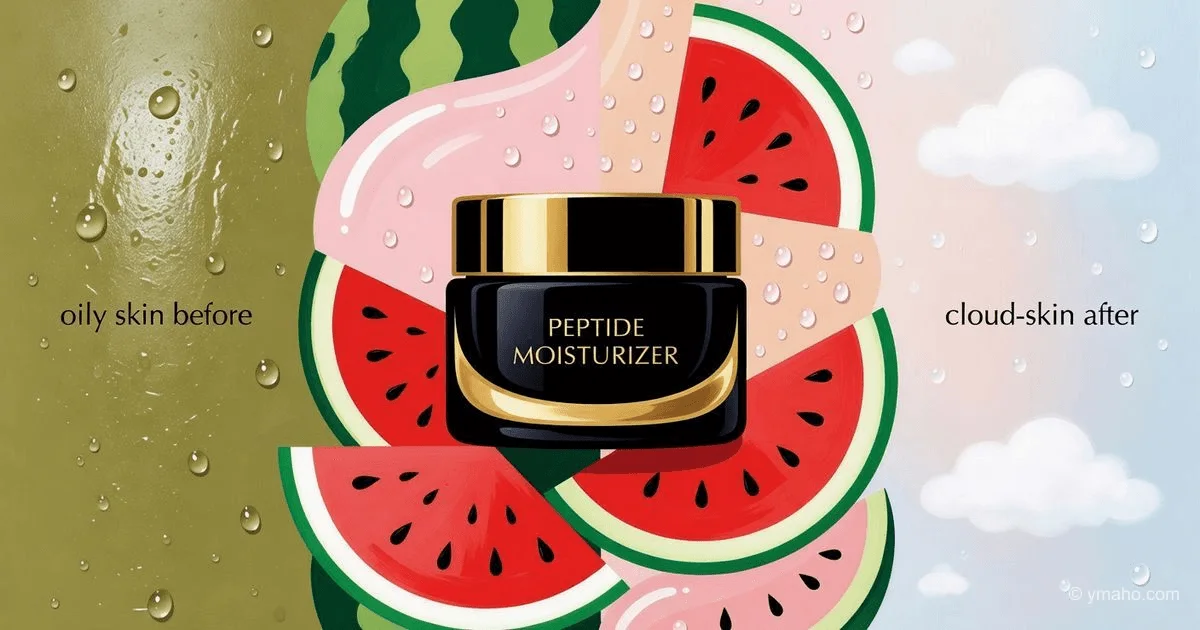
While publications publish reviews of "the best face creams of 2026" where dermatologists unanimously state that "even oily skin needs hydration," the industry is undergoing a concept substitution that no one notices. Glow Recipe Watermelon Milk Peptide Cushion Cream, launched in April 2026, is hailed as the "poster child of the cloud-skin trend" — that same "cloud skin" that replaced the "glazed donut."
But what is really behind this rebranding?
[The Gist]: What Is Really Happening
It's a rebranding of an old problem. "Oily skin needs hydration" is a medical fact. But turning this fact into a marketing slogan has created an entire category of products that sell a solution where there is no problem.
Glow Recipe promises "100 hours of hydration," "barrier repair in 10 minutes," and a "cloud-like" texture that "leaves no stickiness." The formula contains 10+ peptides, including copper tripeptide, ceramides, ectoin, hyaluronic acid, and vitamin C. Sounds like a revolution. Price: $48–56 USD in the US.
But insiders know: "cloud skin" is not a new technology. It's a repackaging of the Korean concept of "cushion skin," which has existed since 2018. The only real innovation is shifting focus from "dewy" to "non-sticky." And here lies the main deception.
The key non-obvious insight that won't make it into reviews:
The category of "moisturizers for oily skin" is a self-liquidating product. If a cream properly hydrates and repairs the barrier, after 3-4 weeks of regular use, oily skin ceases to be oily. Sebum hyperproduction is a protective mechanism of a dehydrated barrier. Remove dehydration, and excess oil goes away. But if the cream truly solves the problem, the consumer no longer needs it. So the industry creates products that give the feeling of hydration without actual barrier repair. They remove stickiness — but don't treat the cause. The consumer remains with oily skin and buys the next "specialized" cream. This is a business model based on maintaining the symptom.
Timeline and Context
Phase 1 (2020–2024): Dominance of "Hydration for All." Riding the Korean cosmetics boom, Western brands copy formulas with hyaluronic acid without adapting them to Western climates and skin types.
Phase 2 (2025): The Collapse of "Glass Skin." Consumers with oily skin realize that "dewy finish" means "pancake face" by the end of the day. Demand for "non-sticky" textures emerges.
Phase 3 (April 2026 – Present): The Birth of "Cloud Skin." Glow Recipe launches Watermelon Milk Peptide Cushion Cream. The brand positions it as a "fragrance-free, silicone-free, non-comedogenic, vegan" product for dry and sensitive skin. The marketing strategy builds on a paradox: "hydration for all, including oily skin." The cream appears at Sephora on May 1, 2026. In Asia, it is resold with a 30-50% markup.
Who Wins and Who Loses
Winners:
- Glow Recipe. Founded in 2014 by two former L'Oréal Korea employees with $25k in personal savings, the brand now sells in 35 countries. Their watermelon line sells one product every 12 seconds globally. The new cream is an attempt to expand the audience to the "adult" sensitive skin segment, tired of aggressive anti-aging.
- Sephora. Exclusive distribution rights in the US and Canada ensure traffic. Retail price in Canada is $56 CAD, about 15% higher than in the US. The markup stays with the retailer.
- Peptide and Ectoin Manufacturers. The biotech active ingredients market is growing explosively. 76% of global consumers associate a healthy barrier with overall skin beauty. Suppliers like Carst & Walker report double-digit order growth for ceramides, ectoin, and peptides.
Losers:
- Traditional "Heavy" Creams for Dry Skin. La Mer, Clé de Peau — their time is passing. Consumers no longer want "greasy shine" even if they have dry skin. The trend for "breathable" textures is killing the occlusive cream category.
- Brands Without a "Non-Sticky" Line. Kiehl's, Origins — their ultra-hydrating formulas are perceived as "old-fashioned" compared to cushion formats.
- Consumers Who Believe in "Hydration Without Compromise." They pay $50 for a cream that doesn't solve their problem, because the problem isn't lack of hydration. The problem is a damaged barrier that requires not a light cream but a comprehensive approach — including rethinking cleansing, avoiding alcohol-based toners, and using occlusives at night.
What the Media Aren't Saying
First: "100 hours of hydration" is a lab manipulation. Glow Recipe's clinical tests show the cream "hydrates up to 10 skin layers" and "repairs the barrier in 10 minutes." But these numbers are obtained under ideal humidity and temperature conditions, with the "correct" amount applied. In real life, under air conditioning or in the sun, 100 hours become 8-10. And "barrier repair in 10 minutes" means repair of the top layer, not addressing deep damage.
Second fact: PDRN and exosomes are the real revolution, but they are being ignored. While Glow Recipe sells peptides (an ingredient known for 20 years), the industry is moving toward next-generation biotech actives. Polydeoxyribonucleotides (PDRN), extracted from salmon DNA, stimulate the synthesis of your own collagen and have already entered the mass market in 2026. Exosomes — nanoparticles that improve intercellular communication and trigger regeneration — are becoming standard in luxury lines from Sesderma and Uriage. These ingredients don't just "hydrate." They reprogram the cell. But they are absent from reviews of "best creams" because they are expensive, and mass brands cannot scale them.
Third (cynical) insight: "Collagen banking" is a new package for an old idea. Asian publications in 2026 promote the concept of a "collagen bank": not just "replenishing" collagen, but "protecting against loss, repairing damaged, and stimulating new." Lancôme, HR, Chanel launch creams with PDRN, exosomes, and "anti-aging" peptide complexes. But these products cost $150–300. Glow Recipe at $48 is "kindergarten" compared to them. The media don't write about this gap because their audience is the mass consumer who needs an "affordable solution."
Forecast: Next 30 Days and 90 Days
Next 30 Days (June 2026):
Expect a wave of imitators. Every other mass brand will release a "cushion cream" or "cloud cream" with peptides and without silicones. First CeraVe, then Neutrogena, then budget brands. The market will be oversaturated with "light" moisturizers. Consumers will be confused.
Next 90 Days (End of Summer 2026):
Segmentation will begin. "Cloud skin" will split into three subcategories:
- For oily skin: mattifying cushion creams with niacinamide and zinc.
- For dry skin: richer versions with ceramides and squalane.
- For sensitive skin: formulas with ectoin, panthenol, and no potential allergens.
In the high-end market, there will be a shift from "peptides" to "exosomes and PDRN." Lancôme has already incorporated "pink PDRN" (from rose petals, not salmon) into its Absolue line. Sesderma promotes Exoses with exosomes. By the end of 2026, a "regular" peptide cream will be perceived as outdated.
Expected Numbers:
- The biotech actives market (PDRN, exosomes, growth factors) will grow by 35% by the end of 2026.
- Glow Recipe will maintain leadership in the "under $60" segment but will lose share when Estée Lauder and L'Oréal launch similar products with more aggressive marketing.
What an Insider Should Do: Don't believe in "cloud skin." Look at ingredients. Peptides are so 2015. If a brand doesn't add exosomes, PDRN, or at least a patented enzyme (like DARPHIN with CDP protease) to the formula, it's falling behind. And "100 hours of hydration" is a number that means nothing.
Conclusion: Hydration without compromise is a myth. There is always a compromise. In Glow Recipe's case, it's price. In budget alternatives, it's efficacy. In the high-end market, it's accessibility. The industry has learned to sell "clouds" to those who are drowning. But drowning people need a lifebuoy, not an illusion of lightness. Real barrier protection is boring, not Instagrammable, and often requires heavy textures. But it works.
— Editorial Team