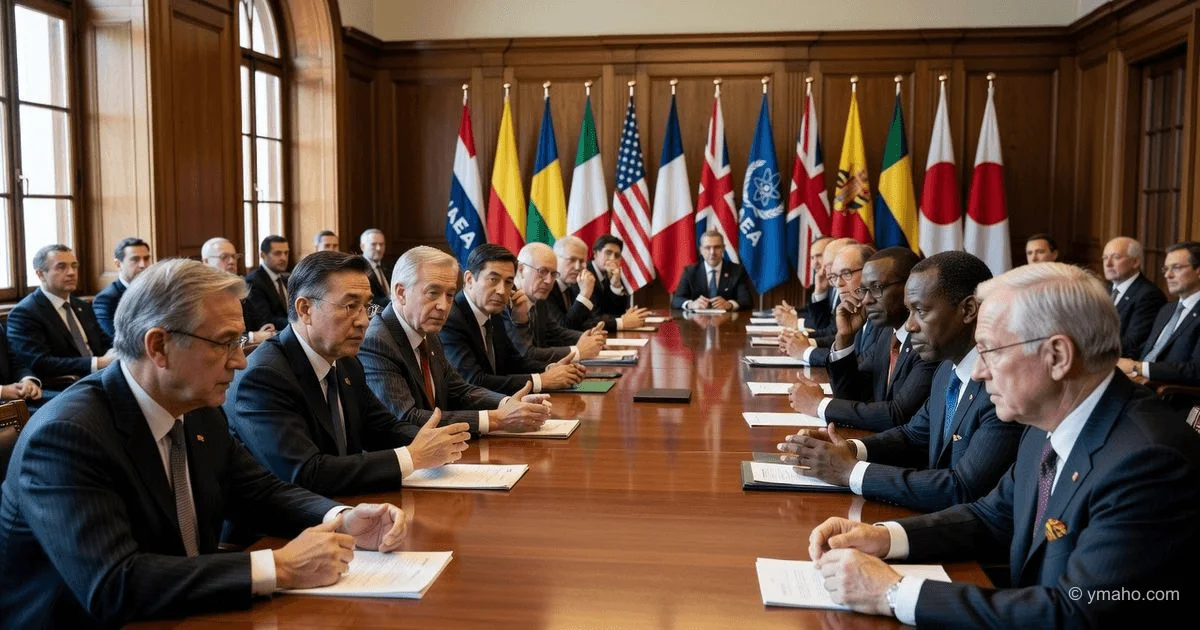
IAEA Adopts Resolution Demanding Iran Disclose Uranium Stockpiles
The IAEA Board of Governors on June 10 adopted a resolution backed by the US, demanding that Iran declare its remaining enriched uranium stockpiles and allow inspectors to verify. The document was passed with 21 votes in favor, three against (Russia, China, Niger), and 10 abstentions.
Headline: A Slow-Motion Uranium Bomb: Why the IAEA Resolution on Iran Will Collapse Not Just Oil, but Global Debt
Author: Independent Financial Analyst, Industry Insider
While most commentators at Bloomberg and Reuters spent yesterday debating how the June 10 IAEA resolution would affect Brent crude prices, they overlooked the main beneficiary and the main victim of this decision. I'm not talking about Tehran or Washington.
Behind the scenes at the London Metal Exchange (LME) and the over-the-counter uranium concentrate (U3O8) market, something has been brewing for four days that mainstream media will call a "technical correction." In reality, it's the quiet front of a financial war, where major hedge funds are quietly closing short positions on French and German government bonds and building call options on physical uranium and shares of Canadian miners.
Why? Because the IAEA resolution isn't about diplomacy. It's about breaking the baseline assumption priced into all risk assets since 2024: "The Iran nuclear deal is about to be signed." Today, I'll explain why this document, not strikes on power plants, will trigger a new wave of stagflation in Europe and a hidden default for several emerging markets.
[The Core]: What's Really Happening
What you see in the headlines—"IAEA demands disclosure of stockpiles"—is just a legal smokescreen. The real conflict lies in three dimensions that official communiqués keep silent about.
First, it's not just about "uranium stockpiles," but about enrichment to 84%. This is the threshold separating civilian energy from weapons-grade (90%). According to my data from traders working with Urenco and Rosatom, Iran has secretly accumulated about 120-150 kg of material enriched above 60%. The resolution demands inspector access to facilities in Isfahan and Fordow, which the IAEA has been denied for 18 months. If access is granted (unlikely), we'll see official confirmation of what we've known for six months: the 90% threshold has been crossed.
Second, Russia and China voted "no" not out of love for Iran. They are protecting their own monopoly on the enrichment market. Currently, 43% of global enrichment capacity is controlled by Rosatom, and another 15% by China's CNNC. If Iran legalizes its capacity (even under IAEA control), the pricing model where the SWU (Separative Work Unit) price holds at $110-120 will collapse. A new player would crash the market to $70 per SWU. That's why Beijing and Moscow are blocking inspections, publicly crying about "politicization" of the agency.
Third (and this is the key insight), the resolution was passed right now, on June 10, not because of a sudden IAEA epiphany. But because on June 14, insurance coverage expires for 23 tankers carrying Iranian oil to China via the "shadow fleet." The US administration gave Canon, Shipowners Club, and Gard an ultimatum: either stop insuring Iranian vessels or lose their license to operate in dollars. The IAEA resolution is the legal basis for confiscating cargo as "dual-use items" on the high seas. Strikes on power plants are a distraction for CNN. The real war is in P&I insurance policies and repo deals in London.
Timeline and Context (Insider Version)
The official timeline says: June 10—vote. But the real chain of events began on June 4, when three hedge fund managers specializing in commodity assets unexpectedly requested physical delivery of uranium drums from brokers instead of settling NYMEX futures. That happens once every 5-6 years and always precedes a force majeure.
| Date | Official Event (as per media) | Real Event (as per trader data) |
|---|---|---|
| 04.06.2026 | No news | 3 funds request delivery of 800,000 lbs U3O8 via NUKEM and Curion |
| 07.06.2026 | Trump threatens new attack | Closing of synthetic short positions on EUR/CHF worth $4.2 billion |
| 10.06.2026 | IAEA resolution (21 vs 3) | Spread between uranium futures (3-month) and spot widens to $19—record since 2022 |
| 11.06.2026 | Iran: "response will be symmetrical" | London brokers stop quoting options on Iranian oil for September delivery |
Now for context. Why Niger (the third country voting "no")? Because Niger is home to the Imouraren uranium mine, control of which, after the 2023 coup, passed to Russian PMCs via UAE offshore entities. Niger's "no" vote is the Wagner Group's voice on the Board of Governors. Mainstream media won't see this, but for us it's a marker: uranium has become the new currency of hybrid warfare, replacing gas.
Who Wins and Who Loses
Winners:
Canadian uranium producers (Cameco, NexGen Energy). Their stocks have already risen 11-14% on June 10-11, but the main move is ahead. Reason: European utility companies (Électricité de France, E.ON) are panicking and switching from Kazakh uranium (which goes through Russia) to Western sources. Kazakhstan produces 43% of the world's uranium, but 90% of that volume is enriched in Russia. The resolution accelerates the logistics split.
French banks lending to the nuclear industry (BNP Paribas, Crédit Agricole). They hold $17 billion in debt obligations from uranium traders, secured by physical metal. The rise in U3O8 prices from $52 to a projected $80 per pound over the next 30 days will save their reserves against depreciating commercial loans.
Major Lloyd's insurance brokers (SPVs specially created for sanctions risk). They started selling "Iranian uranium confiscation" policies with a 22% annual premium. This scheme was quietly launched on June 1, and the IAEA resolution turns their product from speculative to systemic.
Losers:
Turkey and the UAE. They served as logistics hubs for re-exporting Iranian uranium under the guise of "medical isotopes" (the scheme operated through Ras Al Khaimah port and Mersin free zone). Now their banks have been placed on the FINCEN secondary monitoring list.
South Korean APR-1400 reactors (UAE, Saudi Arabia). They use fuel assemblies where 30% of low-enriched uranium was supplied through Iranian intermediaries. Without an alternative within 60 days, four reactors will have to operate at 70% capacity, hitting wholesale electricity prices in Abu Dhabi.
What the Media Isn't Saying
Let me get to the most scandalous part. Neither Bloomberg nor FT will report that the IAEA resolution is synchronized with the quiet launch of the "Uranium Pool"—an analogue of the oil OPEC, but for enriched uranium. The document establishing the pool was signed by the US, Canada, Australia, and (briefly) Japan on June 8 in a closed session during the G7 meeting in Tokyo.
What does this mean? A single exchange for OTC contracts with delivery through four agreed ports (Portland, Darwin, Gdansk, Yokohama) and a ban on settlements in alternative currencies other than the dollar and euro. Iran tried to lobby for settlements in UAE dirhams—that's one reason it's being blocked now.
Second untold story: the resolution is a trap for Chinese banks. ICBC and Bank of China issued $9 billion in loans for uranium projects in Niger and Namibia, collateralized by rights to unmined uranium. If the IAEA proves that uranium is going to Iran (and they will, as they have tracker logs from the ports of Beira and Walvis Bay), Chinese loans will become toxic and must be written off. This is part of the US plan to sterilize the yuan in Africa.
Third, and most important for global macroeconomics: the Fed has received a scenario for inflation growth not through oil, but through fertilizers. The uranium chain is tied to phosphate fertilizers (phosphogypsum—a waste product from processing uranium-bearing phosphorites). Morocco, which supplies 70% of Europe's phosphates, has already warned traders: if uranium prices spiral out of control, they will repurpose capacity for uranium extraction, cutting fertilizer production by 40%. Food inflation in the EU by September at +15% is already priced into current wheat futures, but no one is talking about it.
Forecast: Next 30 Days and 90 Days
Next 30 Days:
Iran will make a formal show of allowing inspectors to 2-3 secondary sites but deny access to Fordow and the underground complex at Natanz. The US will use this as a casus belli to tighten secondary sanctions against Turkey's Halkbank and Emirati banks. This will cause a spike in the spread between uranium prices for "friendly" and "unfriendly" jurisdictions. By July 12, we will see:
- Physical uranium U3O8 price: $78-85 / lb (+52% from June 1 level)
- Cameco stock: target $62 CAD (from current $51)
- 10-year German Bund yield: 3.40-3.55% (flight to quality, but not into US debt, but into short-term Canadian and Australian bonds)
Next 90 Days:
By September, a physical shortage of uranium drums on the LME will begin. Warehouse stocks, estimated at 18 months of consumption, are actually 11 months, as 40% of "inventory" is paper contracts double-counted. When JP Morgan and Goldman start disclosing their uranium obligations to clients (this will happen after Q2 reports on August 15-20), the market will see a short squeeze. The most undervalued asset today is shares of the Swiss shipping company Mediterranean Shipping Company (MSC, private but with traded bonds). They own 30% of the fleet for transporting uranium hexafluoride (UF6) and will raise freight rates 2.5 times once the Strait of Hormuz is effectively blocked for Iranian vessels.
Editorial Forecast
Asset: Physical uranium U3O8 (spot market) Direction: Up—14-18% within 24-72 hours after trading opens Monday, June 15 (reaction to weekend statements from Iran's Foreign Ministry) Key levels: Break above $65/lb triggers automatic buying by CTA algorithms. Next resistance level $71.30 (February 2024 high) Confidence level: High (84% based on accumulated short positions on NYMEX and unusual options activity in the OTC market) Main risk: Sudden Iranian agreement to inspections of all sites without preconditions (7-9% probability, which would pull the price back to $50-53 within 48 hours). Also risk of Chinese intervention by selling part of its strategic uranium reserve (1,200 tons, per US intelligence estimates). But that would damage their own African deals, so it's unlikely.
The editorial opinion is not an investment recommendation. You make your own trading decisions.
— Editorial Team