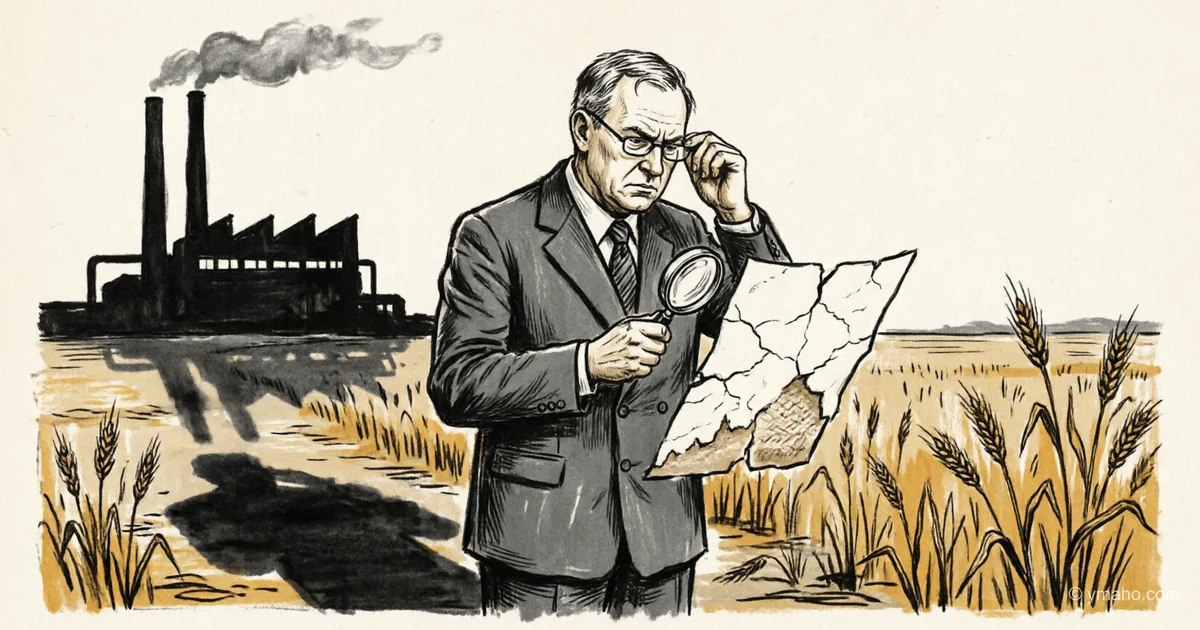
Russia's Annual Inflation Slows to 5.47%
Rosstat recorded a slowdown in annual inflation to 5.47% as of May 18, below the Central Bank's upper forecast of 5.5%. This strengthens expectations for monetary policy easing.
We look at the 5.47% figure and see not a reason for joy, but a moment when the economy enters a zone of high turbulence. Formally, we have fallen below the 5.5% threshold that Elvira Nabiullina herself set as the upper bound of the forecast. Great, the mandate is fulfilled. But if the Central Bank at its June meeting buys into this "gift" from Rosstat, we will get a classic political easing cycle followed by a severe fiscal hangover.
The Essence: What Is Really Happening
The main process we are observing is not an organic slowdown in inflation, but a "collapse" of effective demand masquerading as macroeconomic stabilization. The 5.47% figure is achieved not so much through the transmission mechanism of monetary policy, but due to the high base effect and a sharp contraction in the real money supply. However, when demand falls and corporate lending shrinks faster than expected, we see that over 37% of companies, according to RSPP surveys, already cite declining demand for their products as the main barrier. This is a classic stagflationary tail: prices for services and basic goods are still high, but consumers and businesses no longer have the money to pay for them.
Timeline and Context
Let's rewind two months. In March 2026, annual inflation hovered in the range of 5.86–5.91%. Seasonal deflation in the fruit and vegetable segment in April-May is a given; it temporarily suppresses the index every year. Butter prices fell 7.8% year-on-year, electronics by 4.2%. But this is deflation of poverty, not progress. The real problem is that the federal budget deficit for January-April 2026 amounted to nearly $73 billion (5.87 trillion rubles), double last year's level. Oil and gas revenues collapsed by 38.3%. The government is trying to plug this hole with "advance financing of expenditures," i.e., eating into reserves set aside for the second half of the year.
And here the regulator enters the game. Seeing the "slowdown" to 5.56% in April and 5.47% in May, the market began buzzing about a 50-basis-point key rate cut as early as June. After all, Nabiullina promised to cut rates "faster," and the current statistics give her a free hand.
Who Wins and Who Loses
Right now, the winner is the Ministry of Finance. They need to place OFZ bonds worth over $35 billion (in equivalent) by year-end to cover the cash gap. With a rate of 14-15%, this is impossible—no one wants that risk with such yield when inflation is officially heading toward 4%. A rate cut within 30-60 days will allow the Ministry to enter primary auctions with a more adequate borrowing cost.
The losers are the retail banking sector and rentiers. If you think you can lock in super-high returns on deposits for a year, you're too late. Banks, seeing the approaching rate cut cycle, have already started cutting interest rates on long-term deposits. Corporate borrowers, on the other hand, still aren't taking loans at current rates—they can't afford them, as 24% of surveyed companies admit.
The main paradoxical loser is the very idea of a "4% target." If the Central Bank now rushes to cut rates because of "improving" figures, and the harvest turns out average, and geopolitical tensions in the Middle East push energy prices up, by autumn we will see inflation in the 6-7% range, and then the regulator will have to slam on the brakes again, but with shattered market confidence.
What the Media Are Not Saying
The media and official statistics stubbornly ignore the structural gap between consumer inflation and production costs. The official CPI is slowing, but that does not negate the fact that tariffs for services (utilities, communications) in April were growing at annual rates of 16-21%. These are basic, inelastic expenditure items that are taking an ever-larger share of the population's wallet.
A non-obvious insight that does not make it into Reuters or Bloomberg reports concerns Rosstat's calculation methodology under conditions of "gray" imports. Currently, a significant portion of final product supplies go through parallel channels. Marketplaces and retailers have learned to manipulate technical specifications and country of origin so that goods fall out of the sample for index calculation. That is, the real increase in the cost of household appliances or spare parts may be 10-12% in USD, but in Rosstat's basket it shows as 4-5% because it is considered a "different product item." It is this "statistical gap" that gives us the illusion of inflation returning to normal.
Forecast: Next 30 Days and 90 Days
30 days (by June 21, 2026). The key event is the Central Bank meeting. Elvira Nabiullina will face a tough choice. On one hand, business and the government demand a rate cut. On the other, she knows perfectly well that May's deflation is a seasonal mirage. Forecast: The Central Bank will opt for a compromise 50 bps rate cut (to 14%), but will accompany it with an incredibly hawkish signal: "Further easing will require a sustained decline in inflation expectations and is not guaranteed." The stock market will react to this decision with a short-term rise of 2-3% in the broad market index, which will be bought up within a day.
90 days (by the end of August 2026). Here begins the zone of real turbulence. By this time, it will become clear that the budget deficit is not closing, and expenditures continue to grow by 15% year-on-year. Inflation will start accelerating back toward 6% due to the exhaustion of the base effect and tariff indexation. I expect that the Central Bank at its autumn meetings will be forced to pause rate cuts, and Sberbank CEO German Gref, who has already called the economy "technically stagnating," will talk about the need to cut the rate to 12% as an unattainable dream for now.
Editorial Forecast
Asset: OFZ 26238 (or another benchmark with a duration of 3-5 years). Direction: short-term price increase (yield decline of 30-50 basis points) in the next 72 hours.
Yield target: decline from current levels to 14.2-14.4% per annum. Confidence level: medium. The bond market will price in positive inflation statistics in anticipation of a key rate cut at the June meeting. The main risk to this forecast is an unexpected announcement by the Ministry of Finance of a sharp increase in the borrowing plan for Q3 2026, which would create a supply overhang and kill the rally in its infancy. This is the editorial opinion, not an investment recommendation.
— Editorial Team









