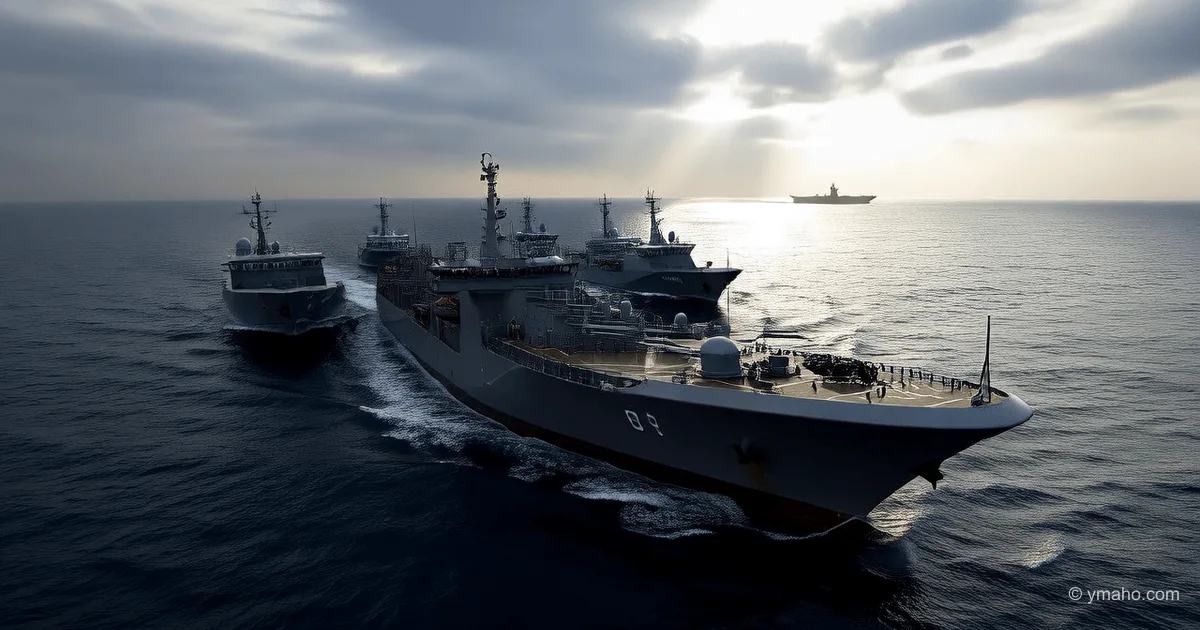
Iran Expands Combat Control Zone in the Strait of Hormuz to 480 km
The deputy commander of the IRGC Navy announced a significant expansion of the controlled waters from 48 to 480 km, increasing military presence and pressure on shipping in the strategic strait.
Tehran's expansion of the declared control zone in the Strait of Hormuz from 48 to 480 km is not a PR provocation but a cold calculation in a war where law and geography are being unilaterally rewritten. While Western media discuss belligerent rhetoric, a new reality has already taken shape in the Persian Gulf, one that international law is currently losing to.
The Essence: What Is Really Happening
This announcement is a legal and military trap. Deputy Commander of the IRGC Navy Mohammad Akbarzadeh stated that "the Strait of Hormuz has become larger and turned into a vast operational zone," stretching from Jask to Sirri Island and beyond to Qeshm and Greater Tunb islands. The width of this zone is now estimated not at 32-48 km, but at 320-480 km. In other words, Tehran has unilaterally rewritten the geography of one of the world's most critical energy chokepoints.
In practice, this means that any warship or commercial vessel within this zone is, from the IRGC's perspective, passing through Iranian "waters of interest." This creates a legal basis for further attacks and seizures. It is important to understand: international law guarantees the right of transit passage through such strategic straits, but Iran acts as if these norms no longer apply to it.
Timeline and Context
The countdown of this crisis began on February 28, 2026, when the US and Israel launched a military campaign against Iran's nuclear infrastructure. Iran responded not only with missile strikes on Israel but also with an asymmetric attack on the global economy—a de facto blockade of the Strait of Hormuz. By early March, tanker traffic through the strait had almost completely ceased, causing a spike in oil prices and a contraction of global supply chains.
The IRGC first published a map of the expanded control zone on May 4, 2026. This happened precisely when US President Donald Trump was preparing to depart for a summit with Chinese President Xi Jinping in Beijing. The timing was no coincidence: Iran wanted to minimize the diplomatic maneuvering space for the US and China on energy security.
By May 7-10, after the failure of Operation "Project Freedom" and a series of strikes on facilities in the UAE, including the Port of Fujairah—through which up to 1.4 million barrels of oil per day bypass the strait—it became clear that a military unblocking would not happen. Against this backdrop, Akbarzadeh's statement about expanding the zone to 480 km turned from a simple declaration into a description of the new reality on the water.
Who Wins and Who Loses
Iran is the clear tactical winner. Its naval strategy, based on asymmetric threats—mass use of drones, fast attack craft, and mines—has proven effective against the technologically superior US fleet. According to estimates from the Windward platform, more than 200 small vessels have been concentrated in the northern part of the strait, while all large commercial ships in the area have either been withdrawn or are stationary. Moreover, Iran has already signed agreements with Iraq and Pakistan to transit oil and LNG from the Persian Gulf through its territory, transforming itself from a pariah into a regional energy hub.
The global economy as a whole loses. The New York Federal Reserve Bank's supply chain pressure index has risen for three consecutive months, reaching a four-year high in April. According to broker Ursa Shipbrokers, the volume of dry bulk cargo loaded in the Persian Gulf during the week of April 27 to May 3 was only 47,000 tons, compared to an average of 2.2 million tons for the same periods from 2016 to 2025. That is a drop of 98%. In monetary terms, losses are estimated in billions of USD.
China is in an ambiguous position. On one hand, Beijing imports about 12% of its oil directly from Iran, and supply disruptions hit its economy. On the other hand, Tehran has effectively given Beijing leverage over Washington: as long as the US cannot unblock the strait, China can demand concessions in trade negotiations.
What the Media Is Not Saying
The key non-obvious insight: this expansion is not so much a military maneuver as a legal one, directly linked to the positions of Saudi Arabia and Kuwait. On May 5, a few days before the announcement, Trump was forced to suspend Operation "Project Freedom" to evacuate ships from the Gulf precisely because Riyadh and Kuwait banned the use of their airspace for US aircraft. Why? The Arab monarchies fear that a US-Iran deal will be made at their expense, and that after sanctions are lifted, Tehran will quickly rebuild its military power.
Now, by expanding its zone to 480 km, Iran legitimizes control over waters adjacent to the coasts of the UAE and Oman. This is a signal to the Arabian monarchies: "You can stay out of the conflict, but your waters are already ours." And most importantly, no Gulf state has naval forces capable of challenging this control without direct US support, which Washington is not yet ready to provide.
The second point that goes unmentioned: the role of GPS jamming. According to maritime brokers, systematic disruptions of AIS and GPS signals have been observed in the strait zone. Iran, presumably using Russian or Chinese jamming technology, is effectively creating a "gray zone" where commercial shipping cannot navigate, and voyage insurance becomes impossible or prohibitively expensive.
Forecast: Next 30 Days and 90 Days
Next 30 days (by mid-June 2026). Iran will not physically block the entire 480-km zone—that is technically impossible. Instead, the IRGC will intensify its "mosquito fleet" tactics and targeted attacks on tankers. Expect 2-3 high-profile incidents involving the seizure of vessels flying flags of countries that supported the US operation. This will trigger a new spike in insurance premiums and Brent prices to $115-$120 per barrel. The US, for its part, will attempt to conduct a "show convoy" of 3-5 ships escorted by destroyers, but not before securing guarantees from Saudi Arabia for airspace use.
Next 90 days (by mid-August 2026). If the diplomatic track with the US reaches a dead end, Iran may move to the next phase: officially announcing the introduction of "safe passage fees" through its expanded zone. This would be an attempt to monetize control over the strait, offsetting losses from oil sanctions. For shipping companies, this creates an existential dilemma: pay de facto tribute to Tehran or take the longer route around Africa, losing $2-3 million per voyage. In any case, the world must get used to the fact that the old Strait of Hormuz—a narrow 33-km artery—no longer exists. In its place, a vast Iranian "zone of strategic influence" has emerged, one that will shape global energy security for years to come.
— Editorial Team









