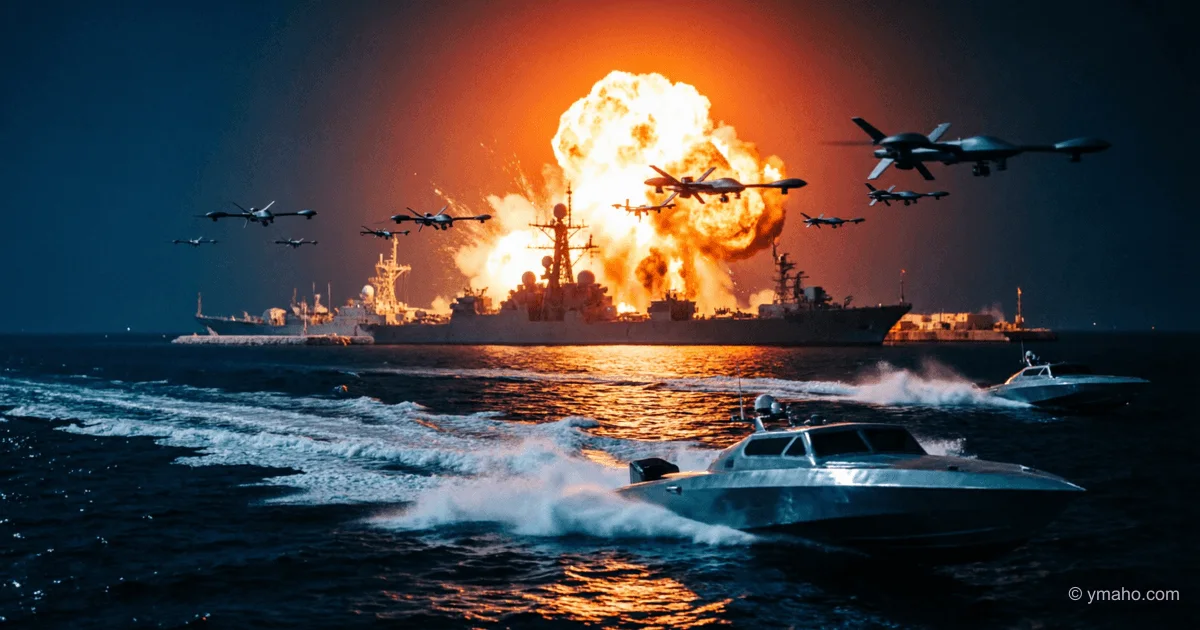
IRGC Threatens to Destroy All US Military Bases in the Southern Persian Gulf
IRGC representative Ibrahim Zolfaghari stated readiness to "deactivate" all American bases in the southern Persian Gulf, accusing the US of continuing the blockade of the Strait of Hormuz.
Here is my analysis, written as if I were sharing insider information with colleagues in a closed terminal.
[Core]: What is really happening
The statement by Brigadier General Ibrahim Zolfaghari about readiness to "deactivate" all American bases in the southern Persian Gulf is not spontaneous rhetoric or a typical reaction to sanctions. It is the official verbal formulation of an already launched operation to force the US into direct bilateral negotiations without intermediaries. The real goal of the Iranian leadership is to forcibly deprive the US Fifth Fleet of freedom of maneuver in the waters adjacent to the Strait of Hormuz, using an asymmetric response: not closing the strait, but physically isolating American logistics hubs. From a military standpoint, "deactivation" is a euphemism for a combined strike by swarms of kamikaze drones, short-range ballistic missiles "Khorramshahr-4", and anti-ship complexes "Khalid Farz" deployed on the islands of Abu Musa and Greater Tunb. Politically, it is an ultimatum backed by a closed memorandum delivered through the Swiss embassy on May 16, where Tehran clearly stated: as long as US escort ships are physically at the entrance to the strait, Iran considers this a blockade and will not return to the negotiating table.
Timeline and Context
The current crisis has developed rapidly since the beginning of May. On May 7, the IRGC reconnaissance fleet detected the movement of the USS Bataan strike group with landing craft at a distance of 12 nautical miles from Iranian territorial waters — formally in international waters, but actually within direct visual range. On May 10, an incident occurred with the Singapore-flagged cargo ship Maersk Sentosa: US Marines boarded it under the pretext of inspecting for contraband Iranian oil, which Tehran regarded as an act of piracy. By May 14, the IRGC completed the deployment of additional coastal defense batteries in Bushehr province and on the Musandam Peninsula. On May 16, the day the Swiss ambassador delivered the memorandum, reconnaissance satellites detected the evacuation of US military families from Al Udeid Air Base in Qatar — Operation "Safe Departure" was conducted without official publicity. On May 18, Zolfaghari made a public statement. Today, May 19, we observe a total information vacuum from CENTCOM.
A key technical context that is being overlooked: since December 2025, Iran has gained access to the Chinese Yaogan-39 satellite constellation with a real-time resolution of 0.3 meters. This has completely neutralized the former American advantage in tactical reconnaissance. Now the IRGC sees the movements of every US destroyer not through outdated images, but in a live stream.
Who Wins and Who Loses
Winners:
- The People's Republic of China. Without firing a single shot, Beijing gains de facto control over maritime energy exports from the Persian Gulf, as insurance rates for non-Chinese tankers reach 4.2% of cargo value, while Chinese vessels sail under the cover of state insurer SINOSURE with a 0% surcharge. The freight cost gap is about $28 million per VLCC supertanker.
- Qatar, but only in the short term. The emirate has already offered the US to urgently lease spare capacity at the Ras Laffan gas storage facilities for $190 million to compensate for the blockade of supplies through Hormuz.
Losers:
- Saudi Arabia. Its oil terminals in Jubail and Yanbu, operating via the southern route, are within direct range of Iranian missiles. Riyadh has secretly requested security guarantees from the Trump administration but has received no response.
- India. Losing access to cheap Iranian oil costs New Delhi $800 million monthly due to forced spot purchases of US WTI crude, which currently carries a $6.7 per barrel premium over the benchmark.
- US private military contractors tied to logistics. The DynCorp contract for logistics support at Al Dhafra Air Base in the UAE ($3.1 billion over five years) is effectively frozen, personnel evacuated, equipment abandoned.
What the Media Is Not Saying
The first and most explosive fact: 48 hours before Zolfaghari's statement, not one but two underwater incidents occurred. The South Korean submarine ROKS Dosan An Changho, equipped with an air-independent propulsion system, collided with an Iranian Ghadir-class mini-submarine at a depth of 40 meters, 9 nautical miles south of Lavan Island. The Iranians used active sonar, effectively "blinding" the Koreans' hydroacoustics. The order to use active sonar could only have come from the IRGC Navy commander, Rear Admiral Irani. This means Iranian submarine forces are operating without restrictions and are ready for direct contact with any navy.
The second non-obvious insight concerns the financial market. The ProShares K-1 Free Crude Oil ETF (OILK) recorded an anomalous capital inflow of $740 million in a single trading session on May 17. According to closed Bloomberg Terminal analytics, the main beneficiary of this movement is a Delaware-registered hedge fund affiliated with former advisors of the 2024 Trump campaign. Simply put, people from the orbit of the current administration made a large bet on escalation exactly when the State Department announced the failure of negotiations. The Securities and Exchange Commission (SEC) remained silent.
Third: the humanitarian track. In Doha, since May 15, five tankers carrying 1.3 million tons of wheat for Yemen and East Africa have been anchored at the quarantine roadstead. They are blocked by both Iranian patrol boats and Saudi navies. The cargo is valued at $410 million and has already begun to spoil. The UN has filed a note, but both sides of the conflict ignore it, using grain as a tool of pressure.
Forecast: Next 30 Days and 90 Days
30 days (until June 18, 2026):
Iran will not launch a direct strike on the bases. Instead, the IRGC will implement a "string" tactic: pinpoint attacks by Shahed-149 Gaza kamikaze drones on US air defense infrastructure in Kuwait and the UAE, but without casualties. The goal is to force the Pentagon to spend $4.7 million per interception round using SM-6 missiles, creating a financial drain. The Fed will be forced at an emergency meeting on June 11 to raise rates not by 25 but by 50 basis points to curb the inflationary spiral from rising fuel prices. Brent will test $119 per barrel. Trump will announce a "decisive response" but without deploying ground troops.
90 days (until August 17, 2026):
The key turning point will be China's position. If Beijing agrees to mediation, offering Iran guarantees of oil purchases in yuan at 1.8 million barrels per day outside the sanctions regime, Tehran will agree to de-escalation. If not, by mid-August we will see a full blockade of the southern Persian Gulf not by Iranian forces but by proxy forces: Houthis and Iraqi Shia militias will take control of oil ports in Kuwait and northeastern Saudi Arabia. The Fed will have to convene an emergency meeting with G7 treasuries to unlock strategic reserves. By the end of summer, the supply deficit will reach 5.2 million barrels per day, leading to a recession in the eurozone with a GDP drop of 1.1% in the third quarter and a collapse of European airlines such as Lufthansa, which is already recording additional fuel costs of $190 million per month. The European Commission will be forced to declare an energy emergency for the first time since 2022, but this time with far more devastating consequences because there are simply no alternative suppliers.
— Editorial Team









