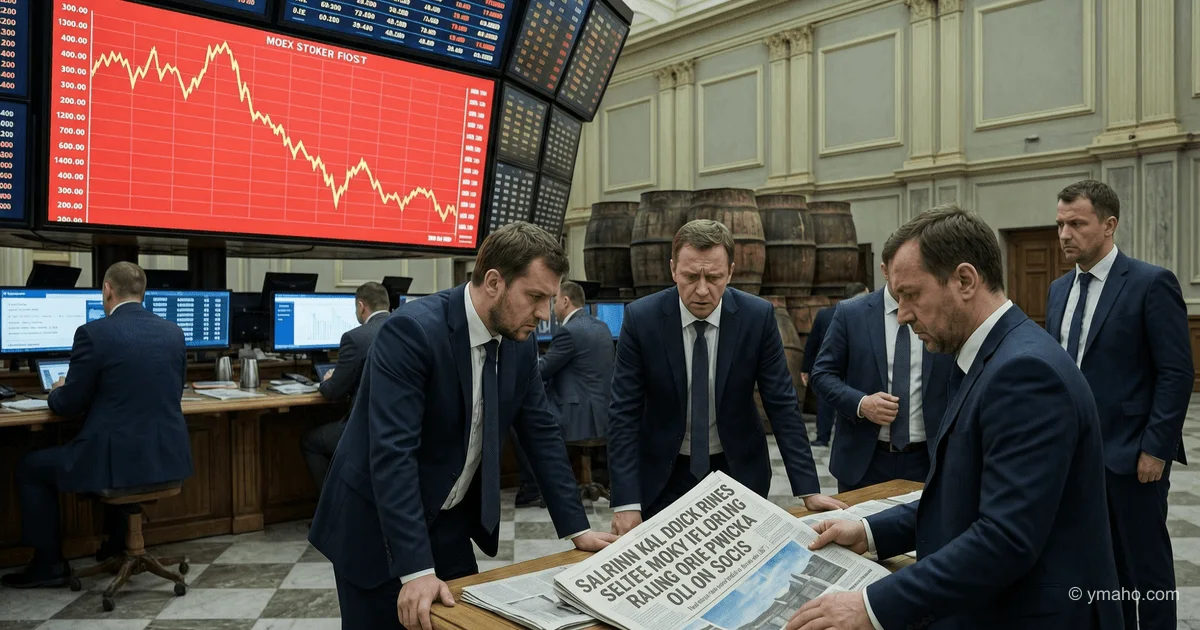
Moscow Exchange Index Falls Despite Global Optimism on Oil Risks
The Russian stock market opened in the red: the Moscow Exchange index fell by 0.4% due to fears of lower oil and gas budget revenues amid falling oil prices
The Moscow Exchange index fell by 0.4% on the morning of May 7, and a superficial glance immediately links this to the drop in oil. But that's just a convenient explanation for the evening news. In reality, we are witnessing a much more dangerous phenomenon — a classic market paradox where the Russian domestic market has found itself in a steel trap between the budget crisis, regulator actions, and a unique situation in Sberbank shares. The index decline is just the tip of the iceberg.
The Essence: What's Really Happening
The Moscow Exchange index is falling not so much because of oil, but because of events in the debt market that most investors overlooked. On May 6, the Russian Ministry of Finance held OFZ auctions, trying to raise 450 billion rubles, but managed to place only 217 billion rubles worth of bonds. This is a failure with a coverage ratio of less than 0.5. The weighted average yield on OFZ-PD series 26246 soared to 16.82% per annum — the highest since November 2025.
The stock market reacted with a one-day delay, but the mechanism here is crystal clear. When the yield on risk-free government bonds approaches 17%, the discounted cash flow model for stocks breaks down. The risk premium for holding stocks at a discount rate above 18% becomes negative for most companies.
Add to this the second factor — the dividend gap of Sberbank, which went ex-dividend on May 6 with a payout of 33.2 rubles per share. Technically, this dragged the index down by about 1.1%, but the stock closed with a decline of only 0.3%. This means an invisible hand supported Sberbank all day, and now, on May 7, that support has weakened — and Sberbank shares fell another 1.4%, creating a false impression of oil panic.
In other words, Brent oil at $101.57 is just a catalyst, not the cause. The cause is a systemic liquidity squeeze and an existential fear that the 2026 budget deficit will spiral out of control.
Timeline and Context
To understand the depth of the problem, we need to go back three weeks. On April 18, 2026, the Central Bank of the Russian Federation kept the key rate at 14.5% at its scheduled meeting. Elvira Nabiullina's rhetoric was unusually harsh: "We see persistent inflationary pressure in the services segment and do not rule out a return to rate hikes at the next meeting." The market, which had been pricing in a cut to 13% by year-end, was shocked.
Then, on April 28, Rosstat released data: weekly inflation accelerated to 0.22% from 0.14% the previous week. Annual inflation stood at 7.8%, well above the Central Bank's 5% target. Money market rates immediately reacted — the MosPrime Rate jumped to 15.2%, and repo rates reached 15.8%.
On May 5, another subtle but critical event occurred. The Bank of Russia published a financial market risk review, which specifically noted that the share of non-residents from "friendly" countries in Moscow Exchange operations had risen to 18.3% of total volume. Then came a phrase that made hedge fund managers freeze: "The regulator is studying the possibility of introducing additional measures to limit destabilizing short-term capital flows." This was a transparent hint at possible restrictions on fund withdrawals.
May 6 — the failure of OFZ auctions. And on May 7, Brent oil falls by $7.43, and the Moscow Exchange index, already hanging by a thread after Sberbank's dividend cut-off, goes down. But the market's main fear is not $101 per barrel. The main fear is that the Ministry of Finance cannot fund the budget deficit, and the Central Bank is hinting at a new round of tightening for non-residents.
Who Wins and Who Loses
Losers: Banks with large OFZ portfolios. Sberbank and VTB hold a combined total of about 8.7 trillion rubles in government bonds on their balance sheets. Rising yields mean a revaluation of these portfolios and potential fair value losses. VTB shares fell 1.8% on May 7, Sberbank by 1.4%.
Losers: Developers. PIK Group (-2.1%), LSR (-1.9%), and Samolet (-2.4%) fell more than the market. Developers' business model relies on project financing, and every tenth of a percent in rates eats into the margins of new projects. With OFZ yields at 16.8%, banks will inevitably raise bridge loan rates for developers to 20% and above.
Losers: The ruble. If oil settles below $100 per barrel for Urals, budget currency inflows will shrink. With imports at current levels, this creates fundamental pressure on the ruble. The USD/RUB pair is still hovering around 75, but this is temporary — the Ministry of Finance and the Central Bank are artificially supporting the exchange rate by selling yuan from the National Welfare Fund at about EUR 220 million per day. If oil continues to fall, the pace of sales will have to increase.
Winners: Gold. Polyus shares rose 1.2%, Seligdar added 0.8%. Gold above $4,700 per ounce creates a unique situation where gold miners become the only safe haven in the Russian market. Investors are shifting from oil to gold — a classic defensive pattern.
Winners: The Ministry of Finance in the long term. If you borrow at 17% per annum with inflation at 7.8%, the real rate is almost 9%. This is a prohibitive level that will force the government to cut spending, which is what the Central Bank wants. The Ministry of Finance may not have failed the auction — it deliberately chose not to place debt at any price, preferring to spend NWF reserves rather than lock in extremely high borrowing costs for years to come.
What the Media Isn't Saying
The most dangerous storyline, completely absent from the Russian business press, is the problem of the twin deficit. The federal budget for 2026 is drawn up with a deficit of 2.1 trillion rubles, but this figure is based on an Urals price of $105. At the current $95 per barrel and a steady downward trend, lost revenues will amount to about 1.1 trillion rubles. This increases the real deficit to 3.2 trillion.
At the same time, the Moscow Exchange corporate debt aggregate index shows that 23% of issuers have a Net Debt/EBITDA ratio above 5.0x — a critical level even at a stable rate. At a rate of 15%+, their debt burden becomes unbearable. The market is silently awaiting a wave of defaults in the second and third tiers.
The second non-obvious insight: the Moscow Exchange index decline of 0.4% is an average figure that hides a dramatic spread. Stocks included in the index at full weight fell by 0.89%, while the second tier dropped by 2.3%. Market makers and large institutional players are supporting the "first line" to hold the index, while mid- and small-cap stocks are taking real losses. This creates an illusion of stability that is dangerous for retail investors who do not see the true depth of the decline.
The third hidden factor is the outflow of retail investor funds. According to the Moscow Exchange, in April 2026, the number of unique clients making transactions fell by 8% compared to March (from 3.2 million to 2.95 million). The average brokerage account size decreased from 197,000 to 184,000 rubles. This is a classic "bearish" signal: the retail investor, who was the main driving force of the market in 2023-2025, is losing interest and leaving.
Forecast: Next 30 Days and 90 Days
Next 30 days (by June 7, 2026). The Moscow Exchange index will continue to slide into the range of 2950-3050 points. The key catalyst is the Central Bank of the Russian Federation meeting on June 13. If Nabiullina confirms the hawkish rhetoric or, worse, raises the rate to 15%, the market will crash to 2800. I estimate the probability of a rate hike at 35% — higher than what the current futures curve implies.
Oil and gas sector stocks will lose another 5-7% amid falling oil prices. The main target of the "bears" is Rosneft shares, which could fall below 520 rubles per share (down from the current 555 rubles). Dividend yield will stop supporting quotes when the market begins to price in a 30% dividend cut in 2027.
Next 90 days (by August 7, 2026). August will be the month of truth. By then, two shocks will materialize: first, Rosstat data for the second quarter may show a technical recession — GDP declining for the second consecutive quarter by 0.2-0.4%. Second, if oil settles below $90, the government will be forced to announce a budget sequestration for 2027.
The only positive counter-narrative is a possible easing of the geopolitical situation, which could open the door for the return of non-residents. But under current conditions, I would estimate this probability at no more than 10-12%. The baseline scenario for August: Moscow Exchange index at 2700-2800 points, OFZ yield around 17.5%, dollar at 78-80 rubles.
The Russian market is entering a period that I call the "great compression" — simultaneous pressure from high rates, budget stress, and corporate defaults. For investors, this is a time of extreme caution. The only working strategy is to move into gold and short-term OFZs; everything else is playing with fire.
— Editorial Team









