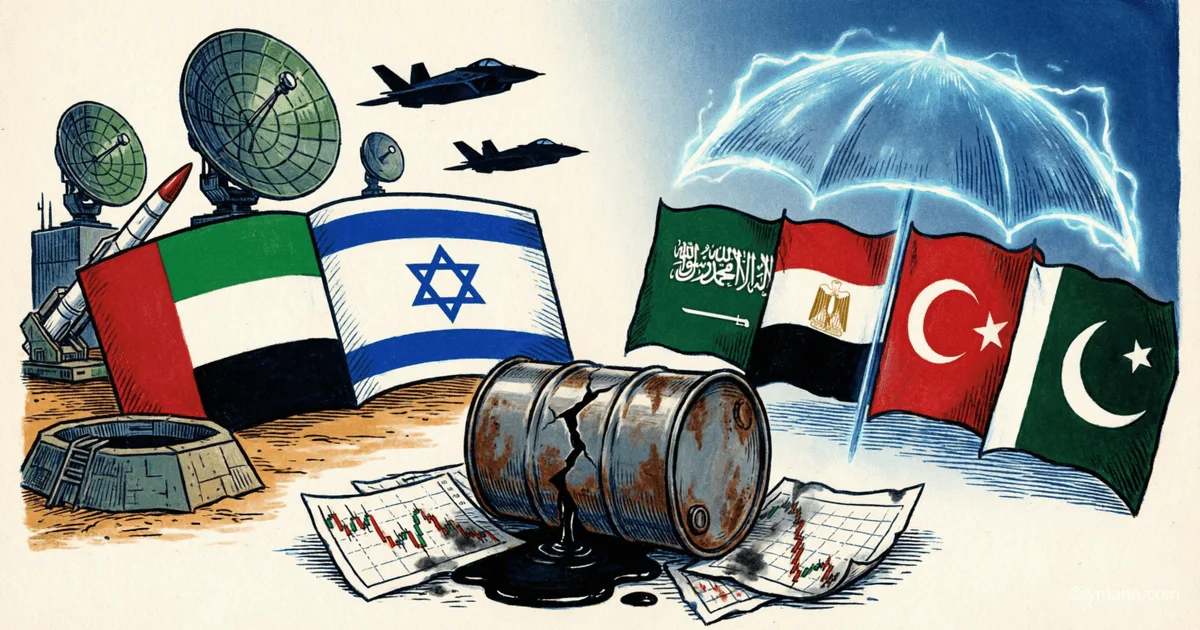
Two New Military-Political Blocs Forming in the Persian Gulf
Against the backdrop of the war with Iran, a rift is emerging in the region: on one side, the UAE and Israel are drawing closer, creating a joint defense fund; on the other, Saudi Arabia, Egypt, Turkey, and Pakistan—dubbed the 'Sunni Quartet'—are strengthening their cooperation.
Playing Two Chess Games: Why the New Alignment in the Gulf Will Crash UAE Markets and Boost Turkey
Author's Analytical Review
[The Gist]: What's Really Happening
What the media calls 'the formation of two new blocs' is actually an acknowledgment of the complete collapse of the old security model in the region. For twenty years, the US acted as the sole guarantor of stability in the Gulf. Now, no one has any illusions: Washington either cannot or will not protect its allies.
The first bloc—UAE + Israel—is a tech alliance funded by money. The second—Saudi Arabia, Egypt, Turkey, Pakistan (the 'Sunni Quartet')—is an attempt to create a regional counterweight independent of both the US and China.
But there's a detail most miss. Formally, both blocs are aimed at Iran. In reality, they compete with each other for the role of 'the West's main partner.' And this competition will have far more serious consequences for markets than any missile strike.
Why does this matter to us financiers? Because until now, the GCC (Gulf Cooperation Council) was a monolithic market with shared dynamics. Now it's splitting. Investors who held diversified portfolios across the Gulf will see their assets behave differently. And the divergence will only grow.
Timeline and Context
Let me reconstruct the sequence of events that led to the current configuration.
September 2025 — Saudi Arabia and Pakistan sign a bilateral defense agreement. It doesn't include automatic military response but formalizes decades of cooperation. This was the first sign.
February–March 2026 — The US and Israel begin a war against Iran. Iran launches missile strikes on five regional countries, including the UAE, Bahrain, Qatar, and Kuwait. The GCC realizes: their territories are targets.
March 2026 — Summit in Islamabad. Turkey, Pakistan, Saudi Arabia, and Egypt coordinate their efforts. Pakistan provides a nuclear 'umbrella,' Turkey offers military technology, Saudi Arabia supplies funding, and Egypt provides diplomatic cover.
May 2026 — In the midst of the war, Israeli Prime Minister Benjamin Netanyahu secretly flies to Abu Dhabi. The result: the creation of a joint defense fund for developing and procuring new weapons. The amount is in the billions of dollars. The information has only now leaked to the media.
May 19–20, 2026 — ABNA agency and other sources confirm details: the fund will finance the development of air defense systems, counter-drone capabilities, and AI integration into defense systems.
What's important in this timeline: the UAE and Israel started their alliance in secret from the US. US Ambassador Mike Huckabee confirmed that Israel deployed Iron Dome batteries in the UAE during the war. But the fund itself is no temporary deployment—it's a permanent structure. And it's financed not with American money, but with Emirati funds.
Who Wins and Who Loses
Winner #1 — Israel's defense industry. Companies like Israel Aerospace Industries, Rafael, and Elbit Systems will receive multi-billion-dollar contracts from the Emirati fund. Meanwhile, American competitors (Lockheed Martin, Raytheon, Northrop Grumman) will lose out—their traditional monopoly on the Gulf market is broken.
Winner #2 — Turkey. Ankara is a key player in the 'Sunni Quartet.' Turkish Bayraktar drones have already proven their effectiveness. In the new alliance, Turkey becomes the technology hub for the entire bloc. Shares of Turkish defense companies (e.g., Aselsan, Baykar, if publicly traded) are undervalued assets.
Winner #3 — Pakistan. Islamabad provides a 'nuclear umbrella'—informal guarantees that in case of an existential threat, Pakistan will use its nuclear weapons. This radically raises the stakes for any aggression against Saudi Arabia or Turkey. Pakistan gains political weight disproportionate to its economic power.
Loser — the UAE, but in an unexpected way. Yes, the UAE gets Israeli technology. But it also becomes Iran's primary target. In March 2026, about 3,000 Iranian missiles and drones were already launched at the UAE. With the new alliance, this threat will only increase. The UAE's tourism sector, real estate, and financial services (together over 50% of GDP) will come under pressure. MSCI is already recording a divergence between oil prices and GCC markets: previously, rising oil lifted Gulf markets; now it doesn't, because investors are fleeing the region.
Non-obvious loser — Qatar. Doha traditionally played the role of neutral mediator and had good relations with Iran (they share the world's largest gas field). In the new bipolar configuration, Qatar finds itself between a rock and a hard place. If the UAE and Saudi Arabia force a choice, Qatar could lose either Iranian gas or Arab investments. The risk to Qatar's sovereign fund (worth about $500 billion) is underestimated.
Those not named but in the game — China. Beijing is watching with interest as the US loses influence in the Gulf. China is already the GCC's largest trading partner. The next step is military presence. Gulf countries are already considering inviting Chinese and Russian troops instead of American ones. For us financiers, this means one thing: sooner or later, oil will be sold not for dollars, but for yuan. And that changes everything.
What the Media Isn't Saying
Insight #1 — The real reason for creating the 'Sunni Quartet.'
The official version is containing Iran. The real reason is distrust of the US. Gulf states saw how the Trump administration first supported Israel and then proved unable to protect their territories from Iranian missiles. They realized that American guarantees are worthless. The 'Sunni Quartet' is an attempt to create a collective defense system independent of Washington.
But there's a problem no one mentions. All four countries have different 'masters.' Saudi Arabia and Egypt are under strong US influence. Pakistan is under China's influence. Turkey tries to balance between Moscow and Washington. How can these four countries, each tied to a different global power center, act in concert? Answer: they can't. The 'Sunni Quartet' will be paralyzed by internal contradictions at the first serious test.
Insight #2 — Why the UAE moved closer to Israel.
Abu Dhabi made a rational but cynical decision. In the short term, Israeli air defense technology is the only thing that can protect against Iranian missiles. The US cannot or will not supply enough systems. Russia and China are politically unacceptable for the UAE (too closely tied to Iran).
But the price of this choice is the loss of Arab identity. The UAE becomes an Israeli outpost in the Gulf. This causes deep discontent domestically and among neighbors. Saudi Arabia, which has also formally normalized relations with Israel, is not ready to go this far. The rift between Riyadh and Abu Dhabi is now public.
Insight #3 — Underestimated market consequences.
MSCI's March study clearly showed: the Gulf war broke the traditional correlation between oil and GCC markets. Previously, rising oil = rising markets. Now it doesn't, because the local economy (real estate, tourism, finance) suffers from the war.
What does this mean for portfolio investors? Hedging through oil no longer works. If you hold shares of Emirati companies, rising oil won't save you from a fall. New instruments are needed. And they don't exist yet.
Moreover, private investment funds continue to enter the GCC at 2023 valuations ($4.2 billion inflow in Q2 2025—up 50% quarter-on-quarter). They are paying pre-war prices for war risks. This is classic underpricing of tail risk. When the market reassesses the threat (and it will at the first real escalation), these funds will lose 20-30% in a month.
Forecast: Next 30 Days and 90 Days
Next 30 days:
- UAE stock market (DFMGI, ADX) — decline of 5-8%. Main losses: real estate sector (Emaar Properties and similar) and tourism (hotel operators). Iranian threat plus tourist outflow.
- Turkish stock market (BIST 100) — growth of 3-5% in dollar terms. Defense sector (Aselsan, Roketsan) — growth leaders. The Turkish lira remains volatile, but the market itself benefits from the status of 'new security hub.'
- Saudi Arabian market (Tadawul) — sideways or slight decline. Riyadh tries to maintain neutrality, but its involvement in the 'Sunni Quartet' makes it a target.
Next 90 days:
Base scenario (60% probability): The two blocs coexist in parallel, competing but without direct clashes. The UAE deepens cooperation with Israel. Saudi Arabia, Turkey, Pakistan, and Egypt formalize the 'Sunni Quartet' (likely signing a charter by September 2026). Investors gradually reassess risks. Capital flows from the UAE to Turkey and Saudi Arabia.
Escalation scenario (30% probability): Iran launches a massive strike on the UAE. The US does not intervene. The UAE calls on Israel for help. This finalizes the UAE+Israel bloc as a US proxy force. The 'Sunni Quartet' distances itself from both. The region enters a cold war phase among three centers: pro-Iran bloc, pro-US bloc (UAE+Israel), and independent Sunni bloc. GCC markets fall 15-20%. The dollar rises. Oil at $120-140.
De-escalation scenario (10% probability): Peace agreement between the US and Iran. The war threat recedes. The UAE scales back military cooperation with Israel (the fund is frozen). The 'Sunni Quartet' loses relevance. GCC markets recover 10-15%. But this scenario is unlikely—too many forces are interested in maintaining tension.
Editorial Forecast
Asset: ETF on the UAE market (e.g., iShares MSCI UAE Capped ETF)
Direction: Decline in the next 24–72 hours
Key levels: Current level (approximately $13-14 for the ETF). Support at $12.50. On a break, $11.80
Confidence level: High (65%). The news of the two blocs forming is an acknowledgment that the region will be unstable for a long time. Markets are only beginning to digest this.
Main risk: An unexpected peace agreement between the US and Iran. In that scenario, the risk premium in the UAE would disappear, and the market could rise 5-7% in a day. But the probability of a peace agreement under current conditions is less than 15%.
This forecast is an analytical opinion of the editorial board and does not constitute individual investment advice. Make decisions based on your own risk assessment and consultations with licensed financial advisors.
— Editorial Team









