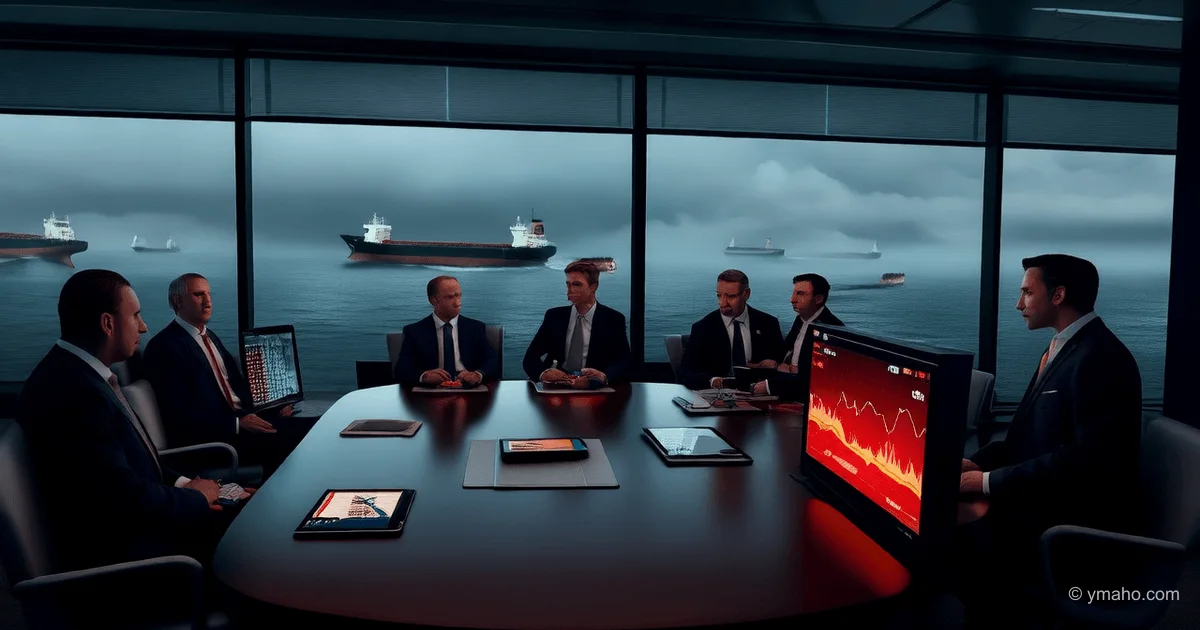
PIMCO Warns Fed May Hike Rates Due to Iran Military Conflict
PIMCO Chief Investment Officer Dan Ivascyn stated that a sharp spike in energy prices due to the situation around Iran could force the Fed not only to delay easing but also to tighten monetary policy again to combat accelerating inflation.
The Bottom Line: What's Really Happening
When one of the world's largest asset managers with a $2.3 trillion portfolio talks about a rate hike, it's not a forecast—it's a warning to clients to reconsider their allocation. On May 10, 2026, PIMCO CIO Dan Ivascyn gave an interview to the Financial Times on the sidelines of the Milken Institute conference in California, and his wording was deliberately harsh: cutting rates now "would be counterproductive" and "would very likely lead to higher medium- and long-term rates."
This statement is a radical departure from the consensus the market has held until now. Federal funds futures still show a 72.3% probability of rates staying unchanged until December, but no one was seriously pricing in a hike. PIMCO is putting that scenario on the table.
The key mechanism described by Ivascyn: the energy shock from a blockade of the Strait of Hormuz translates into persistent inflation that cannot be alleviated by monetary easing. Moreover, any rate cut now would stoke inflation expectations, forcing the market to demand a higher premium for long-term debt—and 10-year Treasury yields would rise, not fall.
This is not just one CIO's opinion. Jenny Johnson, CEO of Franklin Templeton, spoke at the same event and confirmed: "inflation will become increasingly difficult to control." Investors are already ramping up demand for inflation-protected assets, especially in real estate, where rental rates are rising in line with the overall price level.
The market received a coordinated signal from two of the biggest players in the bond world: the era of cheap money is not just being postponed—it could give way to a new phase of tightening.
Timeline and Context
February 28, 2026 — The start of military hostilities between the US and Iran. The Strait of Hormuz, through which about 20% of global seaborne oil trade passes, is effectively blocked. Non-Iranian oil volume through the strait collapses from about 13.6 million barrels per day to roughly 500,000 barrels. Brent crude starts from the mid-$70s.
March 2026 — Headline CPI surges to 3.3%, a 0.9% month-over-month jump—the largest since June 2022. But the market views this as a temporary shock: hostilities will cease, and inflation will recede.
April 2026 — Brent crude exceeds $118 per barrel. Gasoline at US pumps settles above $4.5 per gallon. Saudi Aramco CEO Amin Nasser warns: the world has lost about 1 billion barrels of oil in two months, and markets will need time to stabilize even if supplies resume.
April 24, 2026 — The Fed holds rates unchanged for the third consecutive time. But within the FOMC, a split emerges: three regional presidents—Lorie Logan, Neel Kashkari, and Beth Hammack—vote against the wording about a "shift toward easing." The vote is 8-4, the largest number of dissenters since 1992.
Late April — Reports emerge of preparations for peace talks mediated by Pakistan. The market rallies sharply, pricing in a quick ceasefire. The S&P 500 moves above 7300.
Early May 2026 — Peace talks stall. Iran offers to transfer some highly enriched uranium to a third country but refuses to dismantle nuclear facilities. On May 10, Trump calls the response "absolutely unacceptable."
May 10, 2026 — Ivascyn and Johnson speak at the Milken Institute conference. PIMCO warns of the risk of a rate hike. Goldman Sachs publishes a note the same day, pushing back its forecast for the next two rate cuts to December 2026 and March 2027, expecting energy costs to keep core PCE around 3%.
Today, May 12, 2026 — The market awaits the April CPI release. Consensus is 3.7-3.8%. Two-year Treasuries trade at 3.87%, up 50 basis points since the start of the conflict.
Winners and Losers
Winners: Holders of short-term Treasuries and money market instruments. If rates not only fail to decline but could rise, money market yields remain attractive for at least another year. PIMCO, managing $2.3 trillion, effectively recommends clients keep short duration and not rush to extend portfolios.
Winners: The energy sector. Sanctions and the strait blockade keep oil above $100 per barrel. Even if hostilities cease, supply restoration will take weeks. Saudi Aramco's CEO warned stabilization could drag into 2027. For oil majors, this means sustained super-profits for at least two to three quarters.
Winners: Inflation-protected assets. TIPS, real estate, commodities—Franklin Templeton notes rising demand for these instruments. Jenny Johnson specifically highlights real estate: rental rates rise in line with headline CPI, providing built-in inflation protection.
Losers: Holders of growth stocks, especially in tech. Technology and communication services make up about 43% of the S&P 500. These companies are valued on multiples derived from the discount rate. If Treasury yields continue to rise—and PIMCO warns that any rate cut would only accelerate this rise—the present value of future earnings falls.
Losers: New Fed Chair Kevin Warsh. Trump appointed him with the clear expectation of rate cuts. But PIMCO directly states: "Warsh will find himself in a no-win situation." With CPI above 3.5%, any move toward easing will look like political interference, and the market will punish it with rising yields.
Losers: Low-income households. Inflation above 3.5%, gasoline at $4.5 per gallon, rising rents—all hit real disposable incomes. The Michigan Consumer Sentiment Index is already at an all-time low of 48.2, and worsening inflation expectations will only exacerbate the situation.
What the Media Isn't Saying
First insight: PIMCO is warning not about a rate hike per se, but about an easing trap.
A careful reading of Ivascyn's statement shows he is not saying the Fed will inevitably raise rates. He says that cutting rates under current conditions would backfire—"lead to higher medium- and long-term rates." The mechanism: the market sees the Fed easing policy with inflation above 3.5%, interprets this as a loss of control over prices, demands a higher premium for inflation risk—and 10-year Treasury yields rise instead of falling.
This is a fundamentally different argument from the standard "inflation is high, so rates must rise." Ivascyn describes a confidence trap: the Fed cannot ease not because inflation is high, but because the market no longer believes in it. Cutting rates at such a moment destroys the remaining trust and causes borrowing costs to rise—exactly the opposite effect the central bank aims for.
Second insight: The split within the FOMC is more dangerous than it seems.
The three dissenters in April—Logan, Kashkari, and Hammack—voted against the wording about a "shift toward easing." This is the largest split since 1992. But the point is not the number, but who voted against. Kashkari is a long-time hawk. Logan is a technical expert on the repo market who sees what other FOMC members do not: pressure in short-term rates that portends liquidity problems during easing.
Their votes are not just disagreement. They signal that within the Fed, a group believes the current stance is not tight enough. If April CPI comes in above 3.8%, this group will have a powerful argument for tightening—and Warsh will find himself in the minority on his own committee.
Third insight: Goldman Sachs and PIMCO describe fundamentally different risks—and the market cannot decide whom to believe.
Goldman expects the Fed to simply delay rate cuts until December 2026, maintaining a neutral stance. PIMCO talks about the possibility of a hike. The difference between these scenarios is not a nuance but a chasm. In Goldman's scenario, Treasury yields stabilize at current levels, growth stocks recover, and the market continues its rally. In PIMCO's scenario, yields rise, growth stocks fall, and the energy sector gains.
The market has not yet chosen between these two realities—it is frozen, waiting for CPI. Today's report will be the moment of truth.
Forecast: Next 30 Days and 90 Days
30 Days (to mid-June 2026)
The release of April CPI today is the first and main trigger. Consensus forecast: 3.7-3.8% headline, 2.7% core. If the number comes in at or slightly above expectations, PIMCO's scenario gets its first confirmation: inflation is entrenched above 3.5%, and talk of rate hikes will cease to be a marginal hypothesis.
In the days following CPI, expect a series of comments from regional Fed presidents. Kashkari and Logan, who already voted against easing, may publicly support PIMCO's arguments. This will create an information environment where Warsh finds it increasingly difficult to defend easing.
The 2-year Treasury yield, already up 50 basis points since the conflict began to 3.87%, could break 4% if CPI exceeds 3.8%. 10-year Treasuries will move above current levels. The S&P 500 will remain in the 7200-7400 range, but rotation beneath the surface will accelerate: out of tech stocks and into energy, healthcare, and inflation-protected assets.
Trump's meeting with Xi Jinping, scheduled for this week, will add geopolitical uncertainty. If the talks signal coordinated pressure on Iran, oil could rise, strengthening PIMCO's arguments.
90 Days (to mid-August 2026)
By August, the trajectory of the Iran conflict—and thus the trajectory of monetary policy—will become clear.
Prolonged conflict scenario (PIMCO's base case). The ceasefire collapses, hostilities continue, the Strait of Hormuz remains partially closed. Oil settles above $110. Core PCE holds around 3%. In this scenario, the Fed not only refrains from cutting rates but begins discussing a hike by autumn. The group of dissenters led by Kashkari and Logan gains a majority on the FOMC. The market reprices the fair level of rates upward. Growth stocks lose 15-20% from their peak, while the energy sector continues its rally.
Conflict resolution scenario. If the ceasefire evolves into a sustainable agreement, the strait opens, oil falls below $90. CPI begins to decline. In this scenario, the Fed could return to discussing easing by year-end. Morgan Stanley already factors in this possibility: Andrew Slimmon of MSIM stated that a rate cut could come "about six months after the war ends," i.e., by late 2026. But this scenario requires peace—and diplomatic prospects remain "unclear."
The main risk for both scenarios is forecasting error. Inflation models built on peacetime data do not work under an energy shock. PIMCO could err on the side of excessive hawkishness, and Goldman on the side of excessive optimism. What an investor needs now is not a precise rate forecast, but a portfolio capable of withstanding both scenarios.
Practical takeaway: PIMCO's statement is a watershed. The market is saying goodbye to the illusion that the Fed will ease policy at the first opportunity. Reality has proven more complex: the energy shock has created an inflation trap from which a simple rate cut cannot escape. Those who restructure their portfolios for this new regime—with an emphasis on short duration, energy, and inflation protection—will win. Those who continue to cling to the scenario of three rate cuts in 2026 will lose capital.
— Editorial Team









