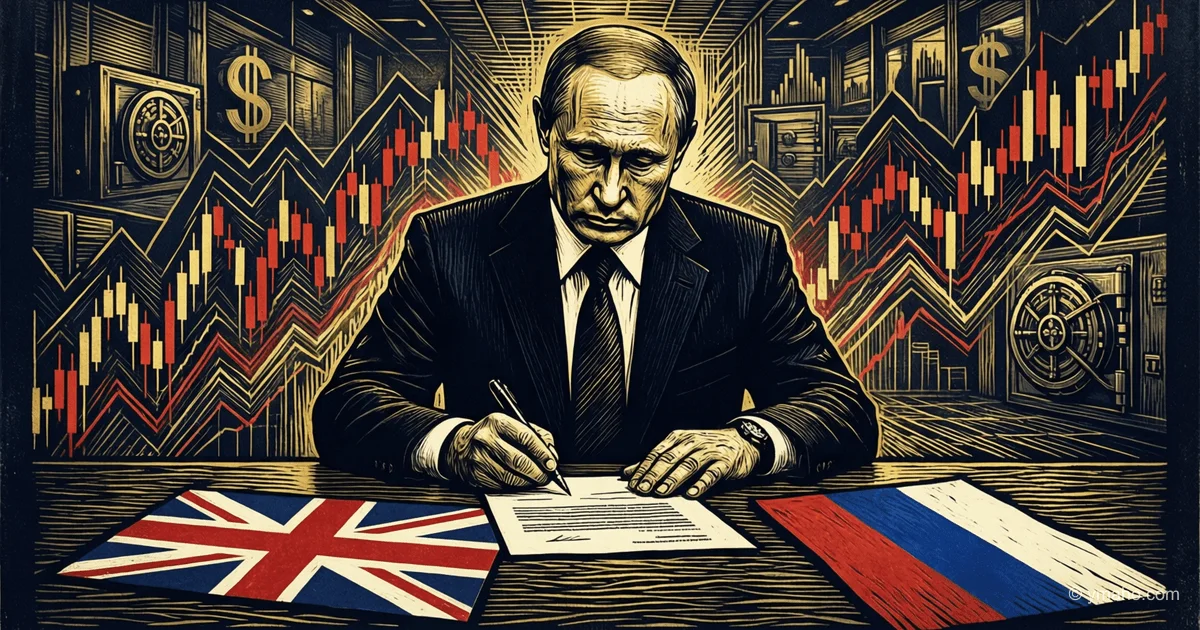
Putin Authorizes Buyback of Ektos Shares from British Company, Deal Details Revealed
The President signed an order allowing the Russian company Kompozit Sistem to repurchase 24,120 shares of petrochemical producer Ektos from the British company Composite System, registered in the British Virgin Islands.
A Deal with Zeroes: How Putin and a British Offshore Gave Ektos to Themselves
The Essence: What Is Really Happening
Formally, the news looks like another episode of "foreigners leaving Russia" — President Putin allowed the Russian company Kompozit Sistem to buy back 24,120 shares of petrochemical producer Ektos from the British Composite System. A routine deal, a routine permit. Boring.
But the non-obvious insight that the media diligently ignores is: this is not a sale of a Russian asset to a foreigner or a foreign asset to a Russian — it is moving papers from one pocket to another through a presidential permit. Because the founder of Kompozit Sistem, Vadim Batrak, who has been heading Ektos since 2009, now becomes the sole beneficiary. The British Composite System, registered in the British Virgin Islands, loses control. But there is likely no real money in the deal — only a change of legal shell.
Timeline and Context
On May 8, 2026, the President signed Order No. 154-rp. The document was published on the official legal information portal. According to the order, Kompozit Sistem received permission to acquire 24,120 shares of JSC EKTOSintez from Composite System Ltd, registered in the British Virgin Islands.
The ownership structure before the deal looked like this: the British Composite System Ltd (BVI) was the sole shareholder of Ektos. The authorized capital of Ektos as of the last reporting period (2021) consisted of 30,000 ordinary shares — meaning the deal covers 80% of the company's capital.
A key detail that no one pays attention to: Kompozit Sistem was founded in Moscow in 2023. The founder is Vadim Batrak. The General Director of Ektos is also Vadim Batrak, and he has held this position since 2009. So the person who already manages the company now receives permission to buy it from the British "shell." This is not a "foreign exit" — it is a repatriation of beneficial ownership to the one who was already in charge.
Who Wins and Who Loses
Winner — Vadim Batrak. Before the deal, he was a hired general director. Formally, not a shareholder. After the deal, he becomes the direct owner through Kompozit Sistem. There is no public data on the deal price — and this is the key point. The price is likely symbolic. Because the real value of Ektos is production of over 1.5 million tons of products per year, including MTBE (methyl tert-butyl ether), liquefied hydrocarbon gases, and benzene.
Winner — Russia. The asset that legally belonged to a British offshore shell comes under direct Russian control. This reduces the risks of account and asset freezes, which are currently relevant for any structure linked to "unfriendly" jurisdictions.
Loser — British Composite System Ltd. But only formally. Because if the company was actually managed through BVI but the ultimate owner was Russian (which is a common scheme), then the "loss" is simply the loss of a legal shell.
What the Media Leaves Out
First: why was a presidential permit needed? Because the deal falls under Decree No. 520 of August 5, 2022. This decree introduced a special procedure for transactions involving assets where "unfriendly" foreign structures participate. BVI is an "unfriendly" jurisdiction. And still — the president allows a buyout from a British legal entity by a structure that is 100% owned by the same person who manages the company being bought. This is not a "deal permit" — it is legitimizing what has already happened.
Second: most likely, no money went abroad. Under the terms of most such deals (within the framework of "counter-sanction" decrees), the proceeds from the sale are blocked in special type "O" accounts in Russia. The foreign seller cannot withdraw them. Thus, the formal permit is simply a document allowing the asset to be re-registered without violating Russian law.
Third, the most non-obvious: this is a precedent, but not unique. Since 2022, hundreds of Russian companies formally owned by offshore entities in "unfriendly" jurisdictions have undergone the same procedure. The difference is that Ektos is a real production facility with revenue likely in the hundreds of millions of dollars. And its "return" to Russian jurisdiction is a signal: the state is ready to authorize such deals even where the ultimate beneficiary does not change.
Forecast: Next 30 Days and 90 Days
30 days. The deal will be closed. The only risk is technical procedures in Russian registries. Ektos is not traded on the market — it is a non-public company. Therefore, there will be no reaction in quotes. But in industry circles, this deal will become another example of "how to properly transfer assets from offshore to Russia without real capital outflow."
90 days. By autumn 2026, Ektos may start public reporting as a Russian company (if the group decides to increase transparency). But the key question is: what will happen to the company's debts to Western banks? If the loans were issued to the British Composite System, then after the change of ownership, banks may demand early repayment or re-registration. This could create unforeseen financial obligations in the tens, possibly hundreds of millions of dollars — and then the "free" change of ownership may not be so free.
Editorial Forecast
Asset: USD/RUB exchange rate.
Direction: neutral / no impact in the next 24–72 hours. This deal is a micro-event for a single non-public asset and does not directly affect the currency market.
Key levels: current levels remain in force — 71.3–71.7 rubles per dollar.
Confidence level: high (85% for no reaction, 15% for extremely minor volatility in the moment).
Main risk: If details of the actual deal price are published (if it turns out to exceed $50–100 million and was actually transferred abroad), there may be short-term demand for currency to pay for the deal. But the probability of such a publication in the next 72 hours is less than 5%.
— Editorial Team