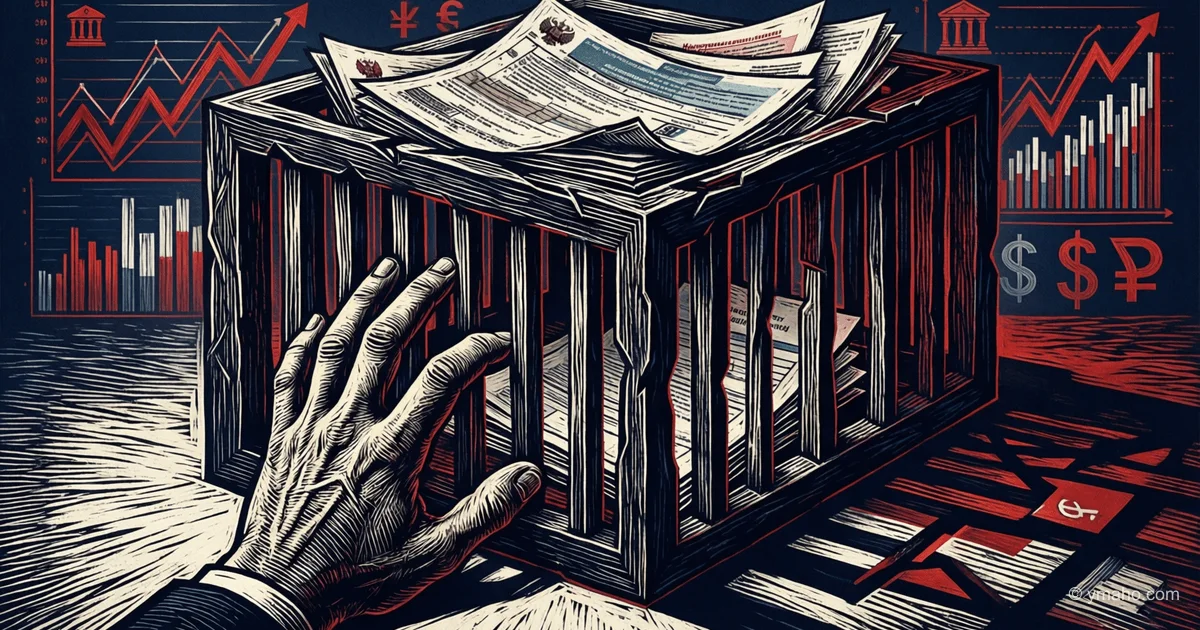
Russian Government Begins Developing New OKVED-3 Classifier for 2029
The White House launches a process to revise the All-Russian Classifier of Economic Activities. The new version is expected to be operational by 2029 and will account for digital platforms and creative industries.
Codes That Will Crack the System: Why OKVED-3 Is Not Bureaucracy, but a Tax Trap
"The Essence": What's Really Happening
Formally, the news sounds like a dry administrative reform: the government is launching a process to revise the classifier of economic activities. The new version should be operational by 2029 and will account for digital platforms and creative industries. Boring. Irrelevant. Wrong.
The non-obvious insight that no one will put in the headline: OKVED-3 is not about "convenience for business," but about total tax visibility. Officials are finally legalizing the ability to see where money is actually earned, and will tie taxes, benefits, and most importantly, fines to that. Companies that currently disguise IT platforms as "retail trade" or logistics as "courier services" will lose the ability to hide. And that will hurt.
Timeline and Context
The Ministry of Economic Development has drafted a plan for transitioning to OKVED-3. The first stages will start as early as August 2026, with the final ones by 2030. Key milestones: in 2026 — analysis of international classifiers; in 2028 — creation of "transition keys" between the old and new systems; in 2029 — the actual transition to the new codes.
But there is a nuance that is being kept quiet: since 2025, a new procedure for determining OKVED has already been in effect. The Federal Tax Service, Rosstat, and the Social Fund have merged their registries. Now businesses have two types of codes: "declared" (what the company said about itself during registration) and "reported" (what Rosstat calculated based on actual statistical reporting). If they don't match, the business has problems. In 2026, the first wave included 50% of legal entities and 42% of individual entrepreneurs who already submit statistics. The rest will be added in 2027-2028. Only after that — in 2029 — will the system finally transition to OKVED-3.
Why so long? Because the bureaucratic machine heats up gradually. By 2029, officials will have three years of data on companies' actual activities. And when they overlay new codes on that, the picture will become perfectly transparent.
Who Wins and Who Loses
Losers — Marketplaces and IT Platforms. Today, Wildberries and Ozon are registered under code 47.91 — "Retail trade via the Internet." But their real business is an IT platform, data processing, logistics, agency services, and advertising. Under the new classifier, separate codes will appear for all of these. Consequently, the tax burden could increase manifold — different types of activities are taxed differently. Currently, they pay as "trade," but will pay as "IT" and "logistics." That's hundreds of millions of dollars in additional taxes.
Also losing — bloggers and online schools. Today, there are no adequate codes for them at all. They are often classified under "information technology activities" or "education," but neither reflects their specifics. The new system will introduce codes for streaming services, podcasts, blogging activities, and the video game industry. This means that evading taxes through a "vague code" will no longer be possible.
Winners — large manufacturing industries and aircraft manufacturing. They will be given codes for new production and unmanned systems. This provides direct access to new government support programs that were previously unavailable due to "wrong codes." Budget subsidies and benefits will go exactly where the state wants them.
What the Media Isn't Saying
First: the reform is already underway, it's just not being noticed. Since September 2025, the new OKVED procedure is not a "plan" but a reality. Discrepancies between declared and reported codes are now an automatic red flag for the Federal Tax Service. By 2029, when OKVED-3 is implemented, the system will be ready to automatically recode millions of companies without their knowledge. The tax authorities won't ask — they will simply change the code in the registry based on statistics. And businesses will find out after the fact.
Second: benefits that businesses received under old codes will disappear at the moment of transition. The OKVED code determines reduced insurance premium rates, the right to tax holidays, and access to government support. When a company is recoded from "manufacturing" to "IT" or from "trade" to "logistics," all benefits will be lost. And it will be nearly impossible to reinstate them — the new code simply doesn't fit the old support programs.
Third, the most non-obvious: this reform is a blow to "gray" business splitting schemes. Today, many companies artificially split their business into several legal entities with different OKVED codes to qualify for special tax regimes (simplified tax system, patent). OKVED-3 will make such splitting pointless — because the actual type of activity will be determined not by the company's declaration, but by Rosstat data on revenue structure. If all legal entities are actually engaged in the same activity, the Federal Tax Service will see it automatically.
Forecast: Next 30 Days and 90 Days
30 days. By July 2026, the final transition plan for OKVED-3 should be approved. This is a technical document, but the market will react. Shares of Wildberries (if the company ever goes public) and Ozon will see increased volatility. Investors will begin to price in the risk of higher tax burdens. Ozon, as a public company, may face pressure on its financial statements as early as the second half of the year.
90 days. By September, the first public discussions of the new codes with the business community will begin. That's when the real "skeletons in the closet" will come out. Lobbyists for marketplaces, IT giants, and logistics operators will try to soften the transition. But the Ministry of Economic Development has already stated: "the scale of upcoming changes is significant." That means there will be few compromises. Expect a series of publications about "business being shocked by the new codes" and corresponding movements in the shares of retailers and IT companies.
Editorial Forecast
Asset: Ozon shares (ticker OZON, NASDAQ).
Direction: Moderate decline in the next 24–72 hours following news about the scale of the OKVED-3 reform. The market will begin to reassess tax risks for marketplaces that may lose their preferential "trade" status.
Key levels: Resistance at $22.5, support at $19.8. A break below $19.5 could lead to further movement toward $18.
Confidence level: Medium (45% for decline, 35% for sideways, 20% for slight increase).
Main risk: A statement from the Ministry of Economic Development about maintaining a transition period with full preservation of benefits for 2–3 years — in that case, shares of Ozon and other platforms could rebound by 5–7%, invalidating the negative forecast.
— Editorial Team