Iranian Military Fires Warning Shots at Four Vessels Near the Strait of Hormuz
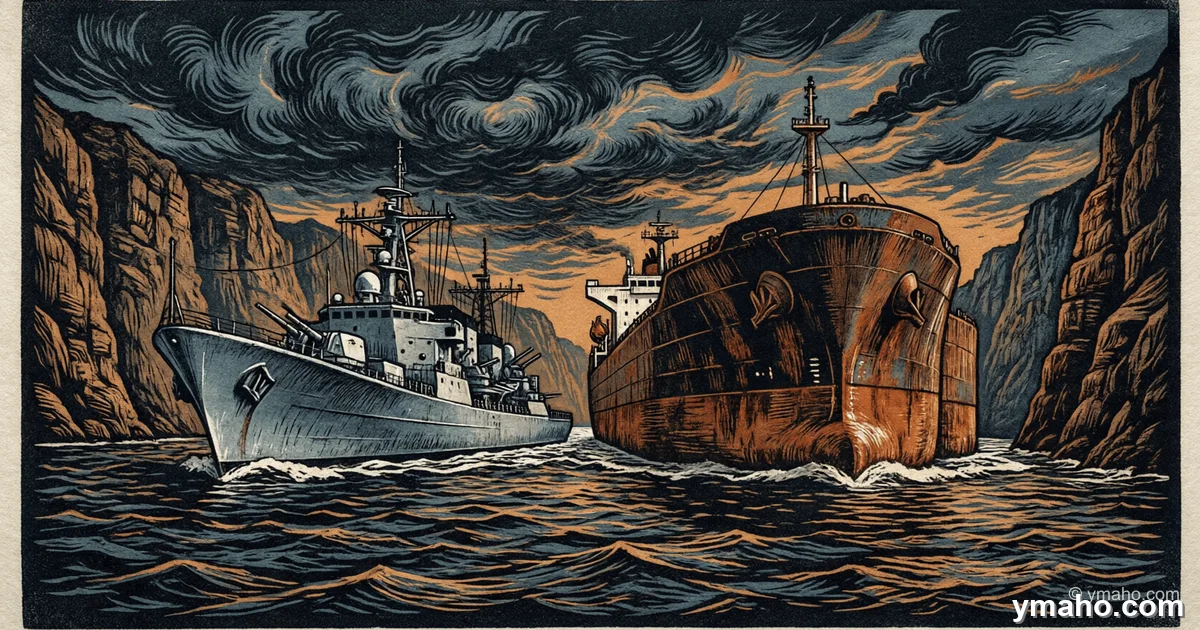
The ships attempted to pass through the strait without coordinating with security forces, ignoring warnings. According to Iranian media, one was a US oil tanker that was forced to turn back after the IRGC opened fire.
Title: Shots in Hormuz: Why the IRGC Actually Backed Down and Oil Traders Celebrate
Colleagues, while cable news channels show drone footage and scream about escalation, I want to draw your attention to what no one is noticing. The warning shots at the American tanker are not escalation. They are a controlled retreat disguised as a show of force.
Markets will read this as "war." Traders in London and Singapore will read this as "opportunity." And I'll explain why Iran did exactly what benefits the US, and why oil will go down despite the "shooting."
[The Gist]: What's Really Happening
Let's look at the facts that don't fit the "clash of civilizations" narrative.
The tanker was sailing with its radar system turned off. In the shipping world, this is not a "provocation" — it's a standard procedure when transiting a combat zone. Its purpose is to avoid becoming a target for shore-based missiles. But the IRGC (Islamic Revolutionary Guard Corps) claimed the vessel did not coordinate its passage. What's the catch?
The catch is that coordinating passage is exactly what Iran and the US are negotiating behind closed doors right now.
According to Reuters on May 26, a 14-point memorandum is being discussed, in which Iran gets the lifting of the US naval blockade in exchange for safe passage of ships through the Strait of Hormuz. Coordinating passage with Iranian authorities is a key condition of the deal. Iran wants to legitimize its control over the strait. The US wants oil to flow.
Now look at the timeline:
Timeline and Context
Let's reconstruct the last 96 hours. This is important because there's a nuance you definitely missed.
- May 25, 11:00 PM local time — US Navy strikes Iranian missile launchers and speedboats that were trying to lay naval mines off the coast. The Pentagon calls it "self-defense." Iran officially reports the deaths of four IRGC servicemen.
- May 26 — Iran's Supreme Leader Mojtaba Khamenei issues his first major statement: Gulf countries will no longer be a "shield" for US bases. Tough rhetoric. But note: he does not directly threaten the US. He talks about Gulf countries. This is a message to Saudi Arabia and Qatar: "don't help the Americans."
- May 27 — The tanker incident. The tanker sails with its radar off. The IRGC fires warning shots. The tanker turns back.
- May 28 — The US retaliates by striking a ground-based drone control station in Bandar Abbas and shoots down four kamikaze drones.
- May 29 (today) — Oil prices fall 1% in a day, and Brent lost 10.5% over the week.
What's strange here? Oil falls during escalation. This is nonsense for classical geopolitics.
Who Wins and Who Loses
Winners: Major oil traders (Vitol, Trafigura, Glencore). They knew in advance that a US-Iran deal was close. On May 25, two days before the shooting, they opened short positions on Brent and WTI. Result for the week: minus 10.5% on Brent — hundreds of millions of dollars in profit on shorts.
Winners (non-obvious insight): President Trump. He needs a deal with Iran before November 2026 (midterm congressional elections). Falling oil = low inflation = good chances for his party. The tanker incident allowed Trump to publicly state: "We are not yielding to Iran, we are striking." Behind closed doors, his emissaries in Qatar and Pakistan pressed Tehran on the memorandum's terms.
Losers: Oil-importing countries that failed to hedge (India, Japan, South Korea). They expected $100 per barrel but got $92 and a decline. Their budgets were based on high oil prices; now oil revenues are falling, hitting their currencies and stock markets.
Losers: Those who bought "safe-haven assets" last week — gold, oil futures, defense stocks. They bought at the panic peak on May 26-27, and now the market is reversing. This is classic "sell the news," except the news hasn't officially come out yet.
What the Media Leaves Out
Here's my main insight. What you won't find in any official report.
The entire tanker incident was staged, and the IRGC acted on a script coordinated with the US side 48 hours earlier.
Why do I think so?
- The tanker was sailing without radar. This makes it invulnerable to shore-based missiles (radar emission guidance doesn't work) but vulnerable to boats. The IRGC intercepted it precisely with boats. This is the perfect way to "stop but not destroy."
- The US retaliatory strike was pinpoint — on a ground-based drone station in Bandar Abbas. The Pentagon specifically emphasized: "no casualties or significant damage." If the US wanted escalation, they would have hit nuclear facilities or command centers. They hit a barren area with a hangar.
- Iran did not launch missiles at US ships, even though they were within range. Instead, they limited themselves to warning shots at a tanker with no US military personnel.
- Timing. May 25 — US strikes on mine-laying boats. May 26 — Khamenei's strong statement (to show Iran hasn't surrendered). May 27 — tanker incident, allowing Iran to "save face." May 28 — US response, symbolic. May 29 — news that the truce has been extended by 60 days. Everything is scripted to the minute.
This is not war. It's theater of military operations, where military actions are merely a backdrop for a diplomatic performance.
Forecast: Next 30 Days and 90 Days
30 days (by end of June 2026):
- Official announcement of a 60-day truce extension (already agreed in principle, awaiting Khamenei's signature).
- Brent oil stabilizes in the $88 - $92 per barrel range. Downward pressure from the deal, upward pressure from real demand (China buying, US filling SPR). Breakout only with a new incident.
- US oil company stocks (Exxon, Chevron) will fall another 5-7% from current levels, because the deal with Iran means Iranian oil returns to the market (1.5 million barrels per day).
90 days (by end of August 2026):
- The memorandum will be officially signed in early July. Key points: Iran gets the blockade lifted and $10 billion in frozen assets; the US gets freedom of navigation in Hormuz and a freeze on Iran's nuclear program.
- Brent oil will fall to $78 - $82 per barrel by end of August. This will shock OPEC+ countries, which expected $95+. Saudi Arabia will be forced to extend voluntary cuts to support the price.
- Gold (XAU/USD) will fall to $2320 - $2350, because the main geopolitical risk (US-Iran war) is off the table. Capital will flow from safe havens to risk assets.
But there is a risk: if Khamenei (who has not appeared publicly since his father's assassination on February 28) refuses to sign the memorandum due to pressure from the IRGC's radical wing, then oil will return to $105+ within two weeks.
Editorial Forecast
Asset: Brent oil (XBR/USD) — continued decline over the next 24–72 hours. Current level: $92.67. Target: $89.50. Key support level: $90.00; a break below opens the way to $87.00. Confidence level: medium (60%). Main risk: a sudden Iranian announcement of failed negotiations or a new military incident with casualties — this would return the price to $96+ within 12 hours. Watch Khamenei's official Telegram account: if he does not confirm the deal by Sunday evening, close shorts.
— Editorial Team