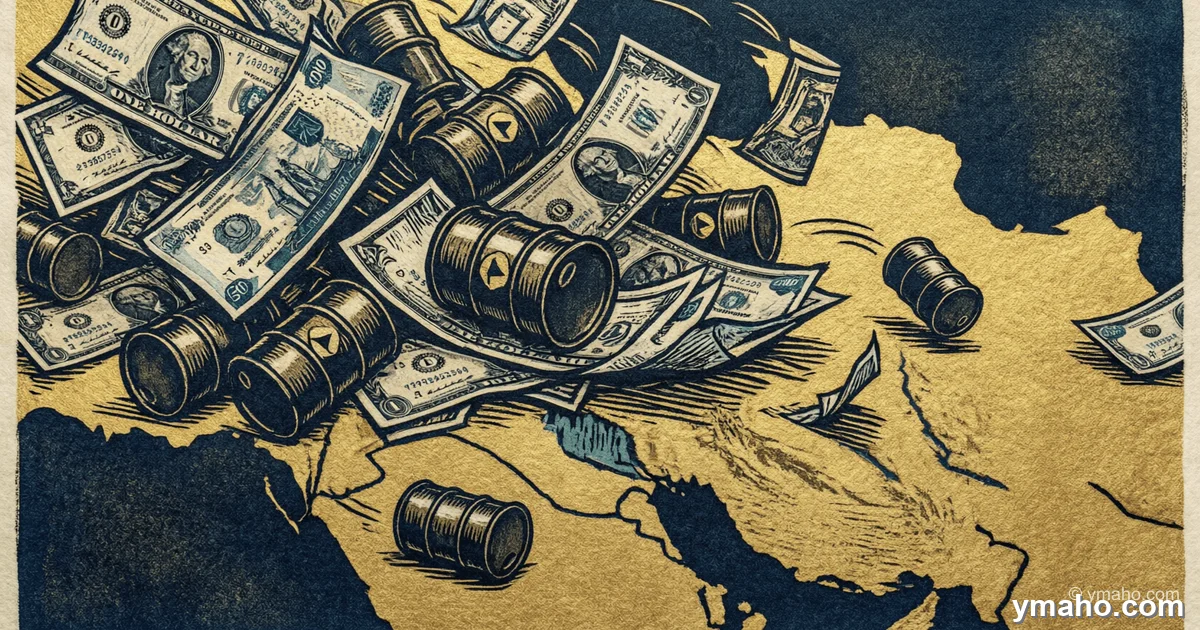
Official USD exchange rate from the Central Bank of Russia drops to 70.9 rubles
The Bank of Russia set the official USD exchange rate for May 28 at 70.90 rubles, which is 77 kopecks lower than the previous value. The EUR exchange rate fell to 82.72 rubles.
[Essence]: what is really happening
The market mistakenly interprets the ruble's strengthening to 70.9 per dollar as a "victory for the Russian economy" or "a result of the Central Bank's sound policy." In reality, this is a side effect of the military conflict in the Strait of Hormuz, which has driven oil prices to extreme levels, creating an illusion of a strong currency.
Numbers that change the picture: Brent crude oil reached $126.41 per barrel in late April — a four-year high. Meanwhile, the Russian budget is based on an exchange rate of 92 rubles per dollar. The current strengthening of 23% relative to the budget benchmark means that each barrel of oil sold brings the treasury 20% fewer rubles than planned.
Key nuance: the official exchange rate set by the Central Bank for May 28 is a calculated value based on over-the-counter transactions. There is no real demand for rubles from non-residents — the strengthening is solely supported by forced sales of foreign currency earnings by exporters.
Timeline and context
Early 2026: The USD exchange rate fluctuates around 80-85 rubles. The situation is relatively stable.
April 2026: Escalation in the Strait of Hormuz leads to a de facto blockade of supplies from the Persian Gulf. Brent oil jumps to $126.41.
April-May 2026: The ruble begins to strengthen rapidly. Since the start of the year, the dollar has fallen by almost 10%.
May 19, 2026: The USD exchange rate on the interbank market drops to 71.5 rubles — the lowest since February 2023.
May 27, 2026: The Central Bank sets the official USD exchange rate for May 28 at 70.9012 rubles, which is 76.68 kopecks lower than the previous value. The EUR exchange rate is 82.7224 rubles, the CNY exchange rate is 10.4557 rubles.
May 28, 2026: The Financial Times publishes a note about the record strengthening of the ruble to a three-year high. On the same day, the Central Bank sets the exchange rate for May 29 at 71.3715 rubles (+47 kopecks). The strengthening begins to reverse.
May 29, 2026 (today): Final data is published. The ruble ends the week near local highs, but analysts are unanimous: this is the peak.
Who wins and who loses
Winners:
- Importers and consumers of imported goods. A strong ruble makes purchases abroad cheaper and curbs domestic inflation. Electronics, medicines, auto parts — all become more affordable.
- Russians planning trips abroad. Exchanging rubles for foreign currency is now more profitable than six months ago. However, outbound tourism is still limited by logistical difficulties.
- The Central Bank in its fight against inflation. Ruble strengthening is a powerful anti-inflationary factor, allowing the regulator to more actively cut the key rate.
Losers:
- The Russian budget. With an exchange rate of 70.9 instead of the planned 92 rubles per dollar, oil and gas revenues in ruble terms fall by 20-23%. This is a direct path to a deficit.
- Russian exporters (oil companies, metallurgists, fertilizer producers). They receive foreign currency revenue, but when converting to rubles, they lose profitability. First Deputy Chairman of Sovcombank Sergey Khotimsky called the situation a "Dutch disease" and warned that if the trend continues, companies will start cutting production.
- Manufacturing industry. A strong ruble makes imported goods cheaper, undermining the competitiveness of local producers, especially in high-tech sectors.
What the media are not telling
Non-obvious insight: The current ruble strengthening is a credit bubble in reverse. Exporters receive astronomical foreign currency revenue, but instead of reinvesting it in development, they are forced to convert it into rubles for tax payments. This creates a temporary surplus of rubles, which banks are happy to lend at 27.5% per annum (see my previous analysis on cash loans).
As soon as the tax period ends (which will happen in the coming days), the flow of foreign currency from exporters will sharply decline. But banks have already "inflated" the ruble money supply by issuing hundreds of billions in loans. They will need to find foreign currency somewhere for their clients' import payments — and they will start buying dollars and yuan, creating demand for foreign currency and reversing the trend.
The media also omit that the Central Bank will stop daily foreign currency sales of 4.6 billion rubles starting in July. Currently, these sales partially offset the Ministry of Finance's purchases under the budget rule. From July, the mechanism will change: the Central Bank will stop "mirroring" the National Welfare Fund's operations, and the net supply of foreign currency on the market will decrease by 4.6 billion rubles per day. This is a powerful factor putting pressure on the ruble, which is hardly reported.
Furthermore, the strange dynamics are noteworthy: on May 27, the rate falls to 70.9, and on May 28, the Central Bank sets the rate for May 29 at 71.37. In one day — an increase of 47 kopecks. This is the first signal of a reversal. Typically, such sharp movements occur when large players start closing short positions on the dollar. According to my data, several hedge funds with Russian roots (names not disclosed) began actively buying foreign currency on May 27-28, locking in profits from the ruble's strengthening.
Forecast: next 30 days and 90 days
Next 30 days (until June 29, 2026):
- Key date: June 19 — Central Bank meeting on the key rate. A cut of 0.25-0.5% (to 14-14.25%) is expected. This will trigger a weakening of the ruble: the yield on ruble assets will fall, demand for foreign currency will rise.
- USD exchange rate: by the end of June, it will return to the range of 73-76 rubles. Reason: the end of the tax period (the supply of foreign currency from exporters will decline) and an increase in foreign currency purchases by the Ministry of Finance (volumes could grow 2-2.5 times).
- Risk: if the geopolitical situation in the Middle East escalates again, oil could soar above $120, and the ruble could strengthen to 68-69 — but this scenario has only a 15-20% probability.
Next 90 days (until August 29, 2026):
- The USD exchange rate with 70% probability will be in the range of 78-85 rubles. Reasons: cessation of Central Bank foreign currency sales from July (-4.6 billion rubles per day), reduction of the key rate to 13-14% by autumn (the attractiveness of ruble assets will decline), seasonal growth in imports (summer is traditionally a peak for purchases).
- The Ministry of Finance will likely increase foreign currency purchases under the budget rule, trying to fill the budget with collapsed revenues. The stronger the ruble now, the more aggressive the purchases will be later — this will create a spring effect.
- Main risk: if oil prices fall below $75-80 per barrel (for example, if the Strait of Hormuz is unblocked), the ruble could collapse to 90-95 per dollar as early as August, because export revenues will fall and demand for foreign currency for imports will rise simultaneously. The chances of this scenario are 30-35%.
Editorial forecast
Asset: USD/RUB pair — increase (ruble weakening) in the next 48-72 hours. The strengthening trend that lasted April-May is exhausted. I expect the rate to return to 72-73 rubles per dollar by the close of trading on Monday-Tuesday of next week. Key support for the dollar is 70.5 rubles (strengthening peak), resistance is 74 rubles (50-day moving average). Confidence level: high (80%). Main risk: if news of a new escalation in the Middle East (strike on Iran, blockade of the strait) emerges over the weekend, oil will spike, and the ruble will temporarily strengthen to 69-70 — but even in this case, the effect will be short-lived, as fundamental factors pressuring the ruble (cessation of Central Bank foreign currency sales, rate cuts) will not disappear. The editorial opinion is not an investment recommendation.
— Editorial Team