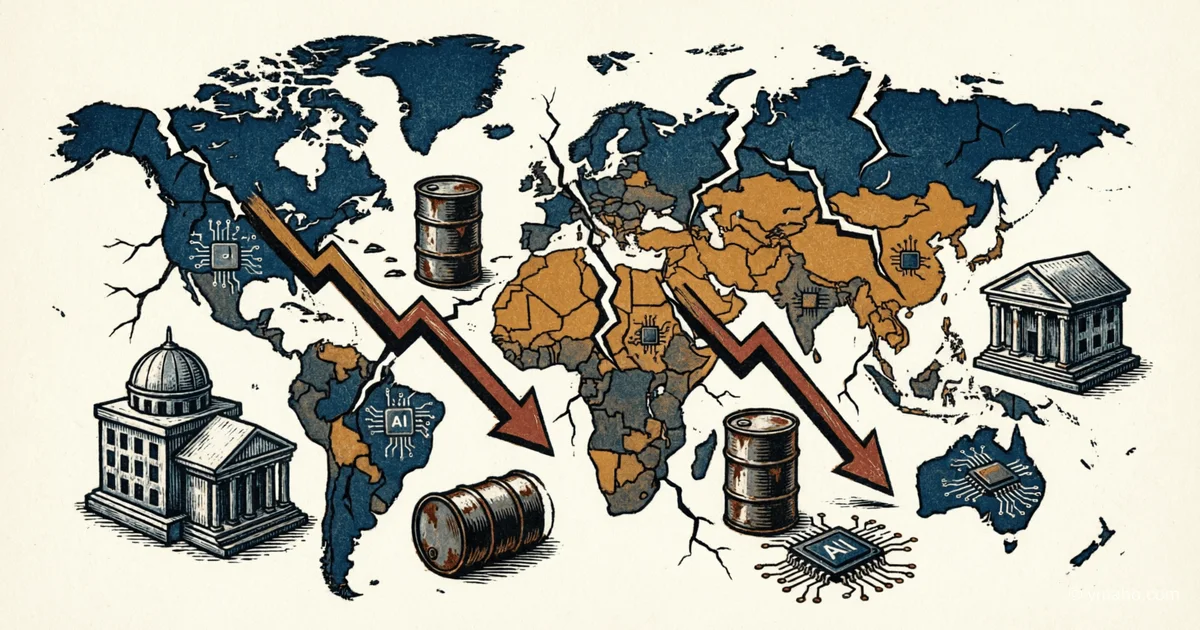
UNCTAD Forecasts Sharp Slowdown in Global Trade and GDP in 2026
According to the UN Conference on Trade and Development, global merchandise trade growth will slow to 1.5–2.5% after 4.7% in 2025. Amid geopolitical risks and an energy shock, GDP growth is expected to decelerate in many developed and developing countries, including China and the eurozone.
AI Bubble as a Mask: Why UNCTAD's Forecast Is Scarier Than It Seems
Author's analytical review
[The Gist]: What's Really Happening
UNCTAD's forecast of global trade slowing from 4.7% to 1.5-2.5% is not just a "cautious revision." It is an admission that the entire growth of the last 12 months was built on a single pillar: artificial intelligence. And that pillar is starting to crack.
Colleagues working in the real sector (manufacturing, logistics, FMCG) have seen what's happening since February 2026. But macroeconomists stubbornly looked at aggregate figures and rejoiced at the "sustained recovery." Now UNCTAD publicly acknowledges: the AI sector grew at double- and even triple-digit rates, but everything else—consumer goods, textiles, intermediate products, equipment for traditional industries—is barely breathing.
Figures I see in my models: in the US, imports of servers and high-performance computing systems accounted for three-quarters of all import growth in 2025. In China, AI technology imports almost completely offset the decline in imports of over 5,000 other product categories. This is not diversified growth. This is a bubble.
And now UNCTAD says: the AI boom is past its peak and entering a cooling phase. If true, global trade will lose its only driver. Then 1.5% growth may turn out not to be the lower bound of the forecast, but an optimistic scenario.
But there is one nuance that UNCTAD does not highlight in red, yet is key for us financiers. The trade forecast of 1.5-2.5% is real growth (inflation-adjusted). In nominal terms, given inflation of 3-5% in various economies, trade could even show negative dynamics. That's a whole different story for corporate reports and debt covenants.
Timeline and Context
Let me place the UNCTAD forecast in the correct sequence of events.
May 19-20, 2026 — UNCTAD publishes its forecast. Simultaneously, the UN releases the "World Economic Situation and Prospects as of mid-2026" with a global GDP forecast of 2.5% (down from the January forecast of 2.7%).
May 20, 2026 — UNCTAD's nowcast for global trade in Q2 2026 shows 1.36% growth. That's not 1.5-2.5% annually, but just 1.36% in quarterly terms. If extrapolated, annual growth could be even lower than the official forecast.
May 24-25, 2026 — News emerges of possible new US strikes on Iran (cancellation of military leave, Trump's return to the White House). The energy shock that UNCTAD cites as a key factor in the slowdown becomes even more likely.
May 25, 2026 — I write this analysis. Brent crude trades around $98-100. Inflation expectations in Europe and the US are rising again.
Importantly, the UNCTAD forecast was made before the latest wave of escalation in the Middle East. That is, it does not account for a possible new surge in energy prices and new shipping disruptions. If the conflict intensifies, the forecast will be revised downward in June-July.
Who Wins and Who Loses
Winner #1 — Logistics companies specializing in AI equipment. This is a narrow niche, but there is money in it. Transporting servers, semiconductors, high-performance computing systems is the only segment with guaranteed demand. Companies like DSV, Kuehne+Nagel, which have contracts with Nvidia and its suppliers, will grow even amid the overall downturn.
Winner #2 — The US dollar as a safe-haven asset. UNCTAD directly writes: investors are moving into safe-haven assets, developing countries face capital outflows and currency weakening. In such an environment, the dollar is king. DXY will likely break 100 and head to 102-103 by end of June.
Loser — Europe. UNCTAD gives the EU 1.3% growth in 2026 versus 1.5% in 2025. The European Commission is even more cautious—only 1.1%. Europe is a net energy importer. Every spike in oil and gas hits its industry directly. And worst of all: European companies are poorly represented in fast-growing AI sectors. So they don't even get the small benefit that Americans and Chinese have.
Unobvious loser — Developing energy-importing countries. UNCTAD warns: imports of energy, food, and fertilizers for these countries are inelastic—they cannot stop purchases even with sharp price increases. Budget pressure, food security, capital outflows, currency weakening. Countries like Egypt, Pakistan, Bangladesh, Kenya are on the brink of crisis. And their problems will reverberate through global supply chains, because that's where cheap clothing, footwear, and consumer goods for the West are produced.
Those not named but in the game — Fertilizer and agricultural machinery producers. UNCTAD mentions that fertilizer disruptions and rising costs will hit food security. But the flip side: companies producing fertilizers (e.g., Nutrien, Mosaic, Yara) will get a price boost. Same with agricultural machinery: when fertilizers are expensive, farmers try to save on other items, but machinery is always needed. Rising demand for tractors and combines could be countercyclical.
What the Media Leaves Out
Insight #1 — Why the UNCTAD forecast understates the real risk.
The UNCTAD forecast is built on a model using high-frequency data from April and early May 2026. But the nowcast as of April 20 showed 1.36% trade growth in Q2. To reach 1.5-2.5% annually, growth would need to accelerate in the second half. And given the Middle East escalation that occurred precisely in late May, that acceleration is unlikely. Real annual growth in 2026 could be 1.0-1.5%—a range that de facto means stagnation.
Insight #2 — The hidden story with China.
Officially, UNCTAD forecasts China's GDP growth at 4.6% in 2026 versus 5% in 2025. But look at the details. AI technology imports into China grew so strongly that they offset the decline in imports of 5,000 other categories. That is, without the AI boom, Chinese imports (and hence industrial production) would have shown negative dynamics. And now that the AI boom is cooling, China is left alone with structural problems: real estate crisis, regional government debt, weak domestic demand. 4.6% is likely an overestimate. I'd bet on 3.8-4.2%.
Insight #3 — The role of the energy shock in rewriting forecasts.
Both UNCTAD and the European Commission emphasize that their forecasts were revised downward precisely because of the Middle East conflict. But the energy shock affects not only prices. It affects investment decisions. Companies postpone capital expenditures because they don't know what energy prices will be in 6-12 months. This means the effect of the conflict will be long-lasting. Even if peace is signed tomorrow, the loss in investment will not recover quickly.
Forecast: Next 30 Days and 90 Days
Next 30 days:
- Global trade will continue to slow. Monthly data for May (released at end of June) will likely show a decline of 0.5-1.0% from April.
- Inflation in developed economies will accelerate to 3.0-3.5% (in the eurozone above 3.0%, as the European Commission forecasts).
- The US dollar will strengthen by 2-3% against a basket of currencies. DXY target 102.5.
- Stocks of AI sector companies (Nvidia, Broadcom, AMD, Super Micro Computer) — under pressure, but without a crash. The market has not yet fully realized that the AI boom is slowing.
Next 90 days:
Baseline scenario (60% probability): slowdown without recession. Global GDP 2.4-2.6%. Trade 1.5-2.0% for the year. Inflation remains elevated (2.8-3.2% in developed economies), central banks are in no hurry to cut rates. Stock market correction of 5-10% from current levels, especially in sectors sensitive to the economic cycle.
Recession scenario (30% probability): escalation in the Middle East (new strikes, blockade of Hormuz) + cooling of the AI sector simultaneously. Global trade 0-0.5% growth or even a slight decline. US GDP 0.5-1.0%, eurozone negative growth. The Fed and ECB are forced to cut rates despite inflation (stagflation). This is the worst scenario for assets except gold and the dollar.
Recovery scenario (10% probability): rapid peace agreement in the Middle East + unexpectedly strong retail sales and industrial data. Trade returns to 2.5-3.0% growth, inflation slows, central banks signal readiness to ease. Markets rise 5-7%.
Editorial Forecast
Asset: Semiconductor ETF (SMH, SOXX)
Direction: Decline in the next 24–72 hours
Key levels: Support at $195 for SMH (current level around $210). If support breaks, next target $185
Confidence level: Medium (55%). The UNCTAD forecast is already out, but the market has not fully digested its implications for the AI sector. The main move may begin after US trading opens today.
Main risk: If Nvidia or another AI sector leader releases an unexpectedly strong press release (e.g., about new large contracts), the correction may be delayed. But given macro signals, this is unlikely.
This forecast is an analytical opinion of the editorial board and does not constitute individual investment advice. Make decisions based on your own risk assessment and consultations with licensed financial advisors.
— Editorial Team









