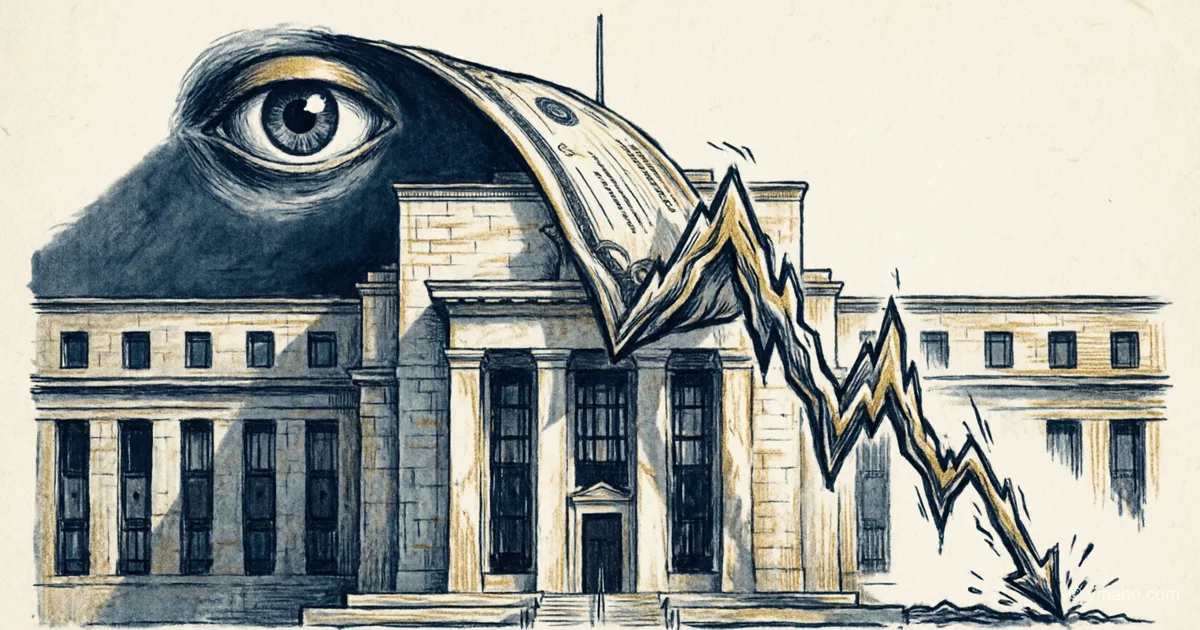
Yield on 30-Year US Treasury Hits 18-Year High
The yield on 30-year US Treasuries rose to 5.18%, a record since 2007. The rising yield is putting pressure on the stock market, especially on technology stocks.
We are witnessing a historic moment: the yield on 30-year US Treasury bonds has broken through 5.18% — the highest since 2007. But the main drama is unfolding not in the charts, but in the offices of the Federal Reserve and on the floors of the largest hedge funds. The market is no longer discussing when the rate will be cut. Bets are being placed on when it will be raised. And that completely changes the rules of the game for the entire world of capital.
The Bottom Line: What's Really Happening
The current sell-off in long-dated Treasuries is not panic, but cold calculation. The largest institutional investors, the so-called "bond vigilantes," are back. Their goal is not just to profit from falling prices, but to force the new Fed Chair Kevin Warsh into concrete action. Warsh, whose inauguration is scheduled for this Friday, is known as a hawk and a critic of large-scale central bank interventions. By his inaction and reluctance to immediately buy up the market, he is giving the "vigilantes" a green light to continue their assault. The market is testing the new sheriff's mettle: either he breaks inflation with tough rhetoric and a rate hike, or the market does it for him by crashing the value of all US government debt.
Timeline and Context
The point of no return was passed in mid-May, when an auction for 30-year bonds showed below-average demand, and the yield settled above the psychological 5% mark. But the real trigger was the escalation of the conflict with Iran in late February, which sent energy prices soaring. Since then, inflation expectations have become unmoored from reality: the April US Consumer Price Index jumped to 3.8% year-over-year. Investors realized that cheap oil is gone, and with it, cheap money. By May 19, the yield on 2-year notes had already exceeded 4.11%, signaling that the market is pricing in at least one Fed rate hike this year, possibly by December.
Who Wins and Who Loses
The winners are large pension funds and insurance companies, which have been on a meager diet of low rates for years and can now build portfolios with guaranteed yields above 5% in dollars for the next 30 years. This is their golden time.
The losers are investment banks sitting on a pile of unsold corporate debt worth over $50 billion, and, of course, the technology sector. For IT giants, whose value is built on expectations of future super-profits discounted at a low rate, the rise in the risk-free rate to 5% is a catastrophe. That is why we are seeing declines in the Nasdaq and S&P 500 indices, despite some positive corporate news. The ceiling for growth stocks is getting lower and lower.
What the Media Isn't Saying
While everyone is discussing inflation, the main non-obvious insight lies in the area of liquidity and accounting manipulation. Analysts overlook that a significant portion of banks, especially regional ones, hold old Treasuries on their balance sheets purchased when rates were 1-2%. Their market value is now 30-40% below par. To avoid booking losses and damaging capital adequacy, banks have moved these securities from the trading book to the held-to-maturity portfolio. This is legal, but it creates a "glass" ceiling for lending: banks cannot sell bad assets, so they cannot issue new loans. The real economy is suffocating not from high rates per se, but from the hidden paralysis of bank balance sheets. It is this mechanism, not just Fed actions, that is choking economic growth while simultaneously preventing inflation from falling due to a contraction in the supply of goods and services.
Forecast: Next 30 Days and 90 Days
30 days (by June 21, 2026). I expect Kevin Warsh to take an uncompromising stance at his first press conference. He will not announce new QE to rescue the stock market. This will cause a shock and a short-term drop in the S&P 500 of another 2-3%, and the yield on 30-year bonds will test the 5.3% level. Warsh needs to show he is not weak. However, a 50-basis-point tightening will not happen — he will limit himself to rhetoric, giving the market time to adapt.
90 days (by the end of August 2026). The moment of truth arrives. According to analysts' estimates, by this time the US Treasury will face the need to refinance multi-billion-dollar debt. Given that a Bank of America survey shows 62% of managers expect the yield on 30-year bonds to rise to 6%, buyers at auctions will demand an even larger premium. If inflation does not start to slow sharply by then, the Fed will be forced to raise rates by 25 basis points. This will shock markets that are still hoping for a "dovish" pivot.
Editorial Forecast
Asset: S&P 500 Index. Direction: decline over the next 24-72 hours.
Key levels: a break below support at 5830 points will open the way to 5780 points. Confidence level: medium. The stock market will continue to price in the rise in the risk-free rate, and even positive PMI data, if released, will be perceived as a pro-inflationary factor, increasing pressure on the Fed. The main risk to the forecast is an unexpectedly "dovish" statement from Kevin Warsh upon taking office, which could trigger a temporary short squeeze and a bounce in the index. This is the editorial opinion, not an investment recommendation.
— Editorial Team









