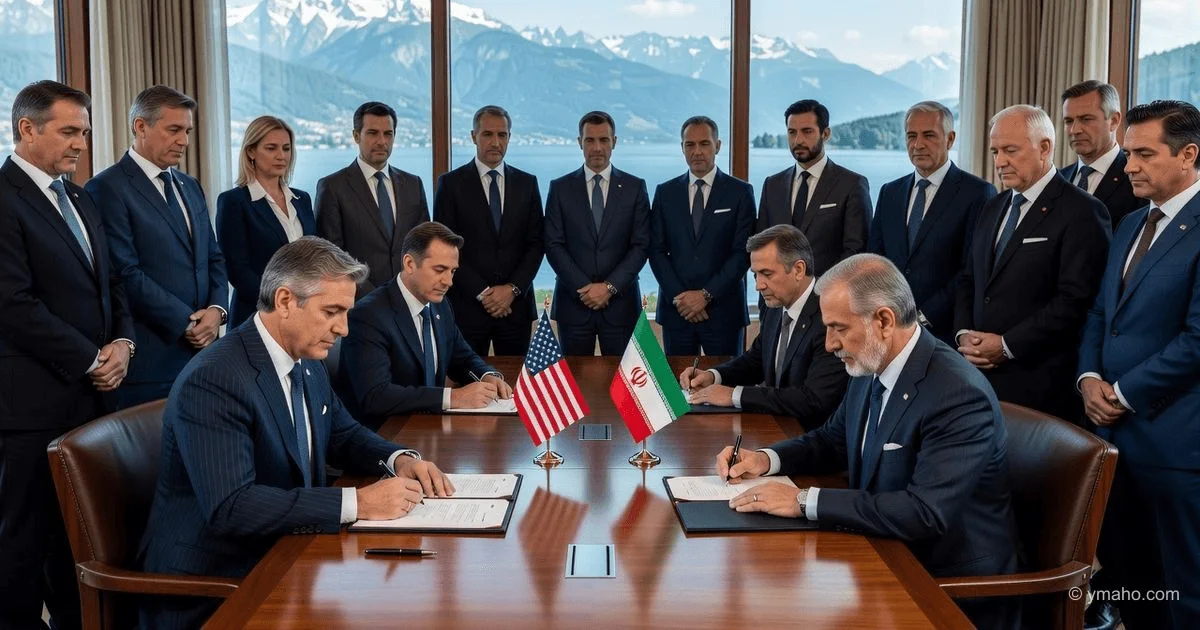
US-Iran Deal Envisions $300 Billion Fund Amid Analyst Criticism
According to Reuters, the framework agreement provides for the creation of a $300 billion investment fund for Iran's reconstruction, with signing expected on June 19. Analysts express doubts about the deal's effectiveness, as a military victory over the regime could turn into economic capitulation, and Iran has retained nuclear capabilities within one year of building a bomb.
$300 Billion Fund for Iran: A Geopolitical Bargain That Will Reshape the Energy Market
Key insight markets are missing: The US-Iran deal is not so much a peace agreement as a giant financial engineering scheme, where $300 billion in private capital acts as a "golden parachute" for the Iranian regime and simultaneously an "insurance policy" for the US economy. Markets have already priced in a reduction in the geopolitical premium for oil, but have not realized the main point: Israel has officially distanced itself from the deal and does not consider itself bound by its terms. This means that the truce in the Strait of Hormuz could be broken at any moment by an Israeli operation in Lebanon or Syria, and then oil will return to $100 per barrel faster than traders can close short positions.
The Essence: What Is Really Happening
The framework agreement between the US and Iran, expected to be signed on June 19 in Bürgenstock, Switzerland, is a complex multi-step structure. On one hand, the US lifts the naval blockade of Iranian ports, gradually releases Iranian assets frozen abroad, and grants Tehran immediate relief to resume oil and petroleum product exports. On the other hand, Iran commits to restoring navigation through the Strait of Hormuz, which has been effectively blocked since February 28, and to begin dismantling its nuclear program.
However, the central element of the deal is the creation of a $300 billion private investment fund, which is intended to serve as an economic anchor for a long-term settlement. This fund is not reparations or state aid. It is exclusively private investments from companies in the US, Persian Gulf countries, Asia, South America, and Africa. More than half of the amount—over $150 billion—is already backed by investor commitments.
Iran initially demanded $400 billion from Washington as compensation for war damage, but was refused. Instead, the parties agreed on a mechanism where regional countries can participate through credit lines or direct financing for the restoration of Iranian infrastructure—from the Mobarakeh steel complex to oil refineries and airports.
It is important to understand: the fund will not be created until the final agreement is signed. The memorandum of understanding to be signed on Friday launches a 60-day process during which fund administrators will work with the Iranian side and investors on project planning.
Timeline and Context
This agreement became possible due to a confluence of circumstances that markets have not yet fully grasped.
| Date | Event | Market Impact |
|---|---|---|
| February 28, 2026 | Start of US-Israel war against Iran, blockade of Strait of Hormuz | WTI oil reaches $113/barrel, inflation rises |
| April 2026 | Fragile ceasefire, indirect negotiations | Oil consolidates around $90-95 |
| May 2026 | Intelligence leak: Iran 9-12 months from nuclear weapon | Geopolitical premium rises |
| June 16-17, 2026 | G7 summit in Évian-les-Bains, announcement of framework deal | Oil falls 5% two days in a row to 3-month lows |
| June 19, 2026 (expected) | Signing of memorandum in Bürgenstock | Key market bifurcation point |
Key context: The deal with Iran came at just the right time for new Fed Chair Kevin Warsh, who held his first meeting on June 16-17. Warsh faced a dilemma: inflation had accelerated to 4.2% due to the energy shock, while the labor market demanded accommodative policy. The drop in oil prices on the news of the deal relieved him of the urgent need to raise rates in the short term. Former Boston Fed President Eric Rosengren called this "clearly positive news" for the economy and the Fed.
However, as Rosengren rightly noted, the Fed is unlikely to price in too much of the deal until it is actually signed: "One bomb in Beirut or an attack on a ship is enough to completely change the situation."
Who Wins and Who Loses
Winners: Traders who opened short positions on oil in anticipation of the unblocking of Hormuz. Over two days, Brent lost about 5%, WTI fell to $75.8 per barrel—three-month lows. However, analysts warn that full restoration of tanker traffic through the strait will take weeks, months, or even years, limiting the potential for further declines. WTI is expected to trade in the $70-90 range in the near term.
Winners: Large international corporations in the energy, logistics, and manufacturing sectors that will gain access to the Iranian market with its 92 million population and vast oil and gas reserves. Companies from South Korea, Japan, Singapore, Malaysia, and the US have been named. This opens opportunities for long-term contracts for decades to come.
Winners: The Iranian regime. It not only gains access to $300 billion in investments but also retains its nuclear potential—according to intelligence estimates, it is still within one year of building a bomb. Moreover, Iran's missile program and support for Hezbollah are not even subjects of negotiation. In effect, the US secured a freeze on the nuclear program and the opening of the strait, but did not achieve regime change, did not stop the missile program, and did not cut Iran off from its proxy forces in the region.
Losers: Investors holding long positions on oil who had priced in a sustained geopolitical premium of $90-100 per barrel. They are forced to lock in losses. However, analysts warn: "the path to normalization is far from straightforward." Physical tanker traffic through the strait has not yet resumed, and any escalation, especially from Israel, which did not sign the agreement, could instantly return prices to previous levels.
Losers: Israel. Prime Minister Benjamin Netanyahu stated that Israel is not bound by the agreement and will not withdraw troops from southern Lebanon, contrary to statements by US Vice President JD Vance. This creates a fundamental contradiction: Hezbollah claims that the withdrawal of Israeli troops from Lebanon is a condition of the deal, while Israel denies this. This is a "time bomb" for the entire agreement.
What the Media Is Not Saying
Three key nuances remain behind the scenes, which most analysts miss.
First: The $300 billion fund is essentially a "golden cage" for Iran, not aid. The fund is created and becomes operational only after the signing of the final agreement, which requires Tehran to fully dismantle its nuclear program, eliminate enriched uranium stocks, and submit to a strict inspection regime. This means Iran will receive investments in tranches as it meets conditions. If Tehran violates its commitments, the fund will be frozen. In essence, it is a mechanism of economic control, not aid.
Second: The agreement sharply changes the outlook for the Fed, but markets have not fully accounted for this. Kevin Warsh is a historical "hawk" who, even in 2009 at the height of the Great Recession, said he was "more concerned about inflation risks than downside risks." The Iran deal gives him a pause: oil has fallen, inflationary pressure is easing, and he can afford not to raise rates at the June meeting. However, Eric Rosengren warned: "I hope now that he is not running for office, he will return to his former concern about inflation." This means that at the first sign of deterioration in the Middle East, Warsh could sharply pivot toward rate hikes, and markets are not ready for that.
Third: Israel is the "elephant in the room" that markets are ignoring. Israel did not participate in the negotiations and officially stated it will not abide by the agreement. Israeli airstrikes on southern Lebanon continue and have already killed at least four people. If Hezbollah (which is an Iranian proxy force) launches retaliatory actions, Israel could strike Iranian targets in Syria or even Iran itself. In that case, the agreement would collapse, the Strait of Hormuz would close again, and oil would soar above $100 per barrel. This is the biggest underestimated risk.
Forecast: Next 30 Days and 90 Days
Next 30 days (until mid-July): Markets will continue to price out the geopolitical premium, but very cautiously. Full restoration of shipping through the Strait of Hormuz will take weeks due to the need for mine clearance, so the physical market will remain tight. Expected WTI volatility in the $70-90 range. If the memorandum is successfully signed on June 19, we will see another round of oil declines, but no more than 3-5%. If escalation from Israel occurs, expect a lightning rebound to $85-90.
Next 90 days (until September): The decisive period is the 60 days after the memorandum signing, during which details of the final agreement will be negotiated. If no serious incidents occur in the Middle East during this time, oil prices will stabilize near $75-80 per barrel, and US inflation expectations will decline, allowing the Fed to hold rates steady. However, if the Israeli factor triggers and the deal collapses, oil will return to $90-100, and the Fed will be forced to consider a rate hike at the September meeting. Iran, with a nuclear threshold of one year, will continue its negotiating game, and by September we will see another round of pressure on its program.
Editorial Forecast
Asset: Brent crude oil (futures). Direction: Weak sideways with elevated volatility ahead of the June 19 signing, then likely a 2-4% decline if the deal is confirmed, but with high risk of a sharp rebound on escalation. Key levels: Support at $76, resistance at $82; in case of deal collapse, $90+. Confidence level: Medium (55%)—too many "hanging" factors, including Israel's position and the details of strait mine clearance. Main risk: An Israeli strike on Hezbollah targets in Lebanon or Syria, which Tehran would consider a violation of the agreement. In that case, oil could surge 5-7% in a single trading session, and all current forecasts would become invalid.
Disclaimer: The editorial opinion is not an investment recommendation. Markets are highly volatile; always conduct your own research before making decisions.
— Editorial Team