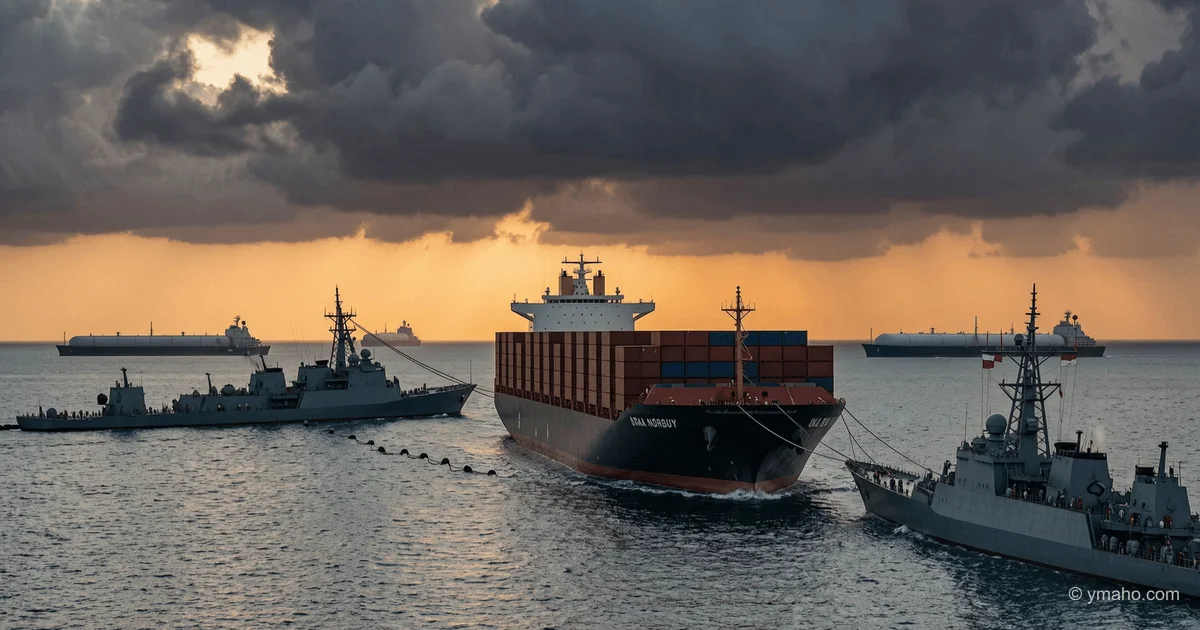
Negotiation Deadlock and Dual Blockade Threaten Full-Scale War in the Middle East
Political scientist Vladimir Shapovalov stated that the negotiation process between the US and Iran has reached a deadlock, and the likelihood of intensified hostilities is higher than ever. According to the expert, the situation with the dual blockade of the Strait of Hormuz cannot continue for long.
This is an analytical article written from the perspective of an insider tracking the non-public mechanics of the negotiation process and the real balance of power in the region.
Deadlock as a Strategy: Why US-Iran Talks Are Not Just Stalled but Weaponized
The Essence: What Is Really Happening
When political scientist Vladimir Shapovalov states that US-Iran talks have reached a deadlock and the likelihood of intensified hostilities is higher than ever, this is not a forecast but a confirmation of an already triggered mechanism. However, reality is more nuanced and dangerous than it appears in expert commentary. The deadlock is not an accidental result of the parties' intransigence. It is a product of deliberate construction: both sides use the negotiation format not to achieve peace but to legitimize their military positions.
At first glance, the dynamics are encouraging. According to informed sources, the US and Iran are "close to signing a memorandum of understanding." Axios reports a one-page document of 14 points being discussed by Special Envoy Steve Witkoff and the Iranian side directly and through Pakistani intermediaries. The document provides for a moratorium on uranium enrichment, lifting some sanctions, unfreezing Iranian assets, and removing restrictions on transit through the Strait of Hormuz.
But this is precisely the deadlock in its most sophisticated form. The memorandum has been under discussion for several days, while Iranian Foreign Minister Abbas Araghchi publicly states that Tehran will only accept a "comprehensive agreement," and a representative of the Iranian parliament's national security commission calls the US proposal a "wish list" and warns that Iran "has its finger on the trigger." Trump, in turn, writes that if no deal is reached, "bombings will resume with much greater intensity."
The essence of what is happening: while diplomats exchange draft memoranda, military logic on the ground and at sea continues to dictate terms. And it is this logic, not the 14 points on paper, that will determine the further course of events.
Chronology and Context
The roots of the current deadlock go back to late February 2026, when the US and Israel launched Operation Epic Fury against Iran. Iran's response was immediate and asymmetric: the Islamic Revolutionary Guard Corps (IRGC) blocked the Strait of Hormuz.
Since March 1, shipping through the strait has virtually stopped. Before the war, about 120 vessels passed through daily; from March 1 to April 8, only 315 vessels total—a traffic drop of over 93%. Iran did not declare a formal blockade but achieved the same effect through threats of attacks and a surge in insurance premiums.
By May, the situation had crystallized into what analysts call a "dual blockade": Iran controls passage through the strait via threats and selective permissions (allowing ships from "friendly" countries—China, India, Russia, Pakistan), while the US declared a naval blockade of Iran itself, intercepting vessels linked to Iranian trade. The strait, as The Indian Express aptly put it, is "open in theory, closed in reality."
Into this architecture came Operation Project Freedom, announced by Trump on May 3. The US promised to ensure safe passage for commercial vessels through the strait with 15,000 troops, over 100 aircraft, and warships. The result of the first day was shockingly modest: only two ships under the US flag passed through the strait on May 4; on the second day, none. For comparison, the pre-war norm was 130 ships per day.
Then came a key episode that almost no one directly linked to the negotiation deadlock, though the connection is direct. On May 5, Trump suddenly suspended Project Freedom. The official reason: "significant progress in negotiations with Iran." The unofficial—and far more important—reason, revealed by NBC citing two US officials: Saudi Arabia banned the US from using its military bases and airspace for the operation. Riyadh was furious that Trump announced the operation on Truth Social without prior consultation with allies. Trump's phone call with Crown Prince Mohammed bin Salman did not resolve the crisis.
Now the picture is complete. The talks are deadlocked not because the Iranians or Americans do not want to negotiate. They are deadlocked because a key US ally in the region—Saudi Arabia—has effectively vetoed the US military operation. Without Saudi airspace and Prince Sultan Air Base, Project Freedom loses its operational meaning. And without Project Freedom, the US side at the negotiating table has only the nuclear club—the threat of resuming bombings—but no tool to solve the strait problem.
Who Wins and Who Loses
Iran is the tactical winner of the current phase. Tehran has managed to turn the blockade of the strait into a negotiating asset that works in its favor even when talks stall. Selective passage for ships from "friendly countries" sets a precedent: the strait functions not under international law but by IRGC permission. With each day this model persists, Iran's position strengthens, and its ability to dictate terms grows.
Saudi Arabia is an unexpected player that has seized the initiative. The ban on using bases and airspace demonstrates that Riyadh is no longer an automatic ally of Washington in any adventure. The Saudis publicly support Pakistani mediation, indicating their interest in a diplomatic rather than military solution. The paradox is that by weakening the US negotiating position, Riyadh objectively strengthens the Iranian one—but apparently considers this the lesser evil compared to a full-scale war on its borders.
The US is the biggest loser. The Trump administration has fallen into a trap of its own making. Project Freedom was launched without coordination with regional allies, failed operationally (two ships in a day), and was suspended with a humiliating explanation. Washington's negotiating position is weakened: Iran sees that the US military option in the strait does not work and that allies are unreliable. The nuclear card—the threat of bombings—remains but does not solve the shipping problem.
The global economy and shipping industry bear enormous costs. War risk insurance premiums have soared from 0.2–0.25% of vessel value to 7.5–10% in extreme quotes. For a tanker worth $138 million, a single premium can now reach $14 million, compared to $345,000 in normal times. Daily tanker charter rates have risen from $50,000 to $420,000. As Lloyd's List notes, the strait is "commercially dead even before being declared militarily blockaded."
China and other Iran-friendly countries are winners. Their ships pass through the strait where Western operators dare not go. This creates a two-tier system of maritime trade, where access to a key energy checkpoint is determined by political loyalty to Tehran.
What the Media Is Not Saying
First omission: the Saudi démarche is not spontaneity but a signal. The ban on base use was not an emotional reaction to Trump's rudeness. It is a carefully calibrated signal from Riyadh that the kingdom no longer agrees to be expendable in US military operations against Iran. Saudi Arabia borders Iran across the Persian Gulf, and in case of escalation, its oil infrastructure—facilities at Ras Tanura and the Ghawar field—would be the primary target of Iranian missiles. The Saudis have just made it clear to Washington that their national interests are not identical to American ones, and this changes the entire security architecture in the Gulf.
Second omission: the 14-point memorandum is not so much a document as a stalling tactic. According to available data, final agreements have not been reached on any substantive point. A Pakistani source says, "We are close, we will close the deal soon," but this formula has been repeated for several days without progress. The memorandum provides for a 30-day period of further negotiations, during which the blockade of the strait will be gradually eased. This means Iran will retain leverage for at least a month after signing the memorandum, and it is still unknown whether it will be signed at all. The parties are bargaining over process, not outcome.
Third omission: US fuel prices—a factor being downplayed. On May 6, the average retail price of gasoline in the US reached $4.54 per gallon. Ahead is the start of the summer driving season after Memorial Day, and analysts warn that if the strait blockade continues, prices could hit $5 per gallon. Trump, in a virtual meeting with Georgia Republicans, stated that "the hardships for Americans will be short-term," but this claim is unlikely to withstand reality with the November 2026 midterm elections approaching. The media have not yet directly linked the negotiation deadlock to gasoline prices—but voters will.
Forecast: The Next 30 Days and 90 Days
30 days (through early June 2026)
In the coming weeks, the negotiation process will simulate movement. The memorandum will likely be signed in some form—too much political capital has been invested by both sides to allow complete failure right now. However, it will be a framework document recording intentions, not resolving contradictions.
The Saudi factor will continue to play a key role. If Riyadh does not restore US access to its bases, any new round of escalation in the strait will leave Washington without an adequate military response. This means the US negotiating position will remain weakened, and Iran's strengthened.
The strait will remain semi-closed. Insurance premiums will not return to pre-war levels even if the memorandum is signed. Shipping companies, as Maersk and Hapag-Lloyd have stated, will not return to the strait until they see a "practically verified peace agreement." A memorandum of intent is not such an agreement.
90 days (through late July–early August 2026)
By the end of summer, the contours of a new equilibrium will become clear. The most likely scenario is the institutionalization of Iranian control over the strait through bilateral agreements with Asian consumers. China, India, and possibly Japan will conclude arrangements with Tehran for guaranteed passage of their tankers, effectively recognizing Iranian sovereignty over the strait.
For the US, this will be a strategic defeat that cannot be camouflaged by rhetoric about "progress in negotiations." The Trump administration will try to compensate for loss of face by tightening sanctions and possibly a new phase of air campaign—but without the ability to control the maritime checkpoint, these measures will be largely symbolic.
The talks, now described as "deadlocked," are actually only at the beginning of a long road. The real deadlock will come not now but in 90 days—when it becomes clear that the memorandum does not work, the dual blockade has become the new normal, and a return to the pre-war model of free navigation will never happen. That is when the question that all sides are carefully avoiding today will arise: is the global economy ready for a world where a key energy checkpoint is controlled not by international law but by a beneficiary of Iran's Revolutionary Guard?
The answer to this question will have a price measured not in barrels or dollars per gallon, but in a fundamental restructuring of the entire global trade architecture. And this is a conversation for which neither Washington, nor Brussels, nor Riyadh is ready today.
— Editorial Team









