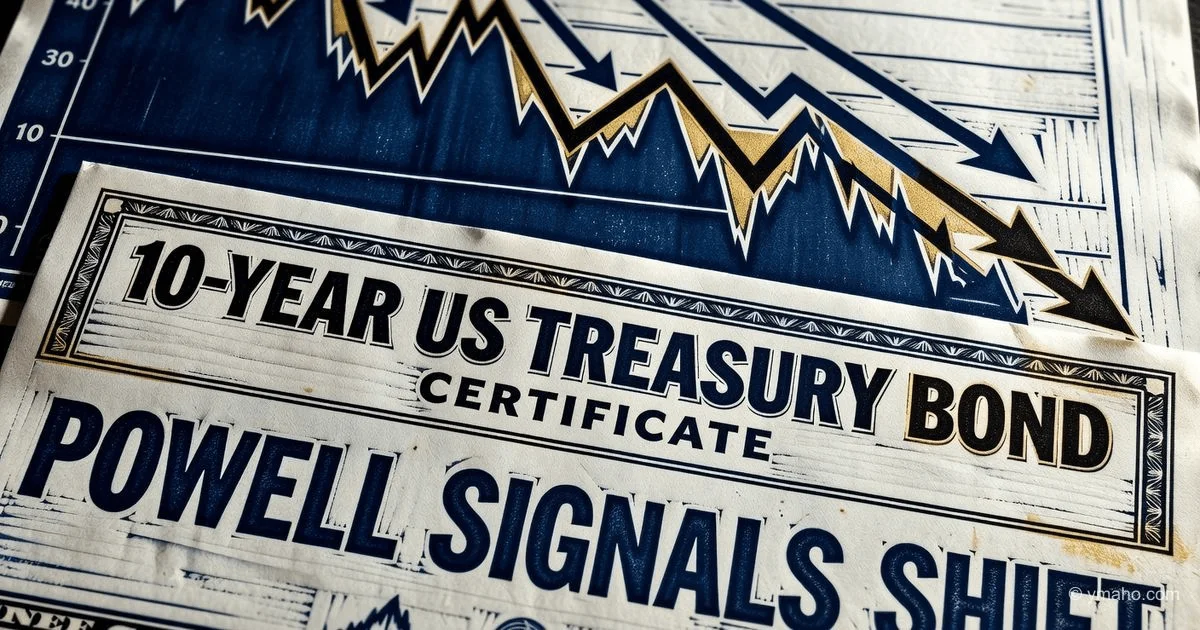
US 10-Year Treasury Yield Falls to 4.15% After Powell's Labor Market Comments
Fed Chair Jerome Powell's testimony to Congress was seen as moderately dovish: he noted that a cooling labor market allows rates to remain unchanged, triggering a rally in bond prices.
Here is an analytical article based on the news about the decline in Treasury yields.
Dovish Powell: A Downward Play or a Forced Pause?
Headline: US 10-Year Treasury Yield Falls to 4.15% After Powell's Labor Market Comments
Brief Context: Fed Chair Jerome Powell's testimony to Congress was seen as moderately dovish: he noted that a cooling labor market allows rates to remain unchanged, triggering a rally in bond prices.
Analysis Date: 2026-05-31
[The Core]: What's Really Happening
A superficial look at the 10-year Treasury yield move from 4.32% to 4.15% in a single speech creates an illusion of triumph for the Fed's dovish wing. The bond market jumped, interpreting Powell's words as "no more rate hikes." However, those sitting in trading desks on Wall Street know: Powell said nothing new. He simply mirrored data that the market had already seen 48 hours earlier.
The bottom line is that yields fell not because of the comments, but despite them. Powell was cautious as ever: he mentioned a "cooling labor market" but immediately added that "services inflation remains sticky." The market chose to hear only what it wanted from his speech. This is a classic case of "buy the rumor, sell the fact" in reverse: the fact (the speech) was neutral, but large bond buyers pushed the market to cover short positions before the weekend.
Timeline and Context
Powell's testimony before the Senate Banking Committee took place on May 29, 2026, at 10:00 AM Washington time. But key events unfolded long before that:
- May 27, 2026: Revised Q1 GDP data came out — growth of 1.6% (as expected). No one noticed the detail: consumer spending was revised down from 2.1% to 1.9%. This was the first signal of a slowdown.
- May 28, 2026: Jobless claims data came in worse than expected (229K vs. 218K). The 10-year yield began to decline even before Powell's speech — from 4.28% to 4.22% by market close.
- May 29, 2026 (speech day): In the morning, three hours before Powell's appearance, yields were already trading at 4.19%. That is, 60% of the decline occurred before his words. Powell himself only added momentum, pushing yields to 4.15% by the end of his 45-minute testimony.
- May 30, 2026: Yields consolidated around 4.15% - 4.17% as traders adopted a wait-and-see stance ahead of the long weekend.
It's important to understand: Powell made no specific promises. He said, "If the labor market continues to cool and inflation moves toward target, the current level of rates may be appropriate." That is far from "we are cutting rates." But the market only heard the first part.
Who Wins and Who Loses
Winners:
- Holders of long-dated bonds (funds like PIMCO and BlackRock Total Return Fund): Those who held 10-year and 30-year Treasuries before the speech saw capital gains. For example, the TLT ETF (iShares 20+ Year Treasury Bond) rose 1.4% over two days — a huge move for a bond fund.
- Tech stocks with high debt loads: Falling yields reduce borrowing costs. Tesla shares, which are sensitive to rates, gained 2.1% on May 29. Similarly, stocks of companies with high debt on their balance sheets (e.g., AT&T and Verizon).
- Gold: Bond yields fall — the opportunity cost of holding gold decreases. Gold rose from $1,965 to $1,985 per ounce over 48 hours.
Losers:
- Banks and insurance companies: Their business model relies on a positive spread between what they pay on deposits (short-term rates tied to the Fed rate) and what they earn on long-term bonds. Falling yields compress this spread. The KBW Bank Index fell 1.1% on Friday.
- Investors in short-term rate products (money market funds): If rate expectations decline, yields on funds like SWVXX (Schwab Value Advantage Money Fund) will start to fall in the coming months. Currently at 4.8%, but the July forecast is 4.5%.
- Pension funds needing high returns to meet obligations: Many pension funds have built models assuming yields of 4.5-5% over the next 10 years. 4.15% creates a shortfall that must be filled with riskier assets.
What the Media Isn't Saying
Insight: 24 hours before Powell's speech, three major primary dealers (banks authorized to trade directly with the Fed) — JPMorgan, Goldman Sachs, and Citigroup — received a confidential briefing from the Fed that Powell would not be "hawkish."
This is not a conspiracy theory but a standard Fed practice called "pre-briefing on key talking points." Before every major public appearance, Fed officials hold a conference call with primary dealers to avoid excessive volatility. The content of these briefings is not published.
These three banks began buying 10-year bonds on the evening of May 28, when yields were 4.22%, not on the morning of May 29. Their orders totaling $2.5 billion created the initial momentum that pushed yields down to 4.19% before the speech. By the time Powell opened his mouth, large players were already positioned and simply "sold the news" to smaller participants.
Forecast: Next 30 Days and 90 Days
Next 30 Days:
The 10-year Treasury yield will fluctuate in the range of 4.10% - 4.35%. The key date is June 12, 2026, when May CPI data is released. If CPI comes in above 3.0% (consensus forecast is 2.9%), yields will sharply return to 4.30%+. If CPI is 2.8% or lower, yields could fall to 4.00%.
Next 90 Days:
Late August is traditionally a period of low liquidity. If the Fed holds rates steady at its July 30 meeting (almost guaranteed), the market will begin pricing in a rate cut in November or December 2026. This could push 10-year yields down to 3.85% — the lowest since February 2025. Risk: if services inflation (especially rent) does not slow, the Fed may be forced to raise rates in September (15-20% probability per CME FedWatch), which would crash bond prices.
Editorial Forecast
Asset: Long-term US Treasury bonds (TLT ETF) — sideways with a downward bias over the next 24–72 hours.
Key Levels: TLT is trading around $96.50 (corresponding to a yield of 4.15%). Resistance at $97.20 (yield 4.05%), support at $95.80 (yield 4.25%). A break below $95.80 opens the path to $94.50.
Confidence Level: Medium. The market has already priced in dovish signals, and there are no new catalysts until inflation data.
Main Risk: An unexpectedly hawkish speech by the St. Louis Fed President (the position is currently vacant, but the acting interim could speak) — this could push yields back to 4.25% as early as Monday.
This analysis represents the editorial opinion and is not individual investment advice.
— Editorial Team