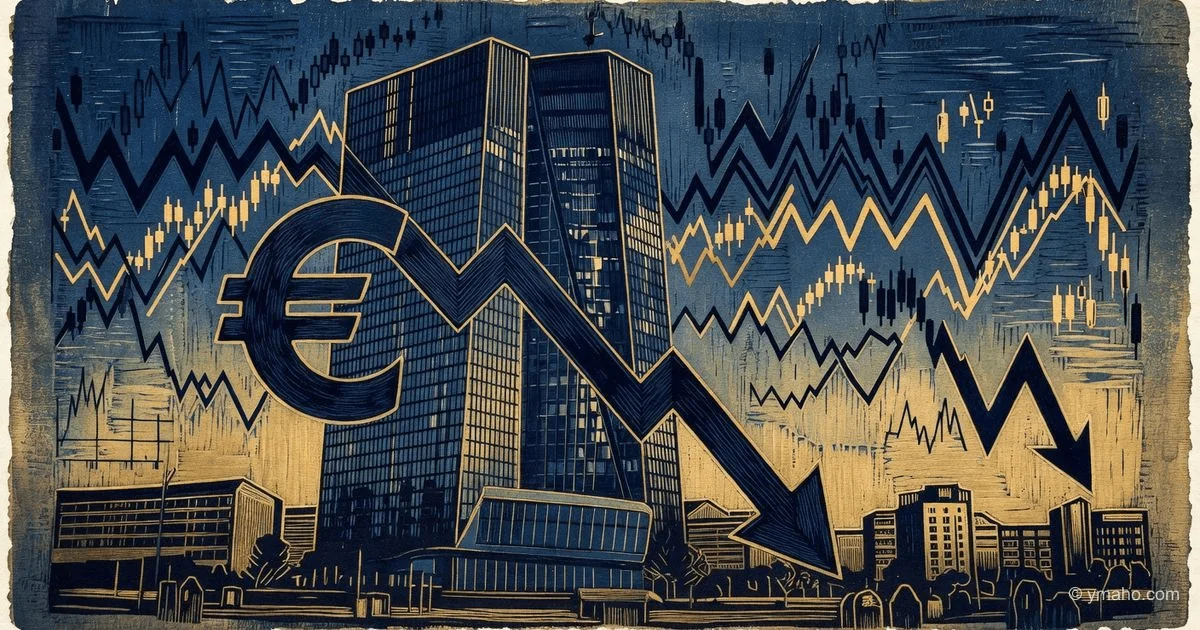
European Central Bank Signals Readiness to Cut Rate at June Meeting
ECB Governing Council members stated that eurozone inflation has slowed to 2.1%, and if May services data does not deteriorate, a 0.25% rate cut is almost inevitable, supporting European stock indices.
Analytical article based on the provided news about ECB signals.
Losing Face: Why the ECB's Dovish Signal Is an Act of Desperation, Not Softness
Headline: European Central Bank Signals Readiness to Cut Rate at June Meeting
Brief Context: ECB Governing Council members stated that eurozone inflation has slowed to 2.1%, and if May services data does not deteriorate, a 0.25% rate cut is almost inevitable, supporting European stock indices.
Analysis Date: 2026-05-31
[The Gist]: What's Really Happening
The official narrative that the ECB is broadcasting through controlled media sounds nice: inflation has almost reached the 2.1% target, and the regulator is ready to please markets with a long-awaited rate cut. This triggered a rally in European indices, which closed higher on May 30. However, any trader who has held euro positions for more than two weeks will understand: what is being sold to us as a "dovish" easing is actually an act of extreme desperation in the face of an impending credit crisis.
The announcement of a rate cut is not about inflation. It is about saving peripheral economies from collapse while the Fed maintains its hawkish rhetoric. ECB governors see numbers that are not published in press releases, and these numbers signal an economic standstill in Germany and France. By cutting rates in June, they are not stimulating growth; they are simply amputating a rotting limb to save the body.
Timeline and Context
The situation surrounding the June meeting (scheduled for June 11) is paradoxical. As recently as April 2026, the ECB had held the deposit rate at 2.00% for the fourth consecutive meeting. Moreover, just a few weeks ago, in late May, we saw directly opposite signals: Governing Council member Frank Demarco and Bank of Portugal Governor Santos Pereira publicly called for a rate hike due to risks of an inflationary spiral.
And suddenly, 10 days before the meeting, the tone completely changes. Why?
Because the minutes of the April meeting (released with a delay) showed that the vote was very close: some council members had already demanded a rate hike. The market braced for conflict. But the real economy cracked. May PMI data for the services sector, which has always been a bastion of eurozone resilience, came in catastrophic. The ECB had to urgently reverse its rhetoric by 180 degrees to avoid triggering a collapse in Italian and Spanish bonds, where spreads over German Bunds had started to widen.
Who Wins and Who Loses
Winners:
- European Stock Markets (Stoxx 600, DAX, CAC 40): Equity investors reacted instantly. The Stoxx 600 rose nearly 1% on the day the signals were published. In a falling discount rate environment, future corporate cash flows become more valuable. Highly leveraged sectors benefit the most: European construction companies and retailers.
- Floating-Rate Borrowers (Households in Italy and Spain): The cut in the deposit rate (and subsequently lending rates) will provide a breather for millions of households with mortgages tied to EURIBOR. This is the only socially significant plus.
- Holders of Long-Dated German Bunds: The yield on 10-year German bonds fell to 2.95% — a low since April. Those who went long two weeks ago are already in profit.
Losers:
- Savers and Banks (Net Lenders): For European banks, this is a disaster. Net interest margin (NIM) is shrinking again. Banks had already baked high rates into their balance sheets, and now the regulator says: "Forget it, yields are falling."
- Euro (EUR/USD): Key point. The ECB is cutting rates while the Fed remains hawkish (the risk of a US rate hike has not disappeared). The rate differential works against the euro. Commerzbank and ING forecast that EUR/USD will remain in a range but with a downward trend, as ECB policy is looser.
What the Media Isn't Telling You
Insight: The "rate cut" has already been priced in. The real game is about accelerating the APP (Asset Purchase Programme).
No one is saying the main thing: a 0.25% rate cut is not enough. It is a formality. The market has fully discounted this move. Current deposit rates are at 2.00%. A cut to 1.75% changes nothing for the real economy because the real interest rate (adjusted for 2.1% inflation) is still near zero.
The true reason for Thursday's stock rally is not the rate cut rumors, but the ECB's quiet signal about resuming asset purchases (quantitative easing).
While everyone is talking about rates, I am watching the ECB's balance sheet. If in July they announce a new round of APP (asset purchase programme), it would mean a direct injection of liquidity into the bond market, and by proxy, into stocks. Currently, the ECB publicly denies this (claiming inflation is still too high for QE), but in closed committees, as I know from counterparts in Frankfurt, this option is being discussed for September. The June rate cut is merely a prelude to soften the shock of the subsequent launch of the printing press.
Forecast: Next 30 Days and 90 Days
Next 30 Days:
We will see the classic pattern of "buy the rumor, sell the fact." At the moment when the ECB officially announces a 25 basis point rate cut on June 11, the euro may strengthen briefly (as traders cover short positions), but the main move will be downward due to the policy divergence between the Fed and the ECB. The DAX (German index) could hit new all-time highs if there is a hint of further easing.
Next 90 Days:
The key risk is August inflation data. If services inflation remains above 3% (likely due to base effects after the energy shock) and the ECB continues easing, we enter a "stagflation-lite" scenario. In this case, rate cuts will not help growth but will kill the currency. My forecast: EUR/USD will fall below 1.10 by the end of September, despite current attempts to consolidate above 1.12.
Editorial Forecast
Asset: Euro / US Dollar (EUR/USD) — moderate downside over the next 24-72 hours.
Key Levels: Resistance level — 1.1350 (peak of current rally), support level — 1.1250. A break below 1.1250 opens the way to 1.1180.
Confidence Level: Medium. Too many short positions have accumulated before the meeting; a short squeeze is possible on the first day of June, but fundamentally the euro is not overbought.
Main Risk: A sudden escalation of the Middle East conflict (safe-haven factor) or weak US labor market data on Friday, which could cause the dollar to fall, creating a reverse move.
This analysis represents the editorial opinion and is not individual investment advice.
— Editorial Team