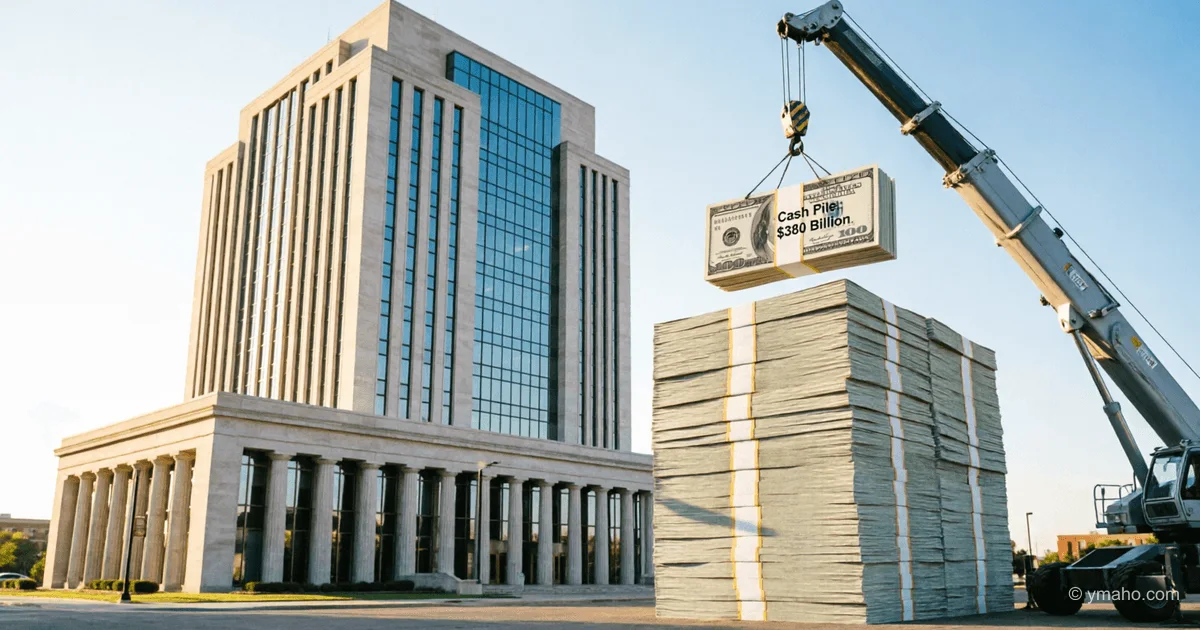
Berkshire Hathaway's Cash Hoard Hits Record $380 Billion
Warren Buffett's company reported a record cash pile after aggressive stock sales, including Apple shares, but first-quarter profit fell short of forecasts.
Record $380 Billion: What Lies Behind Berkshire Hathaway's 'Cash Mountain'
Introduction
When Warren Buffett handed over the CEO role to Greg Abel in early 2026, the investment world held its breath—would Berkshire Hathaway preserve its legendary philosophy or start spending its accumulated reserves? The first quarterly report under new leadership gave a clear answer: the conglomerate's cash cushion hit an all-time high of $380 billion, while stock sales continued for the fourteenth consecutive quarter. This figure is not about passivity but about disciplined waiting for the 'perfect storm' in the markets.
Event Details and Timeline
According to the financial report released on May 2, 2026, Berkshire's cash and Treasury obligations totaled $397 billion at the end of March, with a net cash balance (excluding liabilities for Treasury purchases) reaching $380 billion. Over three years, this metric nearly tripled from $130 billion at the end of 2022.
Two factors drove the reserve growth. First, Berkshire remained a net seller of stocks, realizing $24.1 billion in sales against purchases of just $15.9 billion—a net outflow from equities of $8.1 billion. The key position being sold down remains Apple shares: once worth over $185 billion, the stake has been reduced by more than 70% over the past two years.
Second, the conglomerate's operating income rose 18% to $11.35 billion. The main drivers were insurance underwriting (profit up 28% to $1.7 billion), railroad operator BNSF (up 13% to $1.38 billion), and the energy division. Meanwhile, net profit including unrealized gains on equities more than doubled from $4.6 billion to $10.1 billion.
Impact and Significance
For Berkshire. The $380 billion sum exceeds the current market capitalization of giants like Netflix, Chevron, and Bank of America. This is not just a 'safety cushion'—it is a strategic weapon allowing the conglomerate to act as a lender of last resort during market turmoil. Analyst Tom Russo, whose fund holds a $1.7 billion stake in Berkshire, called the reserve 'an asset specifically designed for today's uncertainty.'
For the Market. Buffett and his successor's inability to find attractive assets for large acquisitions speaks louder than any macroeconomic forecast about market overvaluation. Greg Abel explained at the shareholder meeting: 'There will be dislocations in the markets that will allow us to act.' In other words, Berkshire is deliberately building dry powder for a period when asset prices return to reasonable levels.
For Shareholders. Abel resumed buybacks, repurchasing $234 million in shares—the first time since May 2024. This signals that management considers its own stock fairly valued and the environment for large deals unfavorable.
Key Players' Reactions
Warren Buffett, attending the annual meeting as board chairman, fully supported his successor: 'Greg does everything I did, and more, and does it better in every case.' In typical Buffett fashion, he appeared on stage and asked outgoing Apple CEO Tim Cook to 'stand and take a bow,' calling his work 'one of the wonders of American management.'
The investment community reacted ambivalently. On one hand, Morningstar maintained its 'four-star' rating for Berkshire shares, considering them 'moderately undervalued' with a fair price of $765,000 per Class A share. On the other, Berkshire shares have underperformed the S&P 500 by about 6% year-to-date, reflecting investor concerns about passive management of enormous cash.
Berkshire's disciplined reluctance to pay a premium in the current environment of high rates and geopolitical instability (including the energy crisis around the Strait of Hormuz) resonates with market veterans. Russo recalled how during the 2008 financial crisis, Buffett saved Goldman Sachs and Bank of America, dictating onerous terms for the issuers: 'If a market crash happens, there will again be only one place to turn, and the terms will be very tough.'
Forecast and Conclusions
The main question for Berkshire today is not 'why isn't the money working?' but 'when will it start working?' Given Buffett's track record, this cash mountain is a classic example of patience. Amid global geopolitical turbulence and record stock market valuations after the tech sector's April rally, the chances of a correction are rising. Berkshire, with $380 billion in its pocket, will be positioned as the chief hunter of cheap assets.
However, Greg Abel faces a nontrivial challenge: to act decisively during a crisis without damaging Berkshire's reputation as 'the most trusted buyer.' Any major deal will set a precedent. If successful, Abel will prove the conglomerate thrives without Buffett's daily involvement. If not, the market will wonder whether the era of 'miracles from Omaha' ended with the handover.
For now, the lesson for all investors is simple: when one of history's greatest deal hunters prefers Treasury bills to new purchases, perhaps cash is the best-performing asset of 2026.
— Editorial Team









