Brazil Extends Fuel Subsidies Amid High Prices Caused by Middle East Conflict
The Brazilian government announced a two-month extension of subsidies on diesel and liquefied petroleum gas to curb domestic inflation. The war between the US and Israel against Iran continues to put upward pressure on global energy prices.
Below is an analytical breakdown in the style of an independent financial analyst, focusing on the hidden mechanisms that mainstream media overlook.
Brazil's "Painless Blow": Why Diesel Subsidies Are Not a Rescue but a Delay of Collapse
You see the headline: Brazil extends fuel subsidies to curb inflation. The government allocates funds, protects the poor, and fights the consequences of the war in the Middle East. It sounds like a responsible step by a socially oriented state. But anyone who has ever calculated the budget deficit of a developing country tied to oil pricing knows: this is not a solution. It's morphine. And the dose increases every month.
Brazil has just extended its diesel and LPG subsidy program until July 31, 2026. Starting June 1, the government will pay domestic refiners and importers 1.12 reais (about $0.22) per liter of diesel. A separate subsidy to compensate for tax costs adds another 0.35 reais per liter. The total diesel aid amounts to about 100 billion reais (roughly $19.6 billion at current exchange rates) for spring 2026.
But here's the catch: this money doesn't come from nowhere. It is taken from a budget that is already on life support. And the main question that no mainstream analyst asks is: what will happen to Brazil when the external shock ends and domestic prices turn out to be twice as high as global ones? The answer is simple: the country will fall into a trap from which there is no escape without hyperinflation or default.
[The Gist]: What's Really Happening
Official version: The Lula da Silva government is extending subsidies because the war between the US, Israel, and Iran, along with the blockade of the Strait of Hormuz, has disrupted global energy prices. Brazil imports about 30% of the diesel it consumes. If prices are allowed to float, a transport collapse would kill the economy. So the authorities freeze fuel costs at the expense of the budget.
Reality: Brazil is already in a state of hidden price shock. According to the national statistics institute, annual inflation in April 2026 was 4.39%. The March figure was 4.14%. Transport inflation in March jumped 1.6% month-over-month, with diesel contributing the most—up 13.9% in a single month. Gasoline rose 4.5%.
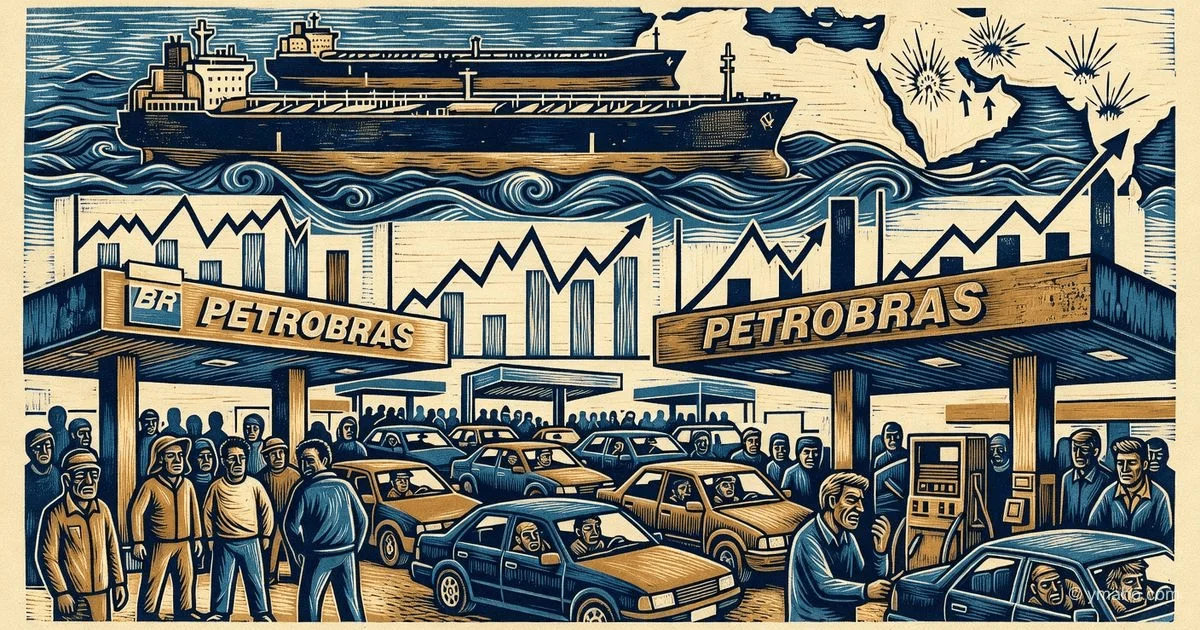
But the most interesting part is not these numbers. The most interesting part is what happens behind the scenes of pricing. According to the Abicom association, on May 29, 2026, the average disparity (the gap between Petrobras' domestic price and import parity) was minus 24% for diesel and minus 46% for gasoline. In other words, Brazilian consumers pay almost half the market price for fuel.
This is not a "subsidy." It's a price cap. The government tells Petrobras: "Sell cheap, we'll compensate the difference from the budget." But the budget is not infinite. And when the program ends (and it will end—either due to lack of funds or IMF demands), prices will skyrocket, pushing inflation into double digits within a quarter.
Timeline and Context
Let's reconstruct the sequence of events, which is rarely shown in context.
Conflict onset—February-March 2026. The US and Israel launch initial strikes on Iran. The Strait of Hormuz is blocked. Brent prices soar above $92 per barrel and stay there.
April 2026. The Brazilian government launches its first package of measures. Tax breaks on aviation kerosene and biodiesel. An emergency mechanism for subsidizing diesel and LPG is created with a limit of 40 billion reais (about $8 billion). To finance this, the authorities impose a 12% tax on crude oil exports.
However, a snag occurs immediately. A judge in Rio de Janeiro suspends the export tax after lawsuits from Shell, TotalEnergies, Equinor, Repsol Sinopec, and Petrogal. The government loses its key source of subsidy financing before it even starts working.
May 2026. Inflation continues to accelerate. On May 15, the government announces a new round of subsidies—this time for gasoline. On May 30, a decree extends the entire program until July 31. Funding for gas subsidies is doubled from 330 million to 660 million reais.
Result: In three months, Brazil has spent or reserved about 100 billion reais on fuel subsidies. Meanwhile, according to economists, the actual budget deficit for 2026 is already projected at around 80 billion reais.
Who Wins and Who Loses
Who wins:
First—Brazilian consumers in the short term. Yes, it's obvious. Low diesel prices mean cheap transport, and thus relatively low supermarket prices. Truck drivers don't strike. Taxi drivers don't block streets. Lula's political rating holds up.
Second—Agribusiness. Brazil is one of the largest exporters of soybeans, corn, sugar, coffee, and meat. Diesel is the lifeblood of logistics: delivering crops from field to port. Subsidized fuel directly increases the margins of large agricultural holdings. In 2025, according to industry associations, fuel costs accounted for up to 25% of a farmer's operating expenses. With subsidies, that share drops to 10–12%.
Third—Oil traders working on arbitrage. When domestic prices in Brazil are disconnected from global ones, opportunities arise to profit from the difference. Formally, export duties and subsidies close this arbitrage window. But informally—through complex schemes involving re-exports, "gray" imports, and smuggling from neighboring countries (Paraguay, Bolivia, Uruguay)—fuel can be taken out of Brazil and sold for much higher prices. The scale is estimated at $1–2 billion per year.
Who loses:
First—Taxpayers. Subsidies are financed from the federal budget. This is money that could have gone to healthcare, education, and infrastructure. Instead, it goes to making gasoline at the pump 46% cheaper than the market price.
Second—Petrobras and its shareholders. The company sells fuel below import cost. Does the state compensate the difference? Partially. But residual losses fall on the state-owned company's balance sheet. According to XP analysts, Petrobras' weekly gasoline price disparity reached 41.3%, and diesel 32.7%. Margins are falling. Dividends are shrinking. PETR4 shares (preferred stock) have fallen 18% since the conflict began in February.
Third—The future of the Brazilian economy. When subsidies end, there will be a one-time price shock. Diesel will become 30–50% more expensive. Transport inflation will hit all goods. The central bank (current Selic rate at 14.75%) will be forced either to raise rates further, killing investment, or to watch inflation accelerate to double digits.
What the Media Leaves Out
The main non-obvious insight that most miss: Brazil is consciously taking on budget risks because there are no elections in 2026, meaning the political horizon extends to 2027. Lula is not running for re-election (under Brazil's constitution, a president cannot serve more than two consecutive terms). So he doesn't need to worry about long-term consequences.
Let's look at the dates. Subsidies are extended until July 31, 2026. Presidential elections in Brazil will be held in October 2026. The current Lula administration leaves office on January 1, 2027. So the program covers exactly the period critical for holding power until the end of his term. After that—let the flood come.
Additionally, the government simultaneously raised taxes on tobacco products. Formally, to compensate for lost revenue. In practice, it's a classic move of shifting the burden onto less protected segments of the population. Smokers (in Brazil, predominantly poor and low-income people) will pay for cheap diesel for agribusiness.
A second hidden factor: Brazil is a net oil exporter but a diesel importer. A paradox that is rarely discussed. The country produces about 3 million barrels of oil per day. Most is exported as crude oil. But diesel must be imported because domestic refining capacity is insufficient. The war in the Middle East has hit global refining chains, and Brazil is caught in a double trap: export revenues rise (oil prices are high), but import bills for diesel also rise. The government tries to offset the difference with the budget.
Forecast: Next 30 Days and 90 Days
30 days:
The extension of subsidies is already priced in by the market. The key indicator is the Brazilian real to US dollar exchange rate. Currently, the Ptax is at 5.05 reais per dollar. If the real weakens to 5.20–5.30, the dollar-denominated cost of subsidies will rise sharply, forcing the government to either cut the program or raise taxes. I expect the real to trade in the 5.05–5.25 range in June.
Inflation in May-June will likely slow to 0.4–0.5% month-over-month thanks to subsidies. But this is a temporary lull.
90 days:
By the end of August, two months before the elections, talk of "winding down" subsidies will begin. The real problem will arise for the new government taking office in January 2027. By then, Brent may stabilize (if the Middle East conflict resolves) or spike to $100–110 (if escalation continues). In either case, the price gap will be so large that subsidizing fuel will become impossible—it would break the budget.
My forecast: In Q1 2027, Brazil will cancel subsidies. Diesel prices will rise 40–60% in one month. Transport inflation will jump to 2–3% per month. The central bank will be forced to raise the Selic to 16–17%. The economy will enter a recession. This will be the price for the populism of 2026.
Editorial Forecast
Asset: Brazilian real to US dollar (USDBRL).
Direction: Real weakening of 1–2% in the next 48–72 hours. I expect movement to 5.12–5.18 reais per dollar.
Key levels: Current support at 5.03; resistance at 5.09. A break above 5.09 opens the path to 5.15–5.20.
Confidence level: Medium (58%).
Main risk: An unexpected drop in oil prices (e.g., due to a ceasefire in the Middle East) would strengthen the real to 4.95–5.00, as it reduces the need for subsidies and improves the trade balance.
The editorial opinion is not an investment recommendation.
— Editorial Team