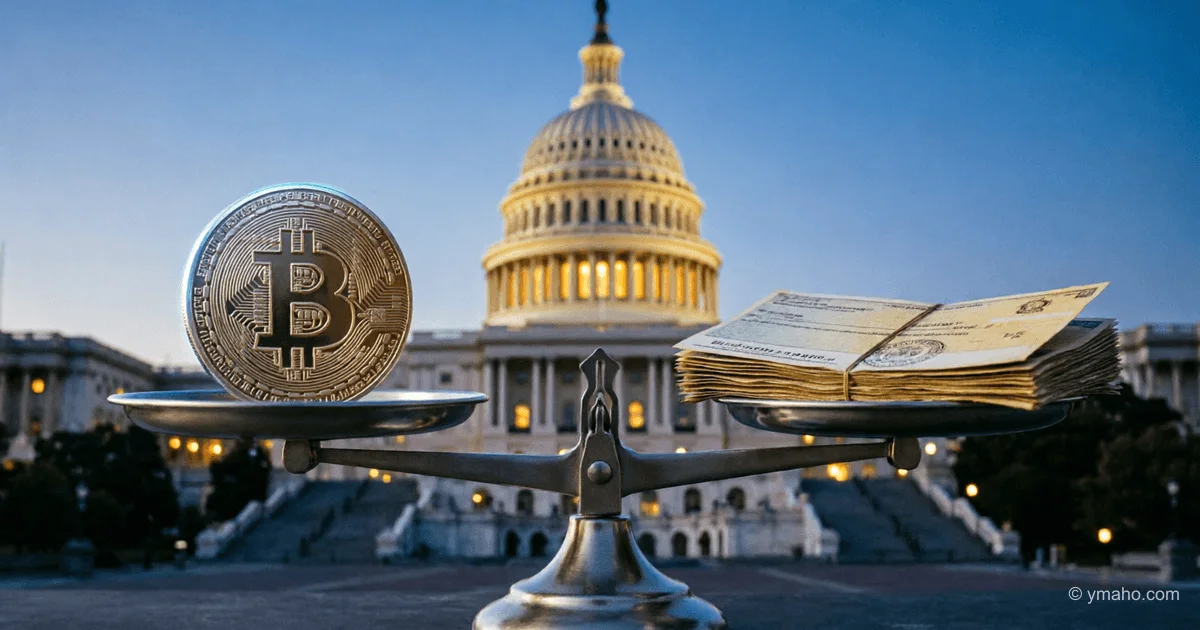
New CLARITY Act Rules Ban Stablecoin Yield from Reserves
The final provisions of the Senate's CLARITY Act prohibit stablecoin issuers from earning yield solely from reserve assets. However, the bill protects incentive programs based on real network participation, paving the way for a vote on long-awaited crypto industry regulation in the US.
New CLARITY Act Rules Ban Stablecoin Yield from Reserves: Compromise Opens Path to Vote
Introduction
On May 2, 2026, the US crypto market received long-awaited clarity. Senators Tom Tillis (Republican) and Angela Alsobrooks (Democrat) published the final compromise text on the most contentious provision of the CLARITY Act — the issue of stablecoin yield. This document, the result of months of negotiations between the crypto industry and banking lobby with White House mediation, removes the last major obstacle to a vote on the digital asset market structure bill.
The essence of the compromise is simple but revolutionary: crypto companies are prohibited from paying interest or yield for simply holding stablecoins (the "buy and hold" model), but reward programs based on actual user activity on platforms (the "buy and use" model) are permitted. This distinction protects the interests of traditional banks, which fear deposit outflows, while allowing the crypto industry to continue incentivizing customers.
Event Details and Timeline
From GENIUS Act to CLARITY Act
The conflict's backstory goes back to July 2025, when the GENIUS Act — the first major stablecoin law — was passed. It required issuers to maintain 100% token reserves and introduced a ban on paying direct yield to holders. However, the GENIUS Act left a legal loophole: it did not explicitly prohibit affiliated companies or third parties from structuring yield-bearing products around stablecoins. The CLARITY Act was meant to close this loophole, making the reward issue the main bone of contention.
January Failure and White House Intervention
The first attempt to bring the CLARITY Act to a vote in the Senate Banking Committee failed in January 2026. At that time, Coinbase CEO Brian Armstrong publicly stated that the company would not support the bill in its current form. Subsequently, the White House personally entered the negotiations, seeking a balance between the banking lobby and the crypto industry.
President Donald Trump repeatedly urged the Senate to pass the law, calling it a necessary step to make the US the "crypto capital of the world." At a private meeting at Mar-a-Lago with memecoin holders, he said he would sign the law immediately after its passage.
April White House Report
On April 7, 2026, the White House Council of Economic Advisers published a report titled "The Impact of Banning Stablecoin Yield on Bank Lending." It analyzed the banking lobby's arguments that yield-bearing stablecoins could trigger a massive deposit outflow.
The report's findings were unexpected for supporters of a strict ban: even in the most optimistic scenario for banks, banning yield would increase bank lending by only $2.1 billion — about 0.02% of the total — with associated net social costs of $800 million. Even with a sixfold growth in the stablecoin market, regional bank lending would increase by only 6.7%. Essentially, the White House indicated that banks' fears were greatly exaggerated.
Final Compromise: May 1, 2026
On May 1, 2026, Tillis and Alsobrooks published the long-awaited text. Key provisions:
- Ban on "passive" yield: "No covered person shall, directly or indirectly, pay yield to a restricted recipient solely in connection with the holding of payment stablecoins or in a manner that is economically or functionally equivalent to the payment of interest on a bank deposit."
- Permission for "active" rewards: The ban does not apply to incentive programs "based on bona fide activity or bona fide transactions."
- Rulemaking: The Treasury Department and CFTC have one year after the law's enactment to develop detailed regulatory framework.
Impact and Significance (for the world, industry, society)
For the Crypto Industry: From "Buy and Hold" to "Buy and Use"
The most direct consequence is the need to restructure business models. As CoinDesk notes, companies will have to transform reward programs from a "buy and hold" model (where users earn yield simply by holding stablecoins) to a "buy and use" model (where rewards are tied to transaction activity).
For Coinbase, which was at the epicenter of negotiations and potentially had the most to lose, this outcome is acceptable. Chief Legal Officer Paul Grewal immediately stated that the wording "preserves rewards based on activity and real participation on crypto platforms, which is exactly what banking lobbyists demanded."
Circle's Chief Strategy Officer Dante Disparte unconditionally supported the deal: "The United States faces a clear choice in digital assets: lead or follow. Today's progress is an encouraging sign that the US chooses leadership."
However, not everyone in the industry is satisfied. Helius Labs CEO Mert Mumtaz stated that the ban on risk-free yield outside the banking system seems controversial. Crypto Council for Innovation CEO Ji Hun Kim expressed concern: the new text "GOES FAR BEYOND" the GENIUS Act, extending the ban to all market participants, not just issuers.
For the Banking Sector: Pyrrhic Victory?
For banks, this compromise is a partial victory. They managed to secure legislative codification that stablecoin yield should not mimic bank deposits. However, as White House calculations show, even without this ban, the threat of deposit outflow was minimal — about 0.02% of total lending.
Meanwhile CEO Zachary Townsend called the banks' fight a "sideshow." "Every incumbent fights against a better financial product," he said. "They lobby, they delay, but they still lose the market."
Standard Chartered predicted back in January that banks could lose up to $1.5 trillion in deposits to stablecoins by 2028 — regardless of yield rules.
For Society and Consumers
Consumers will face a mixed situation. On one hand, they lose access to simple and straightforward stablecoin yield — effectively a digital equivalent of a savings account. On the other hand, the law preserves the ability to earn rewards for active platform use (loyalty, cashback, transaction bonuses) — similar to credit card reward programs.
More importantly, the passage of the CLARITY Act as a whole (of which this compromise is a part) will give the market what it has lacked for years: clear asset classification, understandable oversight logic, and uniform rules for exchanges, tokens, and DeFi infrastructure. Instead of legal disputes and discrepancies between the SEC and CFTC, a systematic framework will emerge, reducing legal uncertainty.
Reactions of Key Players
Crypto Industry: Quick Support
Coinbase: CEO Brian Armstrong wrote on X after the text's publication: "Mark it up." Chief Legal Officer Paul Grewal confirmed that the wording protects rewards for activity — what needed to be preserved at all costs.
Circle: Chief Strategy Officer Dante Disparte called the deal "substantial progress" and noted that USDC continues to grow in cross-border payments, capital market collateral, and agency commerce.
Blockchain Association: CEO Summer Mersinger expressed gratitude to the senators and warned: "Every day without a clear legal framework is an invitation for top talent, capital, and innovative companies to seek opportunities elsewhere."
Crypto Council for Innovation: While supporting the bill, CCI expressed concern about the breadth of the ban but urged the committee to move forward: "The main goal is to ensure US leadership in cryptocurrency."
Banking Lobby: Calm Before the Storm
At the time of publication, banking associations had not made official statements. However, as Incrypted notes, banks are preparing to increase pressure. The issue remains sensitive for them: they have cited estimates that $6.6 trillion in deposits could be at risk, though these figures have been questioned.
White House and Regulators
SEC Chairman Paul Atkins and CFTC Chairman Michael Selig, according to CoinDesk, are already shaping policy and creating precedents, preparing for the law's enactment. They will have one year after the CLARITY Act's passage to develop detailed rules.
Forecast and Conclusions
What's Next for the Bill?
The timeline remains tight. Consideration in the Senate Banking Committee (markup) could occur as early as mid-May. But Alex Thorn of Galaxy Digital warns: "If markup slips past mid-May, the probability of passage in 2026 drops sharply."
According to Polymarket, the probability of the CLARITY Act passing in 2026 is currently around 47% — a notable drop from 82% in February. If the law is not passed before the midterm elections in November, it could be delayed for years.
What Remains Outside the Compromise?
It's important to understand: the yield compromise is not everything. At least two other contentious issues remain unresolved: the decentralization provision (what exactly qualifies as sufficiently decentralized to avoid regulation) and securing enough Republican votes.
Long-Term View
Even if the CLARITY Act is not passed in the current session, the crypto industry has already received an important signal. The SEC and CFTC, as noted by Chris Perkins, CEO of 250 Digital Asset Management, "are already building policy and creating precedents every day." The era of "regulation by enforcement" under Gary Gensler is fading.
Investor Takeaway
For stablecoin holders, the main change is the need to rethink strategy. Simple passive income (staking, fixed-rate lending) becomes legally problematic in the US. Active use — transactions, participation in loyalty programs, cashback — remains permitted.
The broader takeaway: the CLARITY Act is not just a crypto law. It is America's choice in the global race for digital assets. As Disparte said: "Lead or be led." The compromise of May 1, 2026, shows that America, despite all political battles, chooses leadership. And for investors, this means one thing: the legal uncertainty that has weighed on the market for years is gradually becoming a thing of the past.
— Editorial Team









